
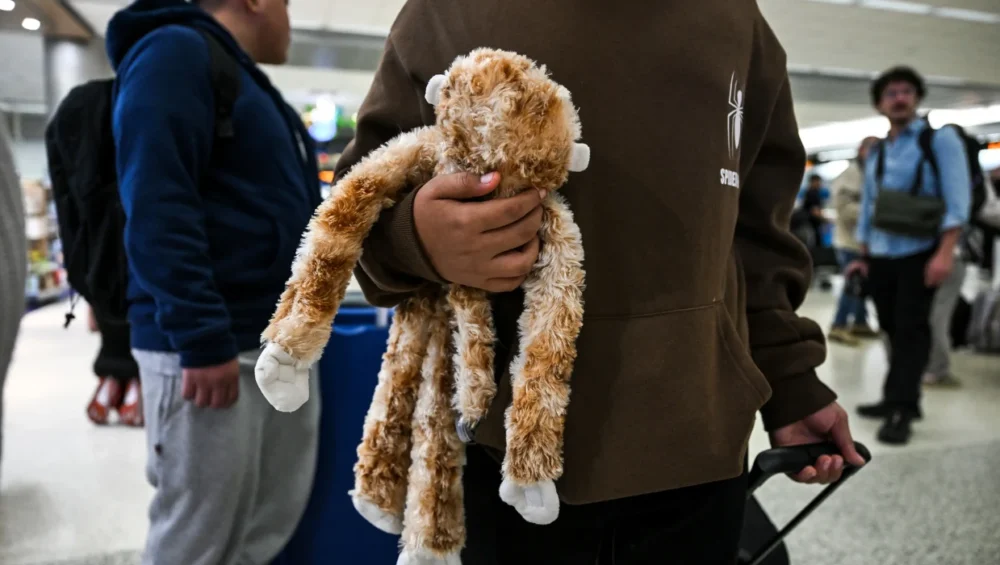
Another controversy regarding deportation has emerged under the Trump administration’s immigration policies with the deportation efforts made by the US authorities for sending Wilfredo (“Wilo”) Gómez Bracho, an 10 year old Venezuelan boy, from Texas to Ecuador.
This deportation order made by the United States Immigration and Customs Enforcement is sparking debates among lawmakers and legal experts dealing with immigration laws, considering the fact that the kid in question had not yet set foot in Ecuador nor does he have any family members there.
Wilfredo entered the country alongside his mother Nexoli Gómez Bracho in August 2023 when they crossed the southern border and were subsequently released and supervised by the US authorities during the Biden era. Initially, the family seemed to be on a well-trodden trail because Nexoli managed to get a work permit and abide by the immigration regulations, settling down in Houston, where Wilfredo started going to school and made a life for himself outside the troubled environment of Venezuela.
None of that biographical information was relevant when it came to the stringent policy of the present administration in enforcing its laws. Once Nexoli was arrested by Immigration and Customs Enforcement (ICE), she was detained and separated from her child, and her case was changed from one of regularization to that of removal.
Moreover, since Wilfredo came into the country along with his mother, who is now detained and will be deported, ICE has classified Wilfredo as removable along with her.
A child in immigration court without a lawyer
Wilfredo’s deportation case has generated controversy not only on account of the destination he is being deported to, but also due to the way this is taking place. At the beginning of 2026, Wilfredo was brought before an immigration judge in Houston, where the child had to appear on his own behalf since he did not have any lawyer appointed by the government for his defense. This case has attracted criticism from immigration attorneys and even legislators.
In reports by Newsweek, Univision, and Texas-based stations, Wilfredo arrives at the courthouse alongside his temporary guardian, Ife Mosquera, his mother’s former employer, who has taken charge of the boy until Nexoli is released from detention. According to Mosquera, one of the biggest concerns she has is that the ICE may take the child into their custody, which might speed up his deportation process to Ecuador despite the uncertainties surrounding his legal status.
That a ten-year-old was permitted to be present at a deportation hearing without legal counsel is symptomatic of a more serious systemic problem in the American immigration system: the failure to provide counsel to minors who may be undergoing irreversible changes in their lives, including deportation from a country where they have no relatives. Organizations committed to human rights claim that this arrangement denies basic procedural justice, particularly since the person facing removal is a non-English speaking minor with an incomplete grasp of what is happening to him/her.
Democratic lawmakers have been especially vocal about the boy’s predicament. Representative Joaquín Castro (D‑TX), a member of both the House Intelligence Committee and the House Foreign Affairs Committee, has used his platform to frame the case as emblematic of broader systemic failures.
He said in X post,
“Wilfredo is 10 years old. Last week, he represented himself in immigration court. His mother, Nexoli, was detained in Houston and has been locked up and away from her son since December. Now, DHS wants to send him to Ecuador—a place he has never been and knows no one. Nexoli has a work permit and was trying to do everything the right way. ICE must release her and stop its case to deport Wilfredo immediately. He should be treated like a kid—not a criminal.”
Castro’s statement is significant not only for its emotional force but also for its legal framing: he explicitly treats the government’s plan as a punishment of the child, not just an enforcement‑driven removal order, and he calls on ICE to halt the deportation case altogether rather than allowing it to proceed through the existing adversarial machinery.
Why Ecuador? The strange logic of third‑country removal
US officials are arguing that Wilfredo is removable under current immigration law, and that the practical destination for the family’s removal is Ecuador, even though the child is Venezuelan by nationality and has no history in Ecuador. Advocacy organizations and lawmakers point out that Ecuador is not his country of origin, and that he has neither relatives nor established social networks there, rendering the idea of “safe return” legally and morally questionable.
A GoFundMe campaign and associated social‑media posts aimed at preventing the deportation stress that
“Wilfredo only has his mother,”
meaning that sending him to Ecuador would effectively sever his only stable family bond. The campaign frames the government’s plan as child‑centric humanitarian harm, not just as the enforcement of a technical removal order.
Critics also note that the government has not publicly articulated a clear “safe‑third‑country” doctrine for Wilfredo’s case, nor has it disclosed specific safeguards to ensure that his transfer to Ecuador would not expose him to neglect, exploitation, or forced institutionalization.
In the absence of such assurances, the episode resembles a broader trend in Trump’s second‑term immigration policy: using procedural enforcement tools to push vulnerable migrants toward deportation, even when the human‑rights costs are high and visible.
The shadow of the Supreme Court and Venezuelan‑TPS revocation
In May 2025, the US Supreme Court allowed the Trump administration to revoke Temporary Protected Status (TPS) protections for roughly 350,000 Venezuelans, stripping many of their work authorization and opening them up to removal proceedings. That decision effectively ended a humanitarian‑style protection regime that had allowed Venezuelans to live and work in the US without fear of immediate deportation.
The revocation of TPS did not immediately deport every protected Venezuelan, but it did shift their legal status from “protected” to “removable” for the purposes of DHS enforcement, giving ICE greater latitude to pursue removal cases, especially where individuals had prior crossings or irregular entries.
For Wilfredo’s family, the change transformed what had been a life of cautious normalization—Nexoli’s work permit, tax payments, social integration—into a prelude to removal, with the child caught in the downdraft of the same policy shift.
Human‑rights analysts argue that the end of TPS protections exemplifies how quickly the US can scale down humanitarian protections, turning migrants who were once regularized into targets for deportation, often with little consideration for the familial and psychological consequences. In Wilfredo’s situation, the revocation appears to be operating as a policy‑to‑child‑deportation pipeline, where macro‑level decisions ripple down into the micro‑level trauma of a 10‑year‑old boy facing banishment to a country he has never known.
Visual and emotional power: Media and public reaction
Local Texas broadcasters have aired footage of Wilfredo entering the Houston immigration court, walking in with his guardian, eyes downcast, dwarfed by the courtroom’s imposing architecture. Those images have been paired with stories describing that he represented himself legally, a detail that shocks many viewers accustomed to the idea that the government is supposed to protect vulnerable children, not subject them to adversarial removal hearings.
Social‑media campaigns and fundraisers are using the phrase
“US deportation of 10‑year‑old Venezuelan boy”
to unify the narrative across platforms, turning the phrase into a mobilization device for lawyers, donors, and activists.
Lawmakers and advocates are also drawing parallels to other recent deportation‑against‑children cases, including the story of a Minnesota‑age‑5‑year‑old boy facing removal to Ecuador, suggesting that the Wilfredo episode is not an isolated anomaly but part of a pattern of treating young migrants as deportable units rather than rights‑bearing individuals.
Human‑rights and policy implications
The case of Wilfredo Gómez Bracho raises several core questions that cut across law, ethics, and foreign‑policy signaling.
First, there is the question of child‑specific safeguards: US law recognizes “unaccompanied alien children” (UACs) as a distinct category with special protections, but Wilfredo’s situation shows that a child who is not technically “unaccompanied” can still be treated as a deportable person with minimal procedural safeguards.
The lack of guaranteed legal representation in immigration court for a 10‑year‑old underscores how the US system outsources due process to the vagaries of private‑attorney capacity, leaving the most vulnerable children to appear literally on their own before a judge who can order their removal.
Second, there is the human‑rights‑and‑third‑country dimension: sending a Venezuelan boy to Ecuador, a country where he has no family, blurs the line between removal and exposure to potential harm, including institutionalization, trafficking risk, and psychological abandonment. Human‑rights bodies argue that states have a duty to ensure that removals do not create conditions of deprivation, neglect, or arbitrary separation from family, yet the US government’s current posture in Wilfredo’s case appears to treat Ecuador as a procedural destination rather than a carefully evaluated safe‑third‑country option.
Third, the case highlights the human‑cost of Trump’s second‑term immigration tightening, especially the end of TPS protections for Venezuelans and the broader push to maximize deportations, even at the expense of family cohesion and child welfare.
A test case for the future of migrant‑child rights
The US deportation of 10‑year‑old Venezuelan boy to Ecuador is more than a single deportation‑order story; it is a test case for how the US defines the rights of migrant children in an era of hard‑line enforcement. The way the government responds—whether it halts the removal, provides the child with legal counsel, or doubles down on the plan to deport Wilfredo—will signal how seriously it treats child‑centric human‑rights norms in the immigration arena.