
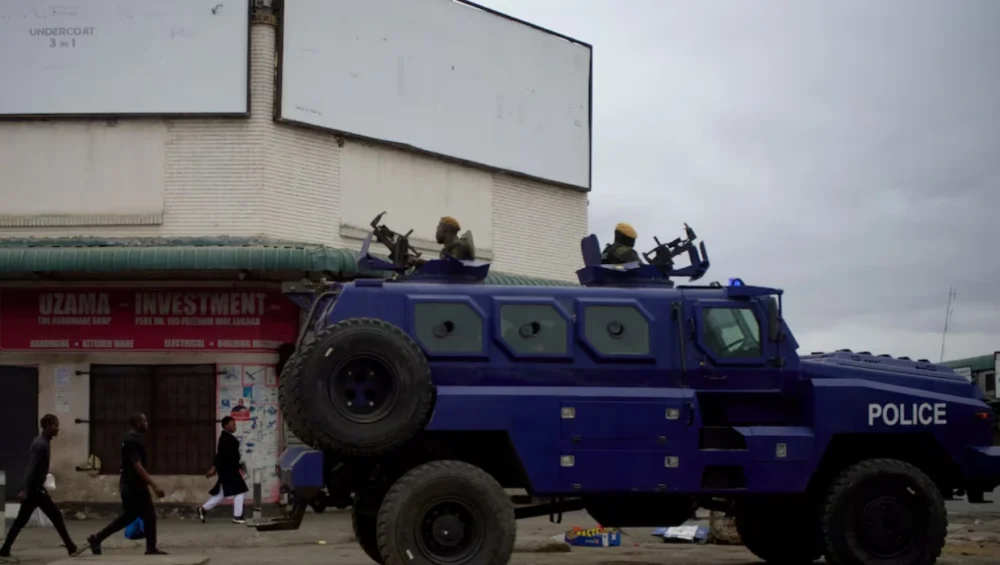
The United Nations has raised alarm over the arrest and detention of opposition figures in Zambia following the country’s August 13 presidential election, warning that the authorities must respect due process regardless of the seriousness of the allegations.
UN High Commissioner for Human Rights Volker Türk called on the Zambian government to stop arbitrary arrests and make sure every person arrested knows why he or she is being arrested and that there is prompt notification about any charges and that the individual gets access to a lawyer and that there is no delay in bringing the arrested to court. This call for action emerged when President Hakainde Hichilema won re-election in an election marred by political tensions, intimidation, and security crackdown on senior opposition figures.
The arrests have raised doubts about the integrity of Zambia’s post-election process. According to the government, the move is an exercise in national security of individuals alleged to be preparing for an armed uprising. On the other hand, the opposition argues that the charges are false and that the crackdown was meant to kill off its candidate.
Arrests deepen post-election tensions
Zambian authorities said security forces arrested 11 people during or after a raid at a property in Lusaka on election night. The government alleged that those arrested were connected to military plans involving foreign nationals, illegal military-training camps and preparations for an armed insurrection.
Patrick Kangwa, Zambia’s top civil servant, said the suspects represented “a serious threat to state security.” He alleged that security forces found
“high-grade military weapons, ammunition and other materials for use in armed insurrection.”
The government also said shots were fired from the premises at law-enforcement officers, resulting in an exchange of fire.
Among those reportedly arrested was Patrick Mwansa, the husband of Tasila Lungu, daughter of former President Edgar Lungu. Other detainees were described as senior members of political parties and members of the opposition alliance supporting Brian Mundubile, Hichilema’s principal challenger.
The government said Mundubile was present at the scene but did not describe him as one of the 11 people arrested. Opposition representatives, however, said several members of his inner circle had been detained or had disappeared, prompting demands for information about their whereabouts and legal status.
The raid occurred at an exceptionally sensitive moment. Votes were still being counted, opposition parties were challenging the emerging results and the electoral commission had briefly suspended the announcement of results because of reported violence against polling staff and the theft of marked ballot papers. The timing made the arrests inseparable from the wider political crisis.
Opposition rejects government account
Mundubile has rejected the government’s description of the operation and denied that a militia or armed group was operating from his home. In an interview with the BBC, he called the insurrection allegations “total fabrications.”
He alleged that heavily armed personnel arrived at his residence in an armoured vehicle, broke through the gate, damaged doors and windows and opened fire.
“They were basically shooting indiscriminately. They directed two shots towards me. Like I’ve always said, it was just by God’s grace that I survived,”
Mundubile said.
He further alleged,
“So they came in to kill us.”
According to his account, former minister Mutotwe Kafwaya was shot while he and his wife were present. Mundubile said Kafwaya was bleeding and that he asked officers to take him to hospital.
Mundubile also described the psychological impact on his family, saying,
“My children saw their uncle… bleeding profusely and being dragged like an animal… 80 soldiers coming into the house, shooting indiscriminately and breaking doors and windows down is not an experience anybody would want to go through.”
The allegations have not been independently verified. Neither the government’s claim of an insurrection plot nor the opposition’s claim of an attempted assassination has been established through an open judicial process. That evidentiary gap is precisely why the UN has emphasized prompt court proceedings, legal representation and effective remedies for any rights violations.
The opposition leader was later reported by his party to be in a secure location under the protection of an international human-rights organisation because of threats against him. The claim illustrates the level of fear surrounding the case, although the identity of the organisation and the nature of the threats were not publicly detailed in the available reporting.
Türk demands legal safeguards
Volker Türk’s statement was carefully framed. He did not dismiss Zambia’s right to investigate alleged violence, weapons possession or threats to national security. Instead, he said that the gravity of alleged conduct cannot justify abandoning legal protections.
“I urge the authorities to stop arresting people arbitrarily and to uphold fully the due process rights of all those detained,”
Türk said.
He stressed that
“all arrests and resulting court proceedings — whatever the gravity of the alleged conduct or specific charges filed — must be fully consistent with international human rights standards, as well as Zambian domestic law.”
The UN rights chief specifically said detainees must be notified at the moment of arrest about the reasons for their detention and must be promptly informed of the charges against them. He also said they must have access to legal representation, be allowed to communicate with their families, be treated humanely in custody and be brought promptly before a judge.
Türk added that detainees must have
“access to effective remedies for any violations of their rights.”
This includes the possibility of challenging unlawful detention, mistreatment or denial of legal access through the courts and other competent institutions.
His appeal also addressed the political consequences of the arrests.
“At this critical post-election juncture, it is essential to uphold respect for human rights and ensure that any grievances arising from the election are voiced and addressed peacefully, and in accordance with international human rights law,”
he said.
The UN’s language signals concern that the arrests could transform an electoral dispute into a broader confrontation between the government and opposition. If suspects remain detained without clear charges or court appearances, the security operation may be interpreted as political punishment rather than a lawful investigation.
Election results and political dispute
The arrests came as Hichilema moved toward a clear victory. The electoral commission said he won around 60% of the vote, while Mundubile received approximately 38%. The result gave Hichilema a second five-year term and placed his economic record at the centre of the election.
As the frontrunner, Hichilema ran for re-election following his role in stabilizing the Zambian economy following a debt crisis brought about by the coronavirus pandemic period and the ongoing debt restructuring process. His supporters considered a second-term presidency as the time to capitalize on his achievements and bring in more investments into the mining economy. However, despite its positives, the presidential poll highlighted existing political disputes. Mundubile argued that his parallel vote count showed that he was winning and there were irregularities concerning ballot box handling and tally centers.
He also claimed there was military interference in the elections process and that the government had sent some individuals from Tanzania to sabotage the process. Tanzania outrightly dismissed the accusation, calling it baseless and unfounded. The allegations of vote rigging have been denied by the authorities. The preliminary assessment by international observers reported a smooth process during voting day. However, their assessment of the political situation was not entirely positive. The temporary suspension of the vote tallying process by the electoral commission due to an attack by armed men led to the theft of marked ballot papers. The vote tallying process resumed after securing the polling stations but raised concerns among the SADC and the EU communities.
The regional observers said the suspension created “uncertainty and anxiety.” The EU said any interruption to the counting process should be clearly explained, legally grounded and proportionate.
The opposition’s planned legal challenge could also affect the timetable for Hichilema’s inauguration. He is expected to be sworn in within seven days of publication of the official results, which was due by August 24, although an election petition could delay that process.
Uneven campaign conditions
The UN intervention cannot be viewed separately from the conduct of the campaign. The EU Election Observation Mission said the election was genuinely competitive, but the candidates did not compete under equal conditions.
EU chief observer Michael McNamara described the election as taking place
“against a backdrop of constrained democratic space.”
He said the contest was “genuinely competitive” but conducted on an “uneven” playing field.
The observers said the advantages of incumbency blurred the line between the state and the ruling party. They also found that state-media coverage was “heavily biased” in favour of the government.
The EU raised concerns about late legal changes, uncertainty over the electoral framework, limitations on media freedom and unequal access to media. It also criticized the absence of important reforms concerning political parties and political finance.
These findings do not automatically invalidate the election result. They do, however, provide context for the opposition’s suspicion of the government’s actions. When an opposition candidate faces restrictions during the campaign and senior opposition figures are arrested during the counting period, even a legitimate security operation can appear politically selective unless authorities provide compelling evidence and follow transparent procedures.
The challenge for Zambia is therefore not only to defend the arrests but to demonstrate institutional neutrality. Police, prosecutors, courts and the electoral commission must be seen to operate independently of the ruling party.
Domestic rights warnings
Even prior to Türk’s statement, Zambia’s own Human Rights Commission had made allegations with regard to the arrests of individuals related to the elections. In its press statement released on August 12, it stated that it was observing the arrests and detentions of candidates, their supporters, journalists, and other parties. Some examples of these included cases concerning Xavier Chungu, Daniel Makina, MacPherson Mukuka, a musician known as Chester, 16 supporters of NRPUP, Martha Lungu, who is the ambassador, Hannah Isreal Katontoka, Valden Findlay, and three other individuals.
Its preliminary findings showed that the people that were arrested and detained had stayed in detention beyond the required 24-hour period without being brought before the competent court. Other issues included some detainees being prevented from accessing relatives and legal counselors as well as being in detention despite there being the possibility of police bond in cases of bondable offences. It referred to Article 18 of Zambia’s Constitution as well as sections 30 and 33(1) of the Criminal Procedure Code. Every election-related arrest should be done according to the due process and police should cooperate with human rights observers. These warnings are crucial because they indicate that the present situation is not an isolated incident but rather an issue of a wider concern about the use of law enforcement powers against political figures.
A wider pattern of shrinking civic space
UN experts had already warned in August 2024 that Zambia was experiencing a downward trend in fundamental freedoms. They cited allegations of arbitrary arrest and detention involving opposition leaders, lawmakers, activists and human-rights defenders.
The experts referred to 26 cases since January 2022 involving allegations linked to unlawful assembly, espionage, hate speech and sedition. They also identified 16 incidents involving journalists or media outlets and 11 cases involving clashes, intimidation or assaults, most of them allegedly involving ruling-party members and opposition supporters.
Their broader concern was that restrictions on rallies, meetings, protests and critical reporting were producing a chilling effect on freedom of expression, association and peaceful assembly. They warned that shrinking civic space could intensify political polarization, regional division and self-censorship.
The 2026 election has now placed those warnings under renewed scrutiny. The government may argue that the security allegations are exceptional and unrelated to ordinary political dissent. But the credibility of that argument will depend on whether authorities publish clear charges, disclose evidence to the courts and allow independent monitoring of the detainees’ treatment.