
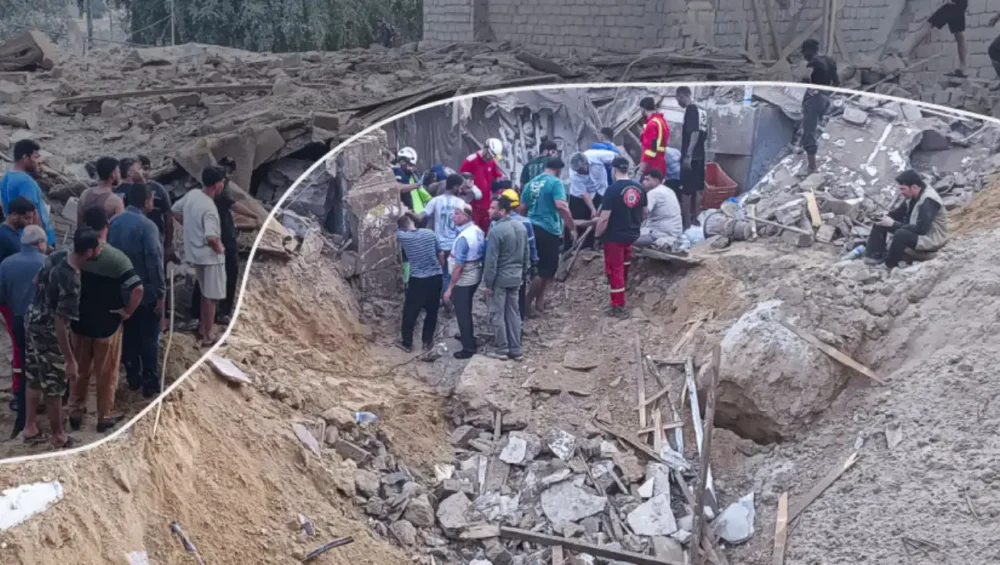
The reported U.S. strike on Qeshm Island has quickly become one of the most controversial incidents in the renewed Iran conflict because it combines two highly sensitive issues at once: the use of a massive 2,000-pound bomb and the allegation that it hit a family home. According to multiple reports, the attack struck a residential building in the Chah Tangu neighborhood of Qeshm City, killing three people from the same family, including a two-year-old child, and leaving two other children injured.
The importance of this event also lies in the weapon supposedly used, besides the casualties sustained by civilians. As per The New York Times, which was referred to in the available reporting, weapons analysts stated that the crater dimensions along with the fragments recovered from the site suggested that the weapon used was a Mark-84 bomb, an aerial bomb that weighed around 907kg. If true, then it will mean that the U.S. has used one of the strongest conventional weapons in a civilian zone of Iran.
What happened on Qeshm
The most crucial details about the incident reported are quite similar among various sources: the attack took place during the night on Thursday, struck a residential building in the southern part of Iran’s Qeshm Island, and claimed the lives of a mother, father, and child. According to Iranian authorities, the other two children belonging to the couple survived the attack, although certain sources reported that the kids were seven and nine years old and taken to a medical facility for treatment. The Iranian side described the deceased father as a taxi driver and named the family by the surname of Jafari. This information is significant because it provides additional proof of civilians’ identity, which Iranian authorities have been trying to emphasize.
The reported strike on a family home in Qeshm has sharpened accusations that the U.S. campaign in Iran is crossing into war crimes territory. Under international humanitarian law, residential homes are protected civilian objects unless there is clear evidence they are being used for military purposes, and strikes that fail to distinguish between combatants and civilians can amount to serious violations. In this case, Iranian officials say a mother, father and their two-year-old child were killed, while the reported use of a 907kg bomb has deepened concerns that the attack may have been disproportionate even if a nearby military objective existed
The weapon question
The most important technical question is whether a 2,000-pound Mark-84 bomb was actually used. The reporting says crater diameter and bomb fragments pointed to that conclusion, and that the munitions used were consistent with a large conventional explosive rather than a smaller guided weapon. That matters because the Mark-84 is designed to cause massive blast and fragmentation, and in a residential setting the civilian risk is inherently severe.
This is why the strike has triggered so much scrutiny. Even if the intended target was nearby or hidden, the reported impact point inside a family home would raise immediate questions under the laws of armed conflict, particularly around distinction, proportionality, and precaution. The public reporting does not answer whether the U.S. believed there was a lawful military objective in or near the house, only that the physical evidence pointed to a very large munition and a devastating blast effect.
Statements from the parties
Centcom’s position, as quoted in the reporting, has been careful and limited.
“We are aware of the reports and looking into them”
said U.S. Central Command, while also stating that
“the U.S. military never targets civilians.”
That wording is important because it neither confirms nor denies the specific munition, target, or strike authorization in the case now under discussion.
Iranian officials, by contrast, have framed the incident as an attack on civilians. Ahmad Nafisi, the deputy governor-general of Hormozgan Province, said the deadliest strike hit a residential house in the Chah Tangu neighborhood and that three family members were killed, with two children wounded and transferred for care. Iranian media and officials have repeatedly used the language of martyrdom and civilian victimhood, making the Qeshm case part of a broader narrative of U.S. aggression in the conflict.
Why Qeshm matters
Qeshm is not an ordinary geographical location. It is strategically located near the Strait of Hormuz, which is one of the most sensitive energy bottlenecks. In other words, this strike can be perceived as a significant military and geopolitical action, especially at this stage of escalation of the Iran crisis. Another reason for the rapid distribution of reports about this strike is its strategic importance of Qeshm Island. The attack on Qeshm cannot be considered simply a case of casualties in the battlefield.
This attack will be viewed as a test for how far the U.S. would go in its anti-Iranian campaign and how careful it is in its actions regarding military and civilian facilities. From the point of view of critics, the image of an innocent family house bombed by this explosive will confirm the fact of the excessive use of force by the United States. On the other hand, the main question for American officials will be the lawfulness of this target and this attack itself according to the rules of warfare.
Broader conflict context
The strike was also part of an escalating cycle of violence. According to the information that has been provided, the U.S. has conducted a “heavy wave of strikes” against Iranian targets, and these strikes were justified by the necessity of retaliation due to the actions of the Iranians against the Jordanian-American base and threats in the regional confrontation. It is possible to say that Qeshm has been targeted as part of the larger military campaign, but that does not make civilian concerns irrelevant. While a military operation can be strategically justified, it can still be very controversial because of its impact on civilians. This is precisely what makes the Qeshm case remarkable, since it brings up issues of operational transparency, civilian safety, risks of escalation, and the reliability of U.S. assurances that civilians are not being targeted.