
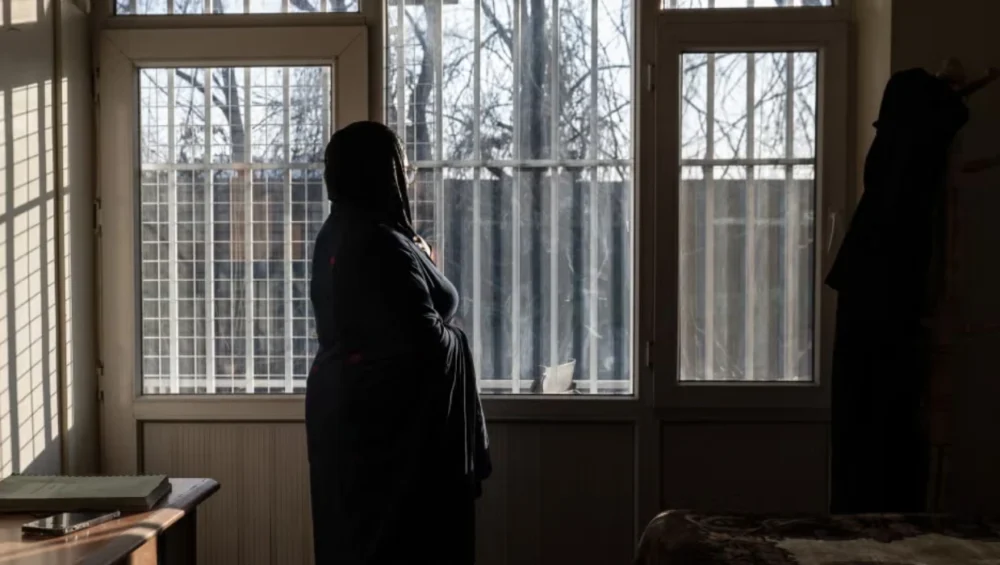
Afghanistan’s five years under Taliban rule have produced what Human Rights Watch calls one of the world’s worst human rights crises, with women and girls bearing the heaviest burden. The group says the Taliban have not only maintained repression, but institutionalized it through a widening web of decrees, policing, and social control that has stripped away basic freedoms in public and private life.
The latest HRW assessment is stark: the Taliban have
“entrenched one of the world’s worst human rights crises and systematically dismantled the rights of women and girls”
since seizing power in August 2021, according to the organization’s Aug. 3, 2026 statement. That claim is reinforced by repeated UN reporting, Amnesty International findings, and a growing body of evidence showing that the erosion of rights in Afghanistan is not accidental or episodic, but deliberate and structural.
Five Years of Repression
It was August 15, 2021, that marked the tipping point when the Taliban came back to power and started to take away all the progress that had been made during the past twenty years regarding education, employment, media freedom, and civil engagement. The HRW reports that the new system has made the humanitarian and rights crisis of the country much deeper, whereas the UN mission in Afghanistan continued to monitor the reduction of civil liberties, in particular, for women. Already by 2025 and 2026, the trend became evident. UNAMA reports that the Taliban rulers implemented their decrees about removing women from the public space, whereas HRW reports increased repression through arrests of journalists and women’s movement.
The UN special rapporteur later described the legal and institutional environment as one designed to entrench
“institutionalised system of gender oppression, persecution and domination”
against Afghan women and girls.news.
Women And Girls Targeted
As stated by human rights organizations, the defining element of the Taliban rule is the systematic exclusion of women and girls from education, employment, healthcare, and visibility in public life. HRW states that Afghanistan continues to be the only country in the world that bans girls from attending schools above the sixth grade, and it has become symbolic of the regression of rights. The European Parliament has said that the Taliban have banned girls’ attendance of schools past age eight, halted secondary and higher education for them, banned women from working in almost all sectors, and banned women’s travel without a male escort. Amnesty International described the Taliban rule as a time when women and girls were banned from education, work, travel without a male escort, and politics.
This exclusion is not only social in nature but is made through administrative and coercive means. According to Human Rights Watch, Taliban morality police have carried out raids on workplaces, streets, and public areas, and have also arrested women for violating the dress code policy. In the UN report of May 2025, it was stated that Afghan women were being deprived of joining the workforce and were unable to access services in the absence of a male guardian.
Institutionalized Discrimination
What makes the case of Afghanistan especially grave is the embedding of discrimination in the system of governance. According to HRW, the Taliban’s decrees have undermined the provisions concerning protection against domestic violence, made child marriage less recognizable, and provided no means for holding violators accountable. Amnesty International provides even more severe conclusions, noting that the Taliban destroyed the system of assistance and protection for the women and children victims of domestic violence and was an instigator in the increasing prevalence of child, early and forced marriages.
It leads to a system of laws where women are deprived not only of their access to education and workplace but also of equality in the eyes of the law. Richard Bennett, a UN Special Rapporteur on the situation of human rights in Afghanistan, called it the Taliban’s weaponization of justice to perpetrate gender persecution, claiming that the legal framework had been dismantled to undermine important guarantees for the safety of women and girls.
The Human Cost
Human cost associated with this policy regime is evident from the magnitude of humanitarian disaster in Afghanistan as reported by HRW where almost 40 percent of the population requires assistance. Earlier reports by HRW indicated that more than 28 million people, or almost two-thirds of the Afghan population, required humanitarian assistance in 2023, while according to the United Nations, there were 4 million people suffering from acute malnutrition, among which 3.2 million were children below five years of age. Violent and lawlessness environment is still another aspect of the situation. As per the 2024 HRW World Report, there were 218 cases of extrajudicial executions, 14 cases of forced disappearances, and over 144 incidents of torture and ill treatment reported by UNAMA since August 2021. UN also reported over 180 cases of flogging in 2025 quarter review, including women and girls.
Taliban’s Position
The Taliban reject the charge that they are violating rights, insisting instead that their system reflects Islamic Sharia and Afghan cultural norms. UN reporting quotes Taliban spokesman Zabihullah Mujahid as defending the restrictions and portraying them as compliant with religious principles. The movement has repeatedly argued that its policies protect morality and social order, even as rights monitors describe those same policies as exclusionary, punitive, and deeply discriminatory.
That gap between the Taliban’s self-description and the assessment of rights groups is central to understanding the dispute. On one side are Taliban assertions of lawful religious governance; on the other are UN and NGO findings that women are being erased from public life and that the state itself has become an instrument of gender-based oppression.
Afghanistan has now become a test case for how the world reacts in situations where oppression is systemic and not sporadic. While the message of HRW is not only about the gravity of the situation, but also the fact that it has gone on for long enough to become normal if states do not take it as a policy crisis. In fact, speaking on the fifth anniversary of the Taliban regime, Fereshta Abbasi of HRW said that
“it was a grim reminder of the high price paid due to impunity.”
The real significance of this is not just because of precedent. When a state manages to systematically bar women from the right to education, employment and movement without any consequences, the rights system of the world faces a setback.