
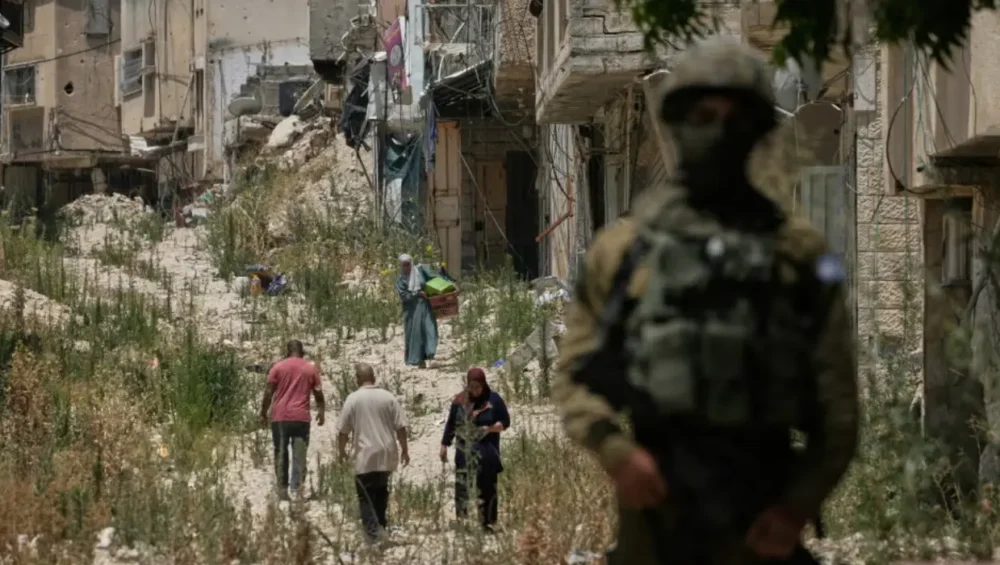
Israel’s reported plan to take control of another Palestinian refugee camp in the West Bank has reopened one of the most sensitive questions in the conflict: whether counterterrorism operations are being used in practice to reshape Palestinian civilian life through forced displacement. Defense Minister Israel Katz’s July 28 instruction, delivered without naming the camp, was presented by Israel as a security measure, but rights groups and critics say the language and the model cited by Katz point to a wider campaign of expulsion, permanent military control, and possible violations of international law.
A familiar model
The Katz order was not an isolated decision. As per the reports, it followed a security meeting attended by top brass of Israeli military and intelligence services such as the IDF chief of staff Lt. Gen. Eyal Zamir, Shin Bet and police representatives along with COGAT. During this meeting, the minister instructed the army to carry out further offensive actions in the West Bank and make plans to occupy yet another refugee camp, with specific reference to the “Jenin, Tulkarem and Nur Shams model.” The reason why this term is important lies in the fact that it goes beyond being just a tactical term. According to the reported Israeli terminology, it refers to the evacuation of inhabitants, destruction of militants’ infrastructure, and the continued military presence of the Israelis inside these camps.
Why the language matters
The political significance of Katz’s wording lies in how it links a present operation to a previous pattern. By invoking Jenin, Tulkarem and Nur Shams, Katz is signaling that the army intends to repeat a method already used in the northern West Bank, where residents were evacuated and the military remained in place. That is why rights groups argue that the policy is not a normal battlefield maneuver but part of a broader displacement strategy.
Human Rights Watch has gone further, saying Katz’s words indicate
“more expulsion of Palestinians from their homes and so more potential ethnic cleansing and war crimes.”
The organization says the Israeli army expelled residents of the camps in January and February 2025 during Operation Iron Wall, and that the result was the largest mass displacement of Palestinians in the West Bank since 1967.
Israeli framing of the operation
The Israeli government claims that it is a counterterrorism measure. According to the Israeli version, there have been militant groups operating in the camps, and the military forces state that they have destroyed the infrastructure related to violent activity. Katz justified the expansion of this operation by saying, “Palestinian terrorism is trying to raise its head again,” explaining the operation as preventive action that should prevent any recurrence of militant attacks. In turn, the Israeli Defense Ministry has stated that the campaign policy conducted by Katz and approved by Prime Minister Benjamin Netanyahu resulted in the decrease of militant activities by 80 percent in 2025.
As Xinhua and JNS report, the Israeli government claims that due to their campaign, the amount of “terrorist” activities in the West Bank in 2025-2026 dropped by 80 percent. However, these numbers should be considered as Israeli security data rather than statistical evidence. It matters since the statistic can be useful for the Israeli government in terms of political gains from this operation, but no calculations and categories are known.
Displacement as policy
The strongest criticism of the plan is that it normalizes displacement as an operational tool. Human Rights Watch says the camps have remained closed off and that more than 33,000 Palestinian refugees were still displaced from their homes around 20 months after the January-February 2025 expulsions. The group says the military has barred return, forced people into rented accommodation or temporary shelter, and demolished homes and buildings to make way for widened roads and access routes.
That is what makes the issue much more complicated than just one side of the debate. In case the new operation is conducted in accordance with the usual scenario, then there will be even greater grounds for considering that this operation is aimed not at the temporary control of territories but at the permanent transformation of Palestinian refugee camps. At least, this is the dividing line between the security operation and forced transfer according to the critics. It can even be seen in the less alarmist wire story. Thus, Xinhua stated that Katz ordered the army to
“prepare to capture another Palestinian refugee camp and evacuate its residents,”
mentioning that the name of the camp remains undisclosed.
Legal and political stakes
The legal question is not simple, but the stakes are high. Human Rights Watch says the forced displacement linked to Operation Iron Wall amounts to war crimes and crimes against humanity, and it has called for investigations into senior Israeli officials including Netanyahu and Katz. The organization argues that the lack of accountability for earlier actions has encouraged a pattern in which grave abuses can continue without consequences.
The UN Human Rights Office has also raised concerns about ethnic cleansing and forcible transfers in Gaza and the West Bank amid intensified violence. That does not by itself amount to a judicial ruling, but it shows that the issue is now firmly within the frame of international human-rights scrutiny.
At the same time, Israel rejects the legal framing used by rights groups. In the Israeli view, the campaign is an anti-terror operation carried out in response to militant threats, including what Katz described as a renewed attempt by Palestinian terrorism to “rear its head.” The gap between those two narratives is the center of the conflict over how the operation should be understood.
The wider West Bank context
This order comes in light of an atmosphere in the West Bank which has become one of escalation already. It is linked to the recent attacks that took place in the village of Tell, killing two Israelis and four Palestinians. It is linked further to the unrest in the territory, as well as other raids and settler violence. The Israeli Defense Forces’ (IDF) Central Command noted that the situation was tense, and there might be escalation in the areas of Judea and Samaria. These statements also come in light of Israel’s strategic plan.
As reported, Katz stated that the Israeli government will expand Jewish settlements in the West Bank, with dozens of new communities to be formed there. Further, he mentioned that the state will not evacuate from areas that it controls in Gaza, Syria and Lebanon. These statements, although they have nothing to do with the refugee camp policy, give an additional understanding of what territorial position the country is taking now. It is in such context that this policy should be understood as it is an element of the general strategy.
What stands out
Most importantly, there is the process of normalizing the existence of troops within camps. In the Israeli method reported, the population is evacuated, the structure is destroyed, and the troops stay in place. While this can be considered a matter of tactical necessity, in essence, it establishes a precedent of transforming the camp from a protected civilian zone to an empty and controlled area. english. The second important thing here is the longevity of displacement. According to Human Rights Watch, the previous camp operations were supposed to be temporary, and yet after twenty months, there were still over 33,000 displaced people.