
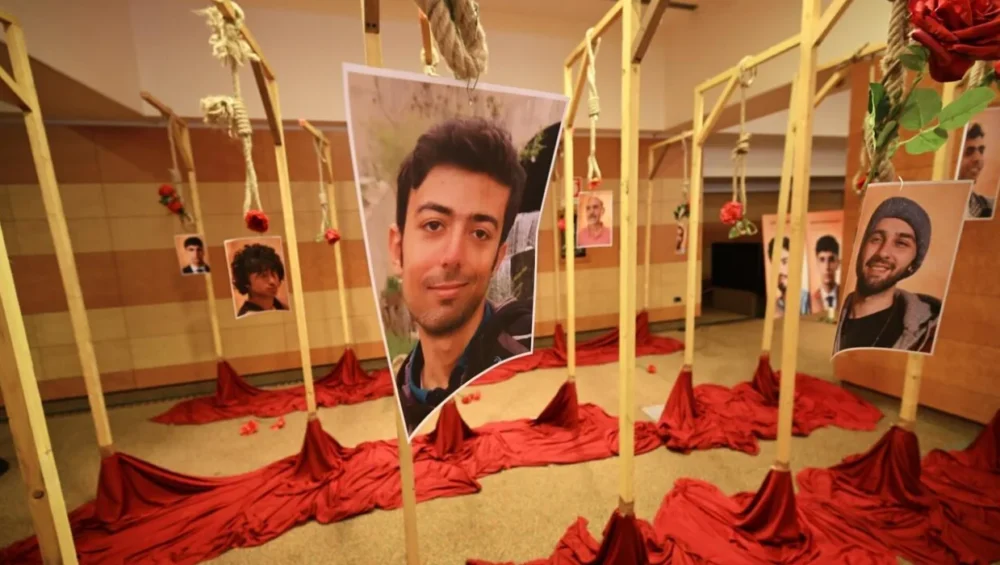
On the morning of Thursday, August 20, 2026, the execution of Ghaem Hosseini, an Afghan citizen aged 21 years, took place within Isfahan Central Prison in Iran. This execution, which has been authenticated by state media and human rights groups, is symbolic of one fact – Ghaem Hosseini becomes the 30th person to be hanged on charges related to protests after the Middle East conflict intensified in February 2026. His execution, which was conducted in the name of justice for the killing of four police men in the January protests, only serves to provoke further condemnation from human rights organizations and the international community.
The Case of Ghaem Hosseini: Charges, Trial, and Execution
Ghaem Hosseini, also known by the nickname “Arian,” was arrested in connection with the so-called “Ali-Khani Square” case in Isfahan, which stems from violent clashes on January 8, 2026. According to Iran’s judiciary news portal, Mizan Online, Hosseini was convicted of
“drawing a weapon and causing fear and terror,”
“creating widespread insecurity,”
“acting against people’s physical integrity and national security,”
and “seriously disrupting public order.” The charges, which fall under Iran’s broad and often vaguely defined national security laws, also included Moharebeh (“waging war against God”) and corruption on earth, both of which carry mandatory death sentences under Iranian law.
According to the Iranian judicial system,
“the verdict in Hosseini’s case had been confirmed and approved by the Supreme Court prior to his execution.”
The Iranian state media mentioned that he was
“a foreign national who was responsible for an attack which caused the death of four police officers in the province of Isfahan.”
The names of the four officers who were brutally murdered were Mohammad Hemmati, Valiollah Safari, Hossein Ramezani, and Seyed Ali Khoshui. They lost their lives during demonstrations in Malekshahr, Isfahan. gauchazh.clicrbs.
However, rights groups present a starkly different narrative. Iran Human Rights (IHR), a Norway-based organization that monitors executions in Iran, reported that Hosseini was accused of kicking one policeman, but authorities presented no evidence that his actions caused any of the four officers’ deaths. IHR director Mahmood Amiry-Moghaddam condemned the execution, stating,
“The execution of Ghaem Hosseini is another stark example of collective punishment and the arbitrary use of the death penalty by the Islamic Republic.”
He added that the case exemplifies how the Iranian regime uses capital punishment not as a tool of justice, but as a means of silencing dissent and instilling fear among protesters and their families.
The Broader Context: 30 Executions Since the War Began
Hosseini’s execution is not an isolated incident but part of a accelerating wave of state-sanctioned killings. According to IHR, since wartime executions resumed on March 19, 2026, at least 30 protesters have been executed across Iran. Of these, 28 were linked to the January 2026 nationwide protests, while two were connected to the 2022 “Woman. Life. Freedom.” movement. This averages to more than one protester execution per week since mid-March, a pace that rights groups describe as unprecedented even by Iran’s own harsh standards.
There have already been five executions in the Isfahan case, and Hosseini is the second Afghan citizen who has been hanged due to his involvement in the Ali-Khani Square protests. Gol Mohammad Mohamadi was the first to receive a death sentence for his participation in the protest movements in Isfahan back in July 2026. According to IHR, over 70 people have already received death sentences in Isfahan due to their involvement in protests while many more have been sentenced in other provinces of the country.
The timing of the executions is critical. It is necessary to note that the war and the crisis started in the region as a result of the U.S. and Israeli airstrikes on the Iranian nuclear and military facilities on February 28, 2026, after which the Iranians responded with counterstrokes. Since the beginning of the conflict, the Iranian government has increased its repression against civilians, using the national security pretext for accelerated executions. UN High Commissioner for Human Rights Volker Türk stated that there were at least 56 executions in Iran since March for the national security-related charges while over 100 people have faced similar accusations.
International Condemnation and Diplomatic Fallout
The execution of Ghaem Hosseini has drawn sharp criticism from the international community. In the week before his death, more than 30 countries, including France, Britain, and Canada, issued a joint statement condemning Iran’s use of the death penalty against protesters. The statement accused Tehran of executing demonstrators to “silence dissent” and called for an immediate halt to all protest-related executions.
Amnesty International, which recorded at least 2,159 executions in Iran in 2025, has warned that the current pace of executions suggests 2026 could surpass even that grim total. The organization has repeatedly called on Iran to impose an immediate moratorium on the death penalty and to commute all death sentences, particularly those handed down in unfair trials.
United Nations human rights experts have also raised concerns about the fairness of trials in the Ali-Khani Square case, citing due process violations, lack of access to legal counsel, and allegations of torture during interrogations. UN experts have described the trials as “a mockery of justice” and have urged Iran to halt all executions pending a thorough, independent investigation into the circumstances of the protests and the subsequent crackdown.
The Human Cost: Families, Communities, and the Shadow of Fear
Beyond the numbers and diplomatic statements there is the human tragedy that goes much deeper than the prison walls of Isfahan. The family of Ghaem Hosseini, like many other families who are suffering from the execution wave in Iran, has been left alone to deal with the tragedy of losing a loved one to state violence, which leaves an emotional scar on them.
For Afghans in Iran, who have suffered and continue to suffer from discrimination in this country that for years has offered refuge to millions of Afghan refugees but provides no protection to them in terms of law, the execution of one of them gives an even more powerful message about how limited are their rights. Rights organizations say that most families whose relatives were executed protesters are scared of speaking out because they risk being arrested if they do or hold public ceremonies for the mournings of their dead relatives. Sometimes even the bodies of executed people are buried in undisclosed places so that the mourning ceremony does not turn into protest gatherings.
The Legal and Moral Questions: Justice or Revenge?
The key question at the center of the dispute about Ghaem Hosseini’s execution is whether it was a form of justice or a form of revenge. While the Iranian judicial system argues that Ghaem Hosseini had been fairly tried for his crimes – including the murder of police officers – and that he was sentenced legally to death, rights activists highlight a trend of injustice in his trial process.
Mahmood Amiry-Moghaddam of IHR put it bluntly:
“This is not justice. This is collective punishment. This is the Islamic Republic using the death penalty as a weapon against anyone who dares to challenge its authority.”
He noted that in many protest-related cases, including Hosseini’s, the evidence linking the accused to specific deaths is weak or nonexistent, yet courts routinely hand down death sentences based on vague charges like “corruption on earth” or “waging war against God.”
The use of such charges, which have their roots in Iran’s interpretation of Islamic law, has long been criticized by human rights organizations as incompatible with international standards of justice. These charges are often applied broadly and arbitrarily, allowing the state to target anyone it deems a threat, regardless of the actual evidence against them. In Hosseini’s case, the fact that he was a foreign national may have made him an even easier target, as Afghan refugees in Iran have limited legal recourse and are often viewed with suspicion by authorities.