
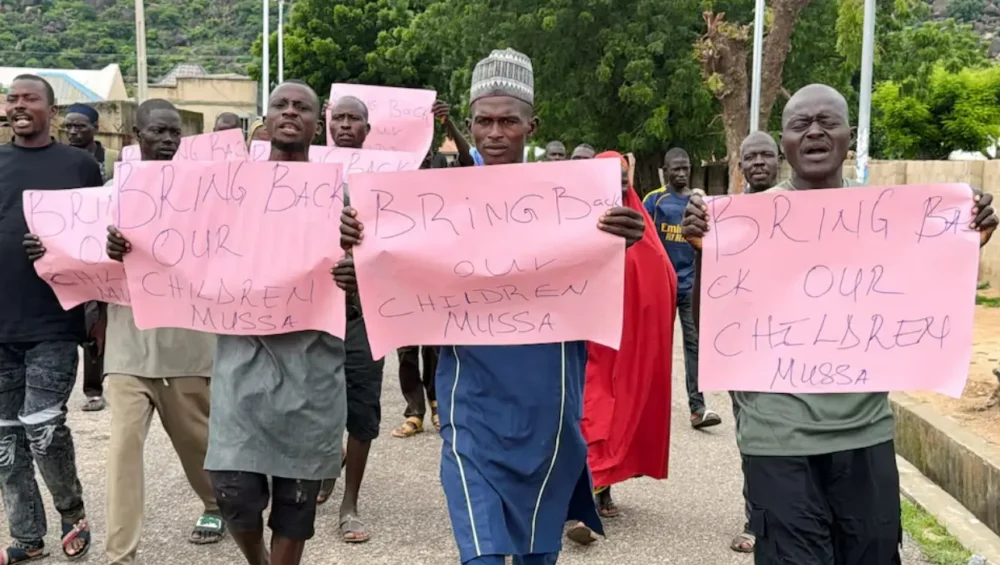
In the dust-filled town of Uba in Nigeria’s troubled Borno state, sorrow has fermented to become anger. In what is now a 100-day-old hostage situation, families of the children who were kidnapped came out on Thursday, August 21, 2026, calling for the release of the children. It took place in Uba town, and the gathering was an expression of not only frustration but also of the human toll caused by Nigeria’s ongoing insurgency and the growing crisis of kidnapping of schools. The children had been kidnapped from their classes in Mussa, a small settlement near the Sambisa Forest, which has long served as a base for various Islamist insurgents such as Boko Haram and its ISWAP branch. Holding up signs as they gathered under the hot sun, the message they were chanting was clear – bring back our children.
The abduction that ignited a movement
The event that led to this protest started early in the morning on May 15, when armed people attacked Mussa Primary and Junior Secondary School. It is said that 42 children were initially reported to have been taken captive, but according to community leaders’ accounts, about 45 children went missing. The assailants, believed to be Islamists, disappeared into the forest taking the missing children with them. To make things worse, less than a month after the first abduction, 36 children and one teacher were abducted from Government Day Secondary School of Lassa, situated in the same Askira/Uba Local Government Area, by another group of gunmen on June 29, 2026. By the end of August, all of them remained missing with the total number of abducted children being no fewer than 78.
For families, the passage of time has only deepened the agony.
“We still have not seen them… We don’t know whether they are healthy or going through difficult conditions,”
said Chinda Buba, a parent of an abducted child, his voice heavy with exhaustion. The uncertainty is a torment in itself—no ransom demands, no clear communication from captors, and little official information on rescue efforts.
Voices from the protest: anguish, fear, and a plea for action
The protest in Uba was not a polished political rally but a raw expression of communal pain. Parents spoke of sleepless nights, of meals left untouched, of the psychological toll of not knowing whether their children are alive.
“We worry every day and struggle to eat… We are pleading with the government to rescue them,”
said Peace Nicolos, whose two young children—aged approximately three and a half and eight and a half—are among the missing.
The abduction of such young children has struck a particular chord in the community.
“There is nothing more painful than separating very young children from parents… The entire community is affected because almost every family is connected to those who were taken,”
said Orbet Lawan Yakubu, representing Mussa’s traditional ruler. His words underscored the collective nature of the trauma; in a tightly knit community, the loss of any child is felt by all.
For many parents, the contrast with other recent abductions has sharpened their sense of injustice. In mid-May, on the same day as the Mussa attack, a separate school abduction occurred in Oyo State, southwestern Nigeria. Those victims were rescued after nearly two months in captivity.
“President Bola Ahmed Tinubu… these are our children, they were adopted on the same day with the children of Oyo State. Well, those of Oyo State have been rescued for over a month. While, our children are still in captivity for almost 100 days,”
said a Borno parent speaking to News Central TV, drawing a direct comparison that highlighted perceived disparities in government response.
The emotional and physical toll on families has been severe.
“Some of us are still in the hospital up to now… I can pronounce three people that are in the hospital because of this situation,”
the same parent added, describing how the stress has manifested in tangible health crises.
Official responses: reassurances without resolution
In the wake of mounting pressure from citizens, authorities’ response has been restrained and devoid of any tangible information. According to a police spokesperson, the military is “on top of the situation.” However, no information has been released by the military about its activities, nor about when a rescue operation will take place. Representatives of the military did not respond to any queries posed by the media at the time this report was published, leaving parents with nothing else than an assurance without any detail. The lack of information has raised more anger. For people who know very well about the insurgencies experienced for decades, these empty assurances have no meaning.
Political pressure mounts: lawmakers call for intensified action
As families took to the streets, political figures began to amplify their demands. On August 20, Senator Mohammed Ndume, representing Borno South, visited the Theatre Command of Operation Hadin Kai in Maiduguri, where he urged the military to intensify rescue efforts. Ndume specifically referenced victims from Mussa, Lassa, the Buratai axis, and Ngoshe in Gwoza, noting that some have been captive for over 100 days. Ndume framed his appeal as a moral obligation of representation, careful not to dismiss the sacrifices made by security forces.
“I am not here to downplay the efforts of the military,”
he said,
“but as a senator, I have a duty to speak for my people. These children have been in captivity for too long, and more must be done.”
His comments reflected a growing political consensus that the status quo is unacceptable, even as the military maintains that operations are ongoing.
Maj. Gen. Abubakar Abdulsalam, the Theatre Commander, acknowledged the concerns and reiterated the military’s commitment to protecting communities and securing the safe return of displaced residents. However, like the police statement, his remarks offered little in the way of new information or actionable timelines.
A pattern of abductions: the broader crisis
Uba protests are part of a larger, deeper crisis that has plagued the region for some time now. Since the notorious abduction of schoolgirls from Chibok in 2014, Nigeria has witnessed over 20 school kidnapping incidents which involve over 1,700 pupils and personnel. As per data gathered by UNICEF and Amnesty International. The statistics continue to rise. Over 3,033 individuals are known to have been abducted in 2025 alone in Nigeria as per the report by Nigeria Security Tracker. At least 1,100 individuals were kidnapped between January and April 2026 alone. The recent cases of mass kidnapping illustrate how bad the situation is.
In November 2025, about 315 individuals (pupils and staff) were kidnapped from St. Mary’s Catholic School located in Papiri, Niger state. Coordinated assaults in May 2026 across the Borno and Oyo states led to the kidnapping of 82 pupils from both states. Amnesty International has been criticizing the federal government over its failure to provide adequate security to schools and the surrounding vulnerable community. Abductions have been linked with school closure cases which have led to reduced accessibility of education in northern Nigeria.
The human cost: education, trauma, and a generation at risk
Beyond the immediate trauma of abduction, the crisis has had a chilling effect on education in the region. Schools in Borno and neighboring states have become targets, leading to closures, reduced enrollment, and a generation of children denied access to learning. For parents, the decision to send children to school is now fraught with fear. “I’m scared of going to school,” one child reportedly said during a separate protest in Abuja over the Oyo abductions, a sentiment that echoes across the northeast. The psychological impact on families is profound. Parents describe living in a state of suspended animation, unable to move forward without news of their children.
“We don’t know whether our children are still alive or they are dead… If rain is coming… some of us will start to cry, due to we don’t know the condition of our children,”
said a Borno parent, capturing the relentless anxiety that defines daily life for these families.
For communities already battered by decades of conflict, the abductions represent another layer of trauma. The protest in Uba was not just about rescue; it was a demand for dignity, for recognition of their suffering, and for a government that acts with urgency and transparency.
The road ahead: demands, delays, and the test of governance
As the protests at Uba began to wind down, the main requests of the families have remained unaltered. These include the safe release of the children as well as the swift intervention of the government. President Bola Tinubu is faced with the task of solving the issue which is bound to test his leadership capabilities and prove whether he can really deliver the promised security improvements to all parts of the nation. It is interesting to compare the situation in Uba with the one involving the Oyo abductions in which children were saved from the clutches of their captors after spending nearly two months in captivity.
Why are the Oyo children free while those from Borno continue to suffer in captivity? Is it a matter of the nature of the environment or of the capabilities and determination of the insurgents? These are some of the questions being asked more often as of late. For now, the fate of the children of Mussa and Lassa remains unresolved. The protests in Uba have shown what the people are capable of, but it also showed the limitations of public pressure. As the time passes, there is a fear that it will be the noise of politics rather than the cries of the victims that will prevail. Only concrete steps will be able to help solve the problem. Until then, the protest in Uba remains the testimony of the fact that the situation with the security in Nigeria has resulted in a tragedy of enormous proportions.