
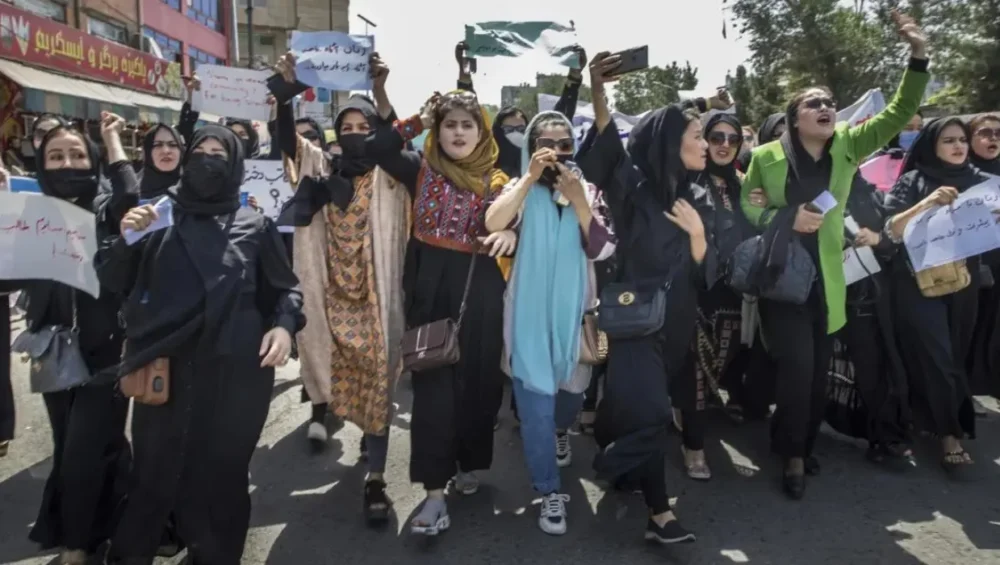
Afghanistan gender apartheid intensified at the end of 2025 when the Taliban tightened their grip on the participation of women in humanitarian and civilian activities. Since September 7, security forces have refused to allow Afghanistan women national staff and contractors to enter all United Nations compounds. At facilities in Kabul, Herat, and Mazar-i-Sharif, the enforcement did not stop until December, even months of diplomatic activity and the agreements that had been reached before the detrimental effect on the working position of women.
It was the latest in a series of multi-year policies that started with verbal bans on the NGOs in early 2022 and progressed into bans on female work and education. As of April 2023, the women employed by UN agencies were restricted in their movement; the directive of September 2025 completely deprived them of it, impacting approximately 400 female workers in the country. This was another step in institutionalizing gender-based discrimination because UNAMA declared the ban illegal by fundamental international norms, such as the UN Charter and the CEDAW.
Cumulative measures shape a closed system
Sequences of edicts have created a system of governance that has minimal room to interpretation. The prohibitions of education, restrictive rules of guardianship, prohibitive rules of employment, restrictions in public spaces, all constitute a system, which is increasingly described by international legal experts as gender apartheid. Both new actions are superimposed on an already limiting space, limiting humanitarian space and challenging the principles of operation of agencies that remained in the country.
Responses frame restrictions as structural discrimination
In 2025, the UN officials such as the Secretary-General Antonio Guterres were still condemning those policies. Human rights observers quoted the actions as being systematically aimed at locking out women in the lives of the public, a finding that was further strengthened by the December 7 declaration by UN Women that the treatment of women in Afghanistan was gender apartheid. Such language has its political and legal connotation, and indicates an increasing consensus in the world regarding the nature of Taliban rule.
Humanitarian crises expose widening gender impacts
The practical effects of the UN compound ban did not take long to go beyond internal staffing challenges. As several emergencies were taking place, female workers were not present, which became a direct hindrance to women and girls receiving the aid.
How does a returnee surges magnified vulnerabilities?
The Afghans also returned 2.4 million in 2025, mostly Iran and Pakistan. Over fifty percent of the returnee women were inaccessible because of the absence of registered female staff to verify and register. UNHCR announced that it was halting eight large cash centers with close to 7,000 returnees daily due to cultural factors that made it impossible to have male employees interview women.
A significant number of deported families had previously lost their homes because of an earthquake in eastern Afghanistan which killed over 2200 people last September. Displacement, loss, and limited access to aid combined and contributed to the possibility of exploitation and the insecurity of food and shelter.
Quake-related operations meet structural hurdles
The balance that the gender policies provided was in the relief efforts that took place after the September earthquake. Women health workers play a critical role in reaching out to women survivors and gaining the necessary and correct needs assessment, but travel and workplace bans put major gaps. WHO revived the demand to eliminate guardian travel restrictions, saying that the current restrictions threatened to cut back on vital medical and psychosocial care.
Agencies tried to make adaptation efforts but it was underfunded further. The 2025 malnutrition response, which was aimed at reaching 19 million people announced by UNICEF, had delays in various provinces in which women were unable to directly interact with male personnel. Such gaps point out the way in which gender apartheid does not only limit rights but undermines humanitarian results in the whole country.
Evolving international recognition and legal framing
An increasing recognition of Afghanistan gender apartheid had diplomatic and operational implications all of 2025. The international organs were increasingly conditioning the legitimacy of the Taliban to quantifiable changes in terms of curtailment of rights.
Global mechanisms shape pressure strategies
Security Council Resolution 2681 (2023) still remained a point of anchor to the member states that required their rights back. Organizations like Human Rights watch have issued reports in the year 2025 of systematic discrimination targeting millions in need of aid. Harassment of women in the open spaces increased with the new edicts being issued and analysts at the United States Institute of Peace also recorded this, with each new edict adding to the surveillance and intimidation.
Legal principles confront institutionalized exclusion
Taliban leaders rejected the arguments of the international law by stating that the matters of governance are under domestic jurisdiction. This stance increased the distance between Afghan de facto authorities and international human rights organizations. Without accountability systems, experts explained that discriminatory systems would only become entrenched, particularly as the Taliban consolidate their administrative power by non-inclusive policies.
UN agencies balance engagement with operational adaptation
UN agencies needed to balance the need to uphold the primary humanitarian principles and the necessity to remain accessible to the affected populations. The 2025 environment compelled the need to rely on the layered negotiation tactics at the local, provincial and national levels.
Internal adaptations reflect political realities
There are isolated modalities sought by some agencies towards women, but the outcomes differed widely throughout the provinces. The inconsistency of the enforcement and the gendered character of the regulatory decisions were also emphasized by the May 2025 lifting of home-based orders of male staff, not female staff.
Multilateral coordination tests the limits of leverage
Fatigue among donors and a decrease in funding became complicated. The authorities have stressed that humanitarian dependency, which applies to about 23 million individuals, constrains coercive power, since suspending operation can cause damage on a population level, without necessarily altering the policy. The necessity to ensure that aid continues to flow has necessitated the agencies to compromise on workarounds despite the fact that these workarounds fail to meet the rights-based standards of operation.
2025 developments deepen global advocacy initiatives
Between September and December, international agencies made new calls due to the renewed appeal by the main international agencies because the earthquake response and the influx of returnees placed increasing pressure on the aid system in Afghanistan. UN Women persisted that a sustainable approach to humanitarianism cannot be achieved without restoring the full participation of women. According to the analysts, the four-year point since the Taliban takeover is considered a turning point, as by August 2025, women were virtually no longer to be found in the activities of the institutions.
Emerging assessments guide diplomatic considerations
According to the humanitarian witnesses, the presence of disasters, infrastructure devastation, deportations, and winter conditions contextualized the Taliban in a way never witnessed before. These pressures were still uncertain in terms of their potential to affect policy change at the end of the year, but some observers noted that long-term crises may compel limited provincial concessions.
Future trajectories and the search for meaningful change
The Afghanistan gender apartheid is already being framed in a way that is influencing the way the world reacts to it through diplomatic utterances or even in legal discourses. Nevertheless, the realities of operations require short-term fixes, which enable women to obtain help, irrespective of the political consequences. Negotiators struggle with the two opposing demands to preserve ideals and avoid additional worsening of the humanitarian situation.
The key question to ask as we head to 2026 is that of pressure points and potential inflection points. Will the persistent increase in the demands of the returned and the disaster-induced vulnerabilities require even limited changes in policy? and with the growth of international legal acknowledgment, will solidarity between world strategies change the calculations of the Taliban, or will deep rooted non-inclusion be the hallmark of the Taliban in the control domain of Afghanistan?