
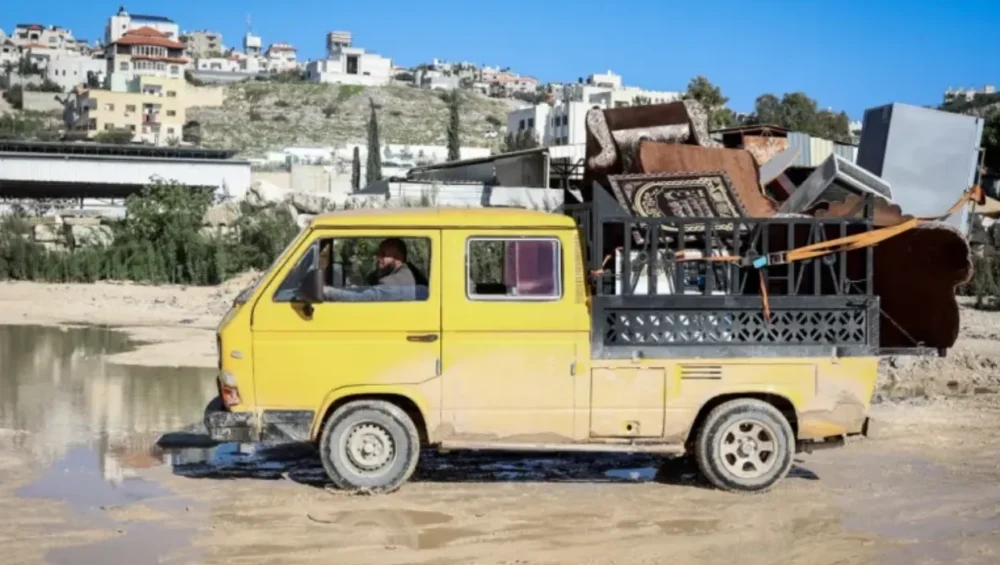
The Israeli Defense Forces have also begun the process of destroying residential buildings where Palestinians have sought refuge in the occupied West Bank. This is happening despite the breach of humanitarian law. The Israeli military has also begun destroying buildings where Palestinians have taken refuge in the West Bank’s occupied areas because the winter season has started.
It also took place on Wednesday, where bulldozers and cranes of the Israeli army razed a large portion of the refugee camp of Nur Shams, near the city of Tulkarem in the West Bank, leaving residences for 100 Palestinian families destroyed. Dust filled the air, where a large number of Palestinians were forced to watch.
The Israeli army asserted that these demolitions were carried out within the framework of a “security operation against” Palestinian armed groups, although this cannot be confirmed independently. The residents, as well as human rights groups and United Nations agencies, have insisted that it “constitutes forced displacement and collective punishment, which are prohibited by the Fourth Geneva Convention.”
How widespread is displacement in Nur Shams and nearby refugee camps?
According to local Palestinian delegates, “The humanitarian crisis in Nur Shums camp had already reached critical proportions prior to these recent demolition incidents.” More than 1,500 families in the camp “are still unable to go back home. What we are witnessing here now is a big catastrophe for the Palestinian refugees in front of the whole international community,” said Nihaya al-Ghandi, member of the popular committee in Nur Shums camp.
This week, UNRWA has supported with Cash for Rent more than 1,600 families from the northern occupied #WestBank.
— UNRWA (@UNRWA) December 31, 2025
These #Palestine Refugees were forcibly displaced from Jenin, Tulkarm and Nur Shams camps, often multiple times, increasing their vulnerability.
Covering rental… pic.twitter.com/Wxc6cNLrhP
Israel has ramped up what it calls “security operations” in the refugee camps in the northern West Bank throughout 2025, especially in the refugee camps of Nur Shams, Tulkarem, and Jenin. According to Human Rights Watch, in the three above-mentioned refugee camps alone, 850 homes have been destroyed or made uninhabitable.
Is UNRWA working in the occupied #WestBank including East Jerusalem in spite of the anti-UNRWA laws?
— UNRWA (@UNRWA) December 6, 2025
Yes, UNRWA continues to serve 935,000 #Palestine Refugees there.
In addition to ongoing services, UNRWA is currently leading the emergency response to the largest displacement… pic.twitter.com/d97FznbLfT
Satellite imagery reviewed by the organisation appears to indicate that these incidents are not random but rather a deliberate attempt at establishing “buffer zones” through a long-term reshaping of the refugee camp layout for easier access by Israeli forces.
Does international law permit such demolitions under occupation?
Human rights organizations say that Israel’s actions contravene several articles of international law. First, in accordance with Article 53 of the Fourth Geneva Convention, property cannot be destroyed unless strictly required in immediate military operations.
The UN Office for the Coordination of Humanitarian Affairs (OCHA) has consistently stated that punitive home demolition is a form of collective punishment, which is specifically forbidden by humanitarian law. The displacement of civilians, including refugees, can also amount to the crime of war if it is not carried out for legal reasons.
Ever since Israel occupied territory in the West Bank, including East Jerusalem, in 1967, international bodies such as the International Court of Justice have held that this territory remains occupied, irrespective of Israeli domestic law.
How does this fit into the wider displacement caused by Israel’s war on Gaza?
The razing of the West Bank is taking place simultaneously within the wider Israeli war on the Gaza strip, which has precipitated the most serious displacement crisis in the territory’s modern history. Sources within the human rights movement observe the concomitant escalation within the West Bank as an indication of the overall strategy of fragmentation and displacement for the entire territory of Palestinian lands.
Since October 2023, over 1.9 million Palestinians, or 85 percent of the population of Gaza, have been forced to be uprooted, reports the United Nations. Neighborhoods have effectively been abolished, with over 70 percent of the housing units in Gaza being damaged or destroyed.
Why is Israel expanding settlements while refugee homes are destroyed?
Note that Palestinian refugee camps are being torn apart, and Israel is speeding up the expansion of settlements in the occupied West Bank, which is illegal according to international law. The Israeli planning authority on Wednesday APPROVED the construction of 126 housing units for settlers in the Sa-Nur outpost in the West Bank, as reported by Israeli media. The move will make way for the settlers to move back to the outpost that was evacuated back in 2005 through the Israeli disengagement plan.
That plan was subsequently officially overturned in March 2024 when Israel’s parliament repealed the Disengagement Law and re-opened four northern West Bank settlement sites. According to human rights organizations, this action indicates that there is a clear agenda to permanently establish Israeli civilian presence in occupied territory.
At the end of 2025, there are over 700,000 Israeli settlers in more than 300 settlements and outposts in the occupied West Bank and East Jerusalem combined. The settlements cover about 42 percent of the territory in the West Bank, as reported by Palestinian land groups, and are reportedly connected to land seizures, mobility constraints, and violence.
1/ Sustainable peace in Israel and the Occupied Palestinian Territory requires international justice for victims of all crimes.https://t.co/wL8omCXyxY
— Amnesty International (@amnesty) December 11, 2025
What is happening to UNRWA and why does it matter?
These demolitions and settlement approvals align with Israel’s increasing campaign against UNRWA-the United Nations Relief and Works Agency for Palestine Refugees-which provides education, healthcare, and humanitarian assistance to millions of Palestinians.
I strongly condemn the unauthorized entry into the @UN Sheikh Jarrah compound held by @UNRWA in occupied East Jerusalem by Israeli authorities.
— António Guterres (@antonioguterres) December 9, 2025
This compound is inviolable & immune from any other form of interference.
I urge Israel to immediately take all necessary steps to…
UN Secretary-General António Guterres, in turn, denounced the reported Israel’s moves to cut electricity or water supplies to UNRWA facilities, warning that such actions would “severely impair” the ability of the agency to perform its tasks. UN Spokesman Stéphane Dujarric underlined that UNRWA and its assets are protected according to international conventions on UN operations.
UNRWA Commissioner-General Philippe Lazzarini characterized Israeli activities as a “systematic campaign” to discredit the UNRWA and destroy the organization that was launched in 1949. In 2024, Israel subsequently enacted a law to halt UNRWA activities in the territory Israel claims as their own and to refrain from any official contact with the organization in spite of the United Nations’ designation of East Jerusalem as an occupied territory.
Is Israel attempting to erase the Palestinian refugee issue?
Critics would suggest that the destruction of the refugee camps, the expansion of settlements, and the constriction of UNRWA activity indicate a pattern that points to the elimination of the refugee question itself.
UNRWA currently provides services to approximately six million Palestinian refugees who are registered in Gaza, the West Bank, Jordan, Lebanon, and Syria. In displacing refugees or destroying UNRWA as a humanitarian organization, human rights groups indicate Israel could be solidifying a permanent humanitarian crisis without options derived from international law.
With the progress of the winter months and the acceleration of displacement, Palestinian families within the West Bank are faced, and are facing, an ever more desperate situation, one characterized by the destruction of homes, decreased space within the humanitarian structure, and the overall lack of accountability.