
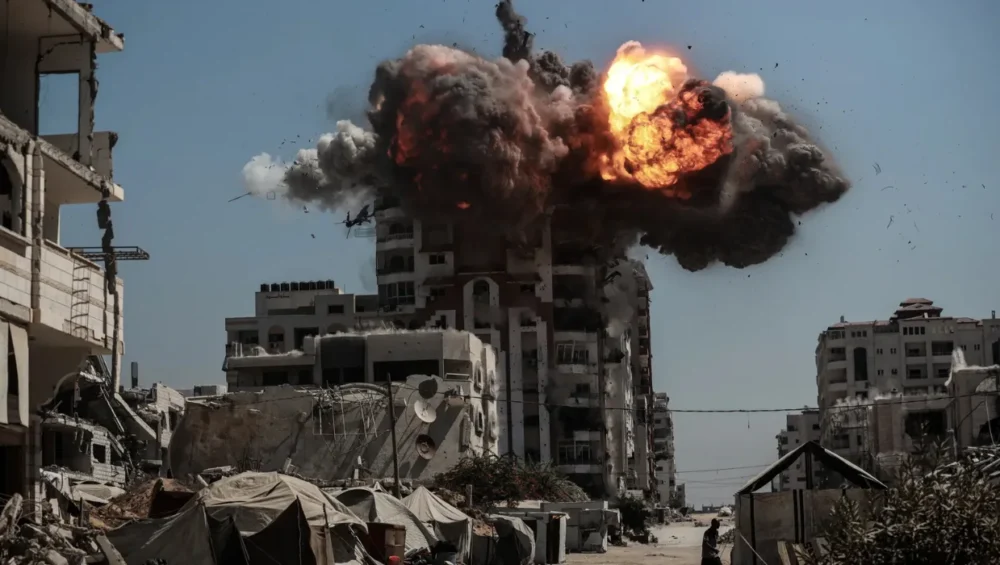
Intensified military activity in Gaza City in September 2025 marked one of the deadliest phases of the conflict, with strikes in densely populated neighborhoods leading to an unprecedented concentration of civilian harm. UN monitors recorded eighteen cases of residential buildings in less than two days, eight of which led to the loss of lives of over fifty people. The Daghmash family houses in As Sabra became synonymous with the destruction of the era following an airstrike that killed over twenty of the family most of whom were children. This sudden escalation of loss of lives was accompanied by a new drive to clear militant strongholds found within urban districts yet the tactic of operation continued to put the lives of noncombatants in the line of fire despite warnings of the weakness of the location.
The crisis of displacement resulted in the intensification when the neighborhoods in the north of Gaza were demolished or evacuated. The result of the combination of strikes and ground incursions was the movement of more than 81,000 people to the south between 17-20 September which indicates the magnitude of the upheaval. The UN Human Rights Office called the situation a climate of growing terror among civilians, as some of the public declarations of Israeli officials were a threat to destroy whole districts unless Hamas would obey the military demands. The pitching of these warnings implied a long term goal beyond battle front demands, which were of long term demographic implications and the possibility of population displacements which could not be reversed in Gaza.
Legal observers following the case maintained that the overall impact of expulsions and structural clearance in the northern districts could reach the level of forced transfer under the international humanitarian law. This trend of neighborhood- by- neighborhood demolition only bolstered these fears, since the demolition of civilian buildings was declared a military danger again even in cases where overt militancy was not publicly proved. The pace of operation was evidently operant towards pressure-based urban restructuring that produced conditions that left minimal space to civilian resilience and recovery..
Buffer Zones And Total Razing In Southern Gaza
Massive destruction of Khuza in May 2025 illustrated how the engineering activities at such scale crossed with the counterinsurgency objectives. During a two week period, the Israeli troops demolished houses, arable lands, factories and workshops as part of Operation Gideon Chariots. The satellite tests carried out by Amnesty International revealed that fertile land was deliberately flattened eliminating important elements of food production. The magnitude of the destruction indicated a plan that was not only intended to achieve the tactical pre-eminence, but also to change the physical landscapes of the area in such a way that the long-term survival could be lessened.
Soldiers reported on the ground were given explicit orders that focused on complete clearance. According to one sergeant major of the 5th Infantry Brigade, his unit was ordered to leave nothing standing which was a construct that gave primacy to area denial rather than graded military necessity. The resulting wasteland stretched some half a mile along the border and did away with any infrastructure necessary to economic continuity. The tactics were reminiscent of previous buffer-zone expansions recorded in northern Gaza in which dozens of buildings in areas like Sheikh Radwan and Zeitoun had been destroyed by the start of September.
AI Targeting And Indiscriminate Bombing
The introduction of AI-based targeting systems in the end of 2024 and extended all the way into 2025 contributed to the formation of operational trends greatly. UN reports raised worries on the lack of adequate control measures on the algorithms of classifying targets. Massive ammunition was often used in situations where living near was manifest and sounded warnings about proportions. The demolition of water networks, sanitation sites, and food storage facilities created the impacting effects on the general health of the people, which led to environmental degradation that had lasted longer after the individual strikes.
Israeli leaked data that 83 percent of the deaths in August 2025 would be civilians strengthened scrutiny. Military analysts highlighted discrepancies between automated threat names and reality on the ground, pointing to the possibility of being faster than human operators because the system was engineered to react quickly to targets. This interaction complicated the attempts to preserve adherence to the principles of distinction especially in the areas that were already destabilized due to the years-long displacement and structural destruction.
Hamas Tactics Exploiting Civilian Proximity
The fact that Hamas was deeply embedded in the densely populated areas continued to characterize the engagements on grounds. The fighters still acted in the areas under residential buildings, in tunnels located on the territories of privacies, as well as near schools and clinics. These operations put civilians at a greater risk and used the congestion of Gaza to restrict operational flexibility by the Israeli forces. Analysts said that the group positioning of them in civilian buildings within places like Rimal and Shuja’iyya was an indication of the effort to create strikes that would alter the international opinion by increasing the apparent casualties of civilians.
Reports circulated that by mid 2025 some hostages have been transported to the top of the earth into civilian territories or temporary shelters to scare off the advances. Though Hamas spoke of such claims rarely and when it mentioned such allegations, it used weasel words, but military investigators said that the trend made it difficult to rescue and made one more likely to be hurt in the firefight. Nevertheless, international law establishes that the illegal application of human shields does not absolve the opposing sides of their duties to reduce the civilian deaths.
IDF Measures Amid Operational Challenges
Whereas the destructive results prevailed in a large part of the 2025 scenario, Israeli forces were also applying warning measures aimed to minimize civilian casualties. Prior to the attacks on high-risk buildings, phone alerts, text messages, and instructions via drone speakers were still in use. Low-yield munition roof-knocking gave extra warning but critics believed that due to their narrowness, evacuation windows could often risk locking their families in. Aerial surveillance drones were used to scan rooftops to detect any civilians in human shields and in a number of reported cases it was due to the presence of noncombatants inside the blast zone that a strike was canceled.
These actions were directed against the background of increased military control over Gaza City, in which Israel claimed to have fifty percent of the territory by September 2025. The fighting in the city still threatened to bring troops within civilian constructions, which supported the army in its claim that in high density co-location of the fighting forces, there was a need to use the power of the clearance operation. Nevertheless, the humanitarian agencies warned that the combined effect of evacuations, demolitions, and the lack was driving civilian populations to irreversible collapse.
Legal Frameworks And Global Responses
The international humanitarian law continued to lead the evaluation of 2025 operations across the globe. The norms of distinction, proportionality and precaution were the aspects applied to assess the legality of the tactics employed by both Hamas and Israel. The claims of starvation methods, needless demolition of infrastructure and forced migrations put an increased focus on by international institutions like the International Criminal Court. In 2025, the Court issued warrants against senior officials in Israel based on the fact that they might have engaged in the violation of a military decision-making process.
UN experts in November 2025 warned that recurring ceasefire breaches and escalating civilian losses risked undermining the fragile diplomatic framework built earlier in the year. Some experts described patterns reminiscent of actions that could align with genocide indicators, amplifying pressure on governments to reassess their engagement. The European Parliament’s resolutions condemned abuses attributed to both parties, citing Hamas’s use of human shields and Israel’s large-scale displacement operations as incompatible with legal commitments.
Casualty estimates surpassed 84,000 by early 2025, with women, children, and the elderly constituting more than half of the dead. This demographic reality underscored the dire human cost of evolving urban warfare models and the widening gulf between military objectives and civilian protection.
As 2025 approached its close, the conflict’s defining dynamics revealed a complex intersection of entrenched militancy, expansive clearance operations, and emerging technologies that transformed the conduct of war. The evolving reliance on AI tools, the reconfiguration of urban landscapes, and the shifting legal debates generated enduring questions about how modern militaries and non-state actors navigate responsibilities toward civilians. Whether future engagements adapt to these lessons remains uncertain, but the trajectory seen in Gaza suggests that the boundaries of urban conflict and the expectations of accountability are rapidly changing.