
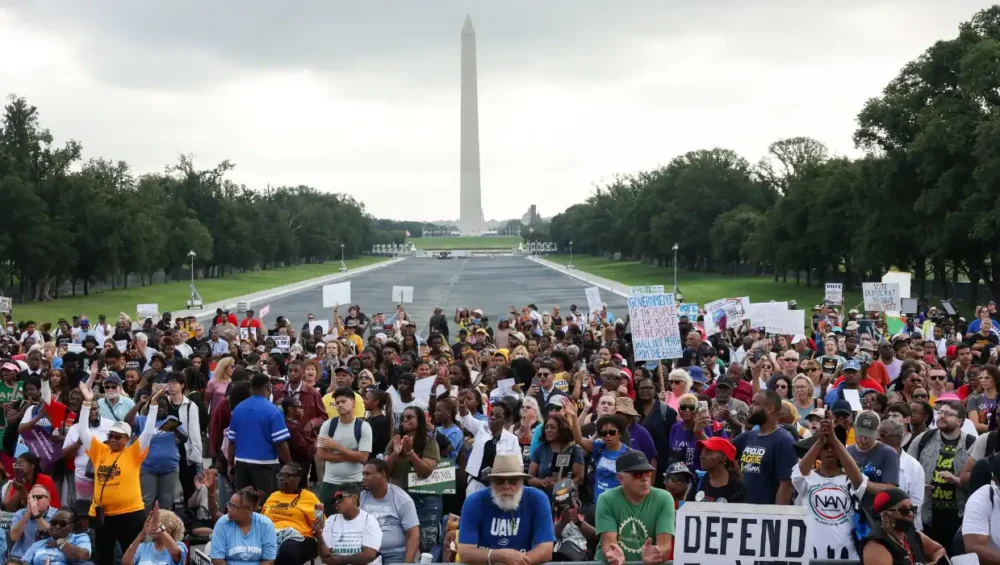
On the 63rd anniversary of Martin Luther King Jr.’s “I Have a Dream” speech, the National Mall in Washington transformed itself into a site of a new form of confrontation. Thousands of people assembled at the Lincoln Memorial to participate in “March on Washington 2026: Defend the Vote,” a massive rally which was both commemorative and a manifestation of political dissent. The organizers see this event not as an act of reminiscence, but as a reaction to the attacks on voting rights and civil rights protections, which have been intensified through the Supreme Court decision in April, along with redistricting efforts in the South and actions by the Trump administration against mail voting.
The march’s core message was stark: if the vote is weakened, every other right becomes precarious.
“The right to vote, the very foundation of our power, is being chipped away in statehouse after statehouse. When the vote is weakened, every other right grows fragile with it,”
said Rev. Al Sharpton, convening the event alongside Martin Luther King III and Arndrea Waters King. That line—delivered to a crowd that stretched toward the Reflecting Pool—captured the moral logic of the day: voting is not one issue among many, but the lever that determines whether other rights can be defended at all.
Who Called the March, and Why Now
The rally was organized by the National Action Network and the Drum Major Institute, with the involvement of over 90 groups, including the NAACP, National Urban League, labor unions, and faith-based alliances. The timing of the event was carefully chosen. As the mid-term election period was nearing, it became clear that there were very few opportunities left for shaping the Congress that will make decisions regarding federal voting rights.
“Defending the vote means defending the foundation of our democracy… we are called to march again, not only in remembrance, but in action,”
said Martin Luther King III, invoking his father’s legacy while insisting that history must be met with present‑tense pressure.
Arndrea Waters King reinforced that point, tying the march’s symbolism to concrete political stakes.
“We march to defend the vote, honor those who sacrificed for it, and ensure that every voice is protected,”
she said, positioning the event as both a tribute and a warning. For the organizers, the warning was aimed at two fronts: state legislatures redrawing maps to dilute Black voting power, and federal actors reshaping the rules of participation in ways that could suppress turnout.
The Legal Trigger: A Court Ruling That Redrew the Map
The root cause of the anger in Washington was the U.S. Supreme Court ruling on the case of Louisiana v. Callais that occurred in April of 2026. This reinterpretation of certain provisions of the Voting Rights Act paved the way for what the organizers saw as discriminatory gerrymandering. The effects of the ruling were immediately obvious in Louisiana, where the legislature quickly redrew the congressional district map in such a manner that it broke up Rep. Cleo Field’s majority Black district, grouping it in whiter areas. Rep. Fields, who had been the center of the controversy, decided to give up his seat in Congress.
“When the courts and the legislature broke apart District 6, they did not just redraw lines… They told hundreds of thousands of Black families… that their voice could be taken away at any moment,”
said Rep. Cleo Fields, speaking to the crowd about the personal and communal impact of the map change. His words underscored a broader fear among marchers: that the Court’s reinterpretation would be replicated across the South, reducing the number of majority‑minority districts and weakening the ability of Black communities to elect candidates of their choice.
Federal Policy Under Fire: Mail‑In Voting and Civil‑Rights Enforcement
Apart from gerrymandering, organizers have also identified several other moves by the Trump administration as indicative of a larger rollback. These include the administration’s efforts to limit voting through executive order, attempts to restrict the scope of civil rights enforcement through policy changes, and attempts to restrict federal civil rights laws. Civil rights organizations, such as the NAACP and the Lawyers’ Committee for Civil Rights Under Law, have brought fresh charges against Trump’s executive order limiting mail-in voting in an ongoing federal suit against him; although the Supreme Court may have paved the way for its implementation in the coming mid-term elections, there is still uncertainty about its scope and implications.
For many on the Mall, these federal actions were not abstract policy debates but direct threats to participation.
“Black communities have endured assault after assault on their constitutional right to fully participate in a voting process that is free from discrimination… On Aug. 28, we are returning to the National Mall to declare, loudly and clearly, that we will not go back,”
said Janai Nelson, President and Director‑Counsel of the NAACP Legal Defense Fund. Nelson’s statement linked the legal battle over mail‑in voting to a longer arc of discrimination, framing the current moment as a test of whether the gains of the 1960s can be preserved in a new legal and political environment.
The Coalition: From Pulpits to Picketers
The diversity of the coalition was another defining characteristic of the march. Along with the well-known civil rights leaders, those on the stage included leaders of trade unions, religious organizations, and politicians from the whole range of progressives. Some of the confirmed speakers were Sen. Bernie Sanders, Rep. Alexandria Ocasio-Cortez, Rep. Yvette Clarke, and Virginia Governor Abigail Spanberger, among many others. The appearance of these people showed the effort to link the voter rights with economic justice and affordability.
Derrick Johnson, president of the NAACP, captured the coalition’s urgency in a single line.
“We will not stand idly by while the voices of the people are silenced… We must protect every eligible citizen’s right to cast a ballot,”
he said, tying the march’s moral language to a practical demand: safeguard the mechanics of participation. For Johnson and others, that meant not only opposing restrictive laws but also pushing for affirmative federal legislation that would restore and expand protections.
The Legislative Ask: A New John R. Lewis Act
If the march had a single legislative target, it was the passage of what organizers called a “new and robust John R. Lewis Voting Rights Advancement Act,” alongside support for state‑level Voting Rights Acts. The original John Lewis Voting Rights Advancement Act, introduced in prior Congresses, sought to restore and strengthen the preclearance regime struck down by the Supreme Court in 2013; the 2026 version, as described by organizers, would go further, responding to the Callais ruling and the new redistricting realities.
The strategy was twofold: pressure Congress to act before the midterms, and build state‑level momentum where federal legislation stalls. Janai Nelson made that dual track explicit, noting that the LDF would pursue court reform and push for state voting‑rights laws even as the national fight continued. For many on the ground, the legislative ask was not just about one bill but about re‑establishing a federal backstop against discriminatory practices that had re‑emerged in new forms.
The Stakes for Representation—and for Power
The focus on the issue of Black representation was no coincidence. The organizers explained that the ruling in the case of Callais and redistricting might result in the reduction of majority-Black congressional districts in the South, impacting various issues from criminal justice to economic investments. In this way, the rally is equally important for the issue of descriptive representation as it is for policy consequences. Rep. Yvette Clarke of the Black congressional district in Brooklyn exemplified such an attitude to the problem by connecting the local movement and the national implications. Although her speech highlighted the issue of turnout and mobilization efforts, the idea behind her words coincided with the overall idea of the march. It is necessary to not only protect the already gained seats but to create other ways of participating in the process starting from automatic voter registration to early voting.
The Counter‑Narrative: Security, Integrity, and Federalism
Everyone did not look at the demands of the march in the same way. Opponents of extensive voting law have traditionally claimed that it is enough for the states to make their laws and any further interference can threaten federalism. After the decision of the Callais case, some conservative lawyers considered that the Supreme Court returned back a balance between federal authority and state sovereignty. In the Trump’s administration, the policy of restricting mail-in voting was considered as a protection against electoral frauds and a source of confidence in the elections.
Opponents claimed that such restrictions will affect more communities of color, the elderly, and poor citizens, who vote by alternative methods. The march was, in some sense, a reaction to this policy, because according to organizers, “integrity” could not be used as an excuse for restrictive policies, and the lack of confidence can only come from restrictive laws.
The Road to November—and Beyond
As the rally wound down, the focus shifted to the midterm elections and the long game of movement building. Organizers emphasized that the march was a starting point, not an endpoint, with voter registration drives, litigation strategies, and state‑level advocacy already in motion. For some, the immediate goal was to flip seats in Congress to create a pathway for voting‑rights legislation; for others, it was to build durable coalitions that could withstand setbacks in the courts.
“This weekend, thousands of Americans will travel to the nation’s capital to mark the 63rd anniversary of the March on Washington… and enshrine the right to vote for American [citizens],”
noted one organizer, capturing the dual nature of the event: a commemoration that demands action. In that sense, the 2026 march was less about recreating 1963 than about answering a new question: whether the tools forged in the civil‑rights era can be adapted to protect democracy in a period of legal retrenchment and political polarization.
Why This March Matters Beyond the Headlines
“Defend the Vote” march becomes relevant since it symbolizes an overarching fight for the access to participation in democratic processes of American society and on whose conditions. This event becomes a reaction to the specific trigger in form of Callais case, specific time frame in terms of mid-term elections in a Trump government period, and the specific fear that the whole structure of voting rights, constructed throughout decades, is being dismantled bit by bit. However, this is also the statement about the future since by associating voting rights with economic dignity and court reform, organizers attempt to create sustainable coalition.
“We are returning to the National Mall to declare, loudly and clearly, that we will not go back,”
Janai Nelson said, and that declaration—repeated in chants, speeches, and signs—was the march’s most enduring takeaway. Whether it translates into legislative wins, judicial pushback, or a shift in the national conversation remains to be seen. What is clear is that, for thousands on the Mall, the vote is not just a right—it is the right that makes all other rights possible.