
The United States’ Immigration and Customs Enforcement department has gone ahead to sign a $16.7 million non-bid deal for 6,000 electric shock gloves, a move that has attracted criticism from human rights organizations, UN experts, and lawmakers due to the possibility of abuse and the future direction of immigration enforcement in the age of President Donald Trump. The deal, signed at the end of August 2026, is one of the most prominent instances of ICE’s use of pain compliance technologies in recent times, taking place during a time when the agency has come under increasing scrutiny regarding its use of force and fatalities.
What ICE Is Buying, and How It Works
At the heart of the controversy is a device that looks like an ordinary patrol glove but can be switched into an “electrical mode” to deliver a painful electric shock on direct skin contact. The gloves, marketed by Kentucky‑based Compliant Technologies LLC as “The G.L.O.V.E.” (CTG‑5 “Generated Low Output Voltage Emitter”), are described in DHS and ICE documents as a
“Conductive Distraction and De‑escalation Device.”
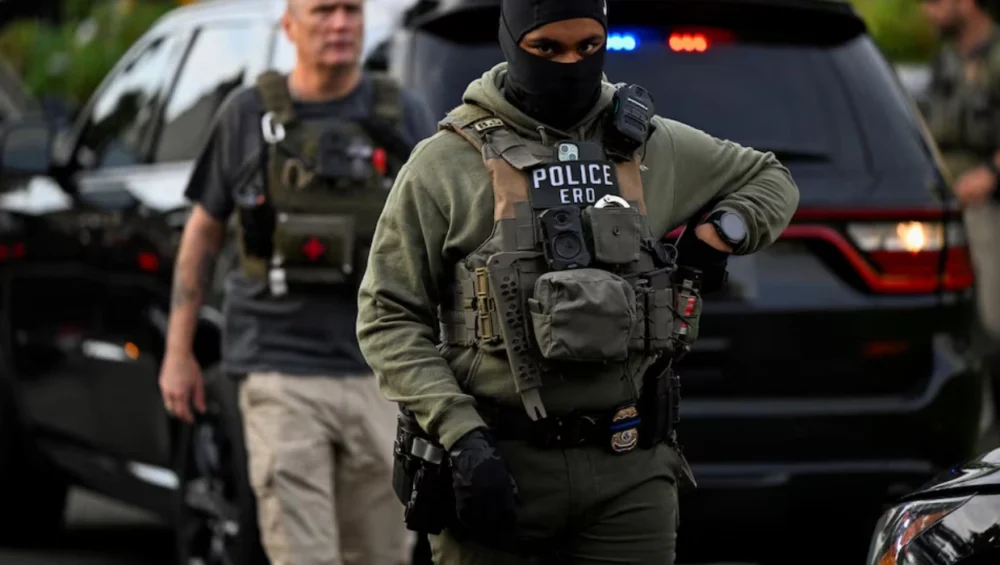
According to the manufacturer’s documentation cited by Human Rights Watch and other organizations, the gloves are designed to disrupt a person’s neuromuscular control through what the company calls “neuro‑peripheral interference.” In practice, that means an officer can press the glove against a detainee’s skin and trigger a shock intended to quickly overcome resistance. ICE says the devices will be issued to officers in Homeland Security Investigations (HSI) and Enforcement and Removal Operations (ERO) for use during arrests, detainee transports, and disturbances around detention facilities.
The agency’s stated rationale is that the gloves will help officers gain control quickly in “high‑tension environments” and avoid using more serious or lethal weapons when someone is “actively or passively resisting.” In ICE’s framing, the gloves are a lower‑impact alternative meant to reduce injuries to both officers and subjects.
The Contract: Numbers, Timeline, and Procurement Method
Details surrounding finances and logistics of the deal further illustrate the reasons why it is getting so much coverage. Compliant Technologies has been awarded a $16.7 million sole source contract for 6,000 pairs of shock gloves along with associated hardware and support services. Procurement has been noted on SAM.gov government system as being no-bid award that did not go through competitive tendering process. The duration of the contract will last for approximately six months, with associated delivery and support services lasting until around March 2027. If the entire sum of $16.7 million is split equally between 6,000 pairs, the estimated average price of each pair will be around $2,780, but the overall price includes training and maintenance services, so the hardware cost of each glove will be somewhat lower. The fact that ICE chose to award sole-source contract itself is a matter of controversy. Critics believe that such valuable and controversial procurement of a pain-compliance device should have been put to more careful examination and bidding.
A Pattern of Escalation in Immigration Enforcement
In terms of the purchase of the shock glove by ICE, the incident cannot be considered without taking into account the broader context of how immigration enforcement has been carried out since the election of President Trump. Following the return of the president to the White House in 2025, there has been an increased use of raiding, arrests, and deportations, often employing an intimidating attitude toward migrants and migrant communities. Civil liberties organizations and watchdogs have found evidence of increased confrontation, the use of force during operations, and the number of deaths among immigrants who have been detained by ICE. Prior to this, there were two cases of fatal shootings of U.S. citizens by ICE officers in the state of Minnesota; both events led to an investigation of the use of force policies in 2026. Moreover, in 2017 over 50 immigrants have died in ICE custody since the presidency of Donald Trump, according to civil liberties organizations and media sources.
Human Rights Alarms: From ACLU to UN Experts
The response from civil society and international bodies has been swift and unequivocal. The American Civil Liberties Union (ACLU) condemned the move, warning that equipping immigration agents with “a concealed means of delivering terrible pain” is
“a recipe for more harm to the public and less accountability.”
For the ACLU, the core issue is not just the physical harm the gloves can inflict, but the way they can be used out of sight, with limited oversight, in an enforcement system already under fire for excessive force.
Human Rights Watch (HRW) went further, placing the gloves in a global context of abuse. HRW noted that
“electric shock devices have long been abusively deployed around the globe, including as a method of torture and other ill‑treatment,”
and pointed out that the European Union has implemented trade restrictions on such equipment because of those risks. The organization also highlighted that the manufacturer itself advises against using the gloves on older people, small children, pregnant people, and some disabled individuals—populations that ICE has repeatedly targeted in its operations.
At the international level, the UN special rapporteur on torture issued a stark assessment in 2023, concluding that “direct contact electric shock weapons” are “inherently cruel, inhuman or degrading” and recommending that governments ban them outright. While that guidance predates the ICE contract, it now serves as a key reference point for critics who argue that the U.S. is moving in the opposite direction by institutionalizing such devices within its immigration enforcement apparatus.
Political Pushback and Oversight Concerns
In Washington, there has been a bipartisan concern regarding the contract, with it being the Democrats who have been vocal with their demands for clarifications. There has been a call for the cancellation of the contract by members of Congress due to the lack of ability to ensure proper use of the technology by the ICE officers and the possibility of use of force and misuse of such tools. The concerns were based on the general issue of lack of oversight within the agency with references to previous incidents of such cases together with the absence of information regarding the use of force. There was a question about how it was a sole-source contract with fast approval. It should be noted that the sensitivity of the procurement and its high cost required more notification to Congress and public comments. According to some Democratic senators, Congress has to inquire “urgently” into such matters.
ICE’s Defense: De‑escalation or Dangerous Expansion?
ICE and the Department of Homeland Security have defended the gloves as a de‑escalation tool, not an instrument of punishment. In their view, the gloves are meant to help officers avoid using more serious or lethal weapons when faced with resistance, particularly in confined or chaotic settings such as detention centers or during transport. Agency officials argue that the ability to quickly incapacitate a resisting individual can prevent injuries to both officers and subjects, especially in situations where traditional tactics might escalate into a physical struggle.
Yet even within that logic, critics see a troubling expansion of the force continuum. By adding a concealed, electric pain‑compliance option, ICE effectively lowers the threshold for using force, potentially making it easier for officers to resort to shocks rather than negotiation, warning, or other non‑physical tactics. Rights groups warn that in an environment where migrants and detainees already feel powerless, the presence of such devices could intensify fear, resistance, and the likelihood of confrontations spiraling out of control.
The Bigger Picture: Technology, Accountability, and Trust
Moreover, there is the question of the appropriateness of such technologies being used in immigration enforcement in general, and how to reconcile the need for officer protection with civil liberties. While on the one hand there is the argument that technological advancements can enhance safety of law enforcement officers and decrease their dependence on weapons and physical force, on the other, there is an additional layer of difficulty in training, monitoring, and accountability that comes with the introduction of new technologies, particularly those which are supposed to be discreet and difficult to identify. There is no denying that communities which are already wary of ICE raids will have even less confidence in cooperating with the authorities knowing that officers can use concealable electric shock devices.