
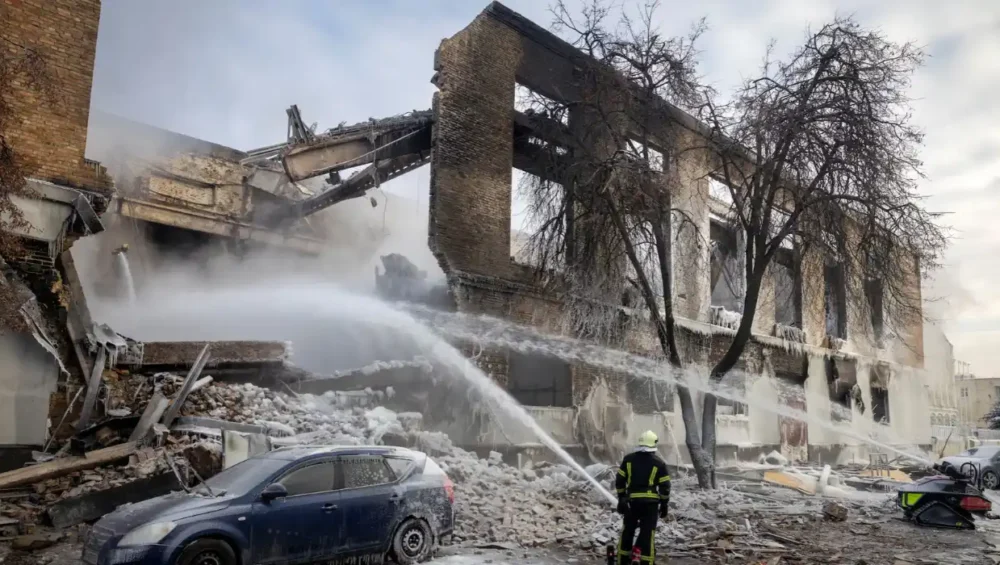
The latest escalation of Russian attacks across Ukraine has raised renewed concerns over the protection of civilians as homes, workplaces, hospitals, shops and other essential facilities continue to come under fire. According to the UN Human Rights Monitoring Mission in Ukraine, Russian forces carried out repeated attacks across the country during September, using ballistic and cruise missiles, drones and guided aerial bombs.
Between 1 and 24 September 2026, the UN Mission recorded at least 200 civilians killed and 1,234 injured across Ukraine. The figures remain preliminary and are expected to increase as verification continues. The scale and frequency of the attacks have prompted the UN human rights monitoring mission to describe the situation as a new level of intensity, with civilians repeatedly exposed to attacks in places where they live, work and obtain essential services.
The latest figures are significant not only because of the number of casualties, but because of the range of civilian locations reportedly affected. The attacks raise broader questions about civilian protection, compliance with international humanitarian law and the ability of Ukrainian communities to maintain basic services under sustained bombardment.
A New Level of Pressure on Ukrainian Civilians
The UN report describes a pattern of repeated attacks rather than isolated incidents. On 24 September, Russian forces struck a vegetable-sorting facility at a farm in Stara Hnylytsia in the Kharkiv region, killing seven civilians and injuring 12 others, according to local authorities. The victims were reportedly farm workers who were sorting vegetables when the facility was hit. The incident illustrates one of the most troubling characteristics of the current situation: civilians are being exposed to danger while carrying out ordinary activities necessary for daily life.
The UN Mission reported that other facilities damaged during the recent attacks included homes, hospitals, shopping centres, post offices, pharmaceutical facilities, food warehouses and fuel stations. Such locations are central to civilian life and economic activity, making repeated attacks particularly disruptive to communities already living under the pressures of war.
This pattern also means that the humanitarian consequences extend beyond those directly killed or injured. When a hospital is damaged, patients may lose access to treatment. When food warehouses or fuel stations are struck, supply chains can be disrupted. Damage to workplaces can deprive families of income, while attacks on residential buildings can leave civilians displaced and dependent on emergency assistance.
Kyiv Faces Repeated Attacks
The situation in Kyiv provides another indication of the growing pressure on civilians. According to the UN Mission, civilian casualties were recorded in Kyiv on 16 of the first 24 days of September. The organisation said that this frequency had not been recorded in any other month in the capital since the beginning of Russia’s full-scale invasion. Repeated drone attacks during the day have also frequently been followed by large-scale attacks overnight. For residents, this creates a form of continuous insecurity. The danger is no longer confined to occasional major strikes. Repeated attacks can affect people’s ability to travel, work, attend school, access healthcare and maintain normal family routines.
The psychological consequences are also important, although they are more difficult to quantify than deaths and injuries. Constant exposure to air-raid warnings, explosions and uncertainty can create a prolonged state of fear, particularly among children, older people and families living in areas repeatedly targeted. The frequency documented by the UN suggests that civilian protection in Kyiv is becoming a continuing challenge rather than an emergency limited to individual attack days.
Civilian Infrastructure Is Increasingly at Risk
The range of facilities affected by the attacks is particularly important from a human-rights perspective. Civilian infrastructure is not simply a collection of physical structures. Hospitals, pharmacies, food facilities, fuel stations, workplaces and postal services support rights and basic living conditions. When these facilities are damaged, the consequences can spread through an entire community.
A damaged hospital affects healthcare access. A destroyed workplace affects livelihoods. A damaged food facility can affect local supplies. Destruction of homes can force families to relocate and place additional pressure on already stretched humanitarian services. The UN Mission’s description of repeated attacks on places where civilians live, work, shop and receive essential services therefore points to a wider humanitarian concern. The cumulative effect can become greater than the immediate physical damage from any single strike.
What International Humanitarian Law Requires
International humanitarian law places clear obligations on parties to an armed conflict regarding the protection of civilians. The UN Human Rights Monitoring Mission stated that international humanitarian law prohibits attacks directed against civilians and requires parties to take all feasible precautions to protect civilians from harm. This distinction is important when assessing individual attacks.
The presence of a military objective does not remove the obligation to distinguish between military targets and civilians. Parties must also consider the foreseeable impact of an attack and take feasible measures to reduce civilian harm.
Determining whether a particular strike violated international law requires detailed investigation of the circumstances, including the intended target, available information, weapons used, precautions taken and resulting civilian harm. The UN report provides documentation of civilian casualties and damage but does not, by itself, establish that every reported incident constituted a war crime. That determination requires investigation and assessment of the specific circumstances of each attack.
The Kharkiv Attack Raises Questions About Civilian Protection
The strike on the agricultural facility in Stara Hnylytsia is particularly significant because the victims were reportedly farm workers engaged in sorting vegetables. Agricultural workers are civilians unless they are directly participating in hostilities. Their ordinary work does not make them military targets. The incident therefore reinforces the need for independent investigation into how such locations are being selected and what information was available to those responsible for the attack.
The broader pattern identified by the UN Mission also makes individual incidents part of a wider question: whether sufficient precautions are being taken to protect civilian life during increasingly frequent attacks. That question cannot be answered solely through casualty statistics. It requires examination of targeting decisions, intelligence assessments, weapon selection and the measures taken to warn or protect civilians.
Odesa Faces a Similar Pattern
The pressure is not limited to Kyiv and Kharkiv. The UN Mission reported repeated attacks in Odesa city and region, with homes, a hospital, a shopping centre and other civilian facilities damaged. Odesa has particular humanitarian and economic significance because of its position on Ukraine’s Black Sea coast. Damage to civilian facilities in the region therefore has implications extending beyond individual neighbourhoods. The continued threat to urban infrastructure can affect healthcare, commerce, transportation and the wider functioning of the region.
The repeated attacks also demonstrate the geographic breadth of the current campaign. For Ukrainian authorities, protecting civilians across multiple major population centres requires substantial air-defence and emergency-response capacity. For residents, however, the immediate issue is more basic: whether they can remain safe in homes, workplaces and public spaces.
The Humanitarian Cost Extends Beyond the Death Toll
The figure of at least 200 civilians killed and 1,234 injured during the first 24 days of September provides an important measure of the immediate human cost. But the actual humanitarian impact is considerably broader. Every civilian death affects families and communities. Every injury can create medical and financial needs that continue long after the attack itself. Displacement adds another layer.
People whose homes have been destroyed or made unsafe may need temporary accommodation, financial assistance, healthcare and psychological support. Repeated damage to civilian infrastructure can also force people to leave areas that had remained habitable despite the wider war. This creates a cumulative humanitarian burden. Even when an individual attack produces relatively limited physical destruction, repeated attacks can gradually undermine the conditions required for communities to remain stable.
Ukraine’s Counterattacks Add Another Dimension
The UN Mission also noted that Ukraine has increased attacks against the Russian Federation and that local authorities in Russia have reported growing numbers of civilian casualties. The UN described this as an escalating trend. This development is important because the protection of civilians applies throughout an armed conflict. The nationality of the victims does not determine whether they are protected under international humanitarian law. Civilians remain protected from attacks directed against them regardless of which side controls the territory in which they live.
This makes independent documentation particularly important. Accusations against one side do not eliminate the obligations of the other. Each reported attack needs to be assessed according to the applicable rules and the available evidence. The UN Mission’s documentation work therefore has significance beyond recording casualties. It contributes to establishing an evidentiary record that can potentially support future accountability processes.
Documentation Is Central to Accountability
The UN Mission says its teams regularly visit attack sites and interview victims and witnesses to document the consequences for civilians. That process is essential in a conflict where information can be contested and access to affected locations can change rapidly. Evidence gathered close to the time of an attack can help establish what happened, who was affected and what civilian infrastructure was damaged.
Documentation can also become important years later. War-crimes investigations often depend on evidence collected long before a case reaches a courtroom. Photographs, witness testimony, satellite imagery, medical records and damage assessments can all contribute to establishing the circumstances of an incident. The continued documentation of civilian harm in Ukraine therefore has significance not only for the immediate humanitarian response but also for the longer-term pursuit of accountability.
The Risk of Normalising Civilian Harm
One of the broader concerns arising from the latest UN assessment is the danger that repeated attacks become normalised. When civilians are exposed to attacks every few days, individual incidents can begin to disappear into a much larger stream of violence. Yet each destroyed home, damaged hospital and injured civilian represents a separate humanitarian event.
The frequency of attacks documented in Kyiv is particularly significant in this regard. If civilian casualties become an expected feature of everyday life, the distinction between an emergency and a permanent condition of insecurity becomes increasingly blurred. This places additional pressure on international institutions to maintain attention on civilian protection even as the conflict continues for years.
The Accountability Question
The continuing documentation of civilian casualties also raises the question of accountability. Recording an attack is only one stage. A meaningful accountability process requires investigations capable of establishing responsibility and determining whether international humanitarian law was violated. That can involve national courts, international mechanisms and other investigative institutions.
The broader issue is whether evidence gathered during the conflict will eventually lead to credible investigations and prosecutions where violations are established. Ukraine has already pursued war-crimes cases connected to the conflict, while international institutions have continued documenting alleged violations. The Washington Centre for Human Rights has previously examined the challenges involved in balancing national proceedings with international justice in Ukraine. The continuing accumulation of evidence means that the question of accountability is likely to remain central long after individual attacks have disappeared from the daily news cycle.
The Road Ahead
The latest UN assessment demonstrates that civilian protection remains one of the most urgent human-rights challenges in Ukraine. The immediate priority is reducing civilian casualties and ensuring that essential infrastructure remains available to communities facing repeated attacks. That requires effective protection measures, emergency assistance and continued humanitarian support. At the same time, independent documentation must continue.
The preliminary figures released by the UN are expected to change as additional incidents are verified. That makes sustained monitoring essential, particularly in areas where access is difficult and information is incomplete. The wider challenge is accountability. Repeated attacks on civilian areas cannot be addressed solely through emergency response after each incident. Where credible evidence indicates violations of international humanitarian law, those allegations require impartial investigation.
The September attacks have therefore become more than another chapter in Ukraine’s continuing war. They highlight the persistent vulnerability of civilians, the importance of protecting essential services and the need to preserve evidence of what happens on the ground. For the families affected, the issue is immediate and personal. For the international community, it is also a test of whether the rules designed to protect civilians during war can be meaningfully enforced when violations are documented. The continuing work of UN human-rights monitors will remain crucial in determining the scale of civilian harm and ensuring that the record of these attacks is not lost.