
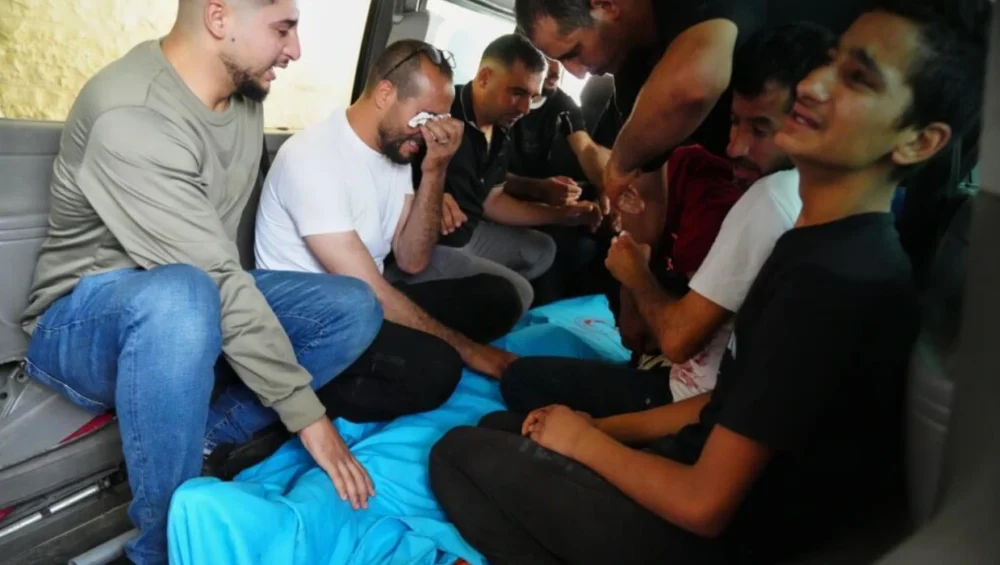
The occupied West Bank has again become the stage for lethal confrontations that lay bare the deepening cycle of violence between Israeli forces, armed settlers, and Palestinian communities. On Friday, August 21, 2026, two separate incidents—one involving a settler attack near Hebron and the other an Israeli military raid in Jenin—left two Palestinians dead and underscored the volatile security dynamics that have intensified throughout 2026. The killings, occurring within hours of each other, highlight not only the immediate human cost but also the broader political and humanitarian crisis unfolding across the territory.
Dual fatalities expose escalating tensions
The first case took place in the south of the West Bank where a 17-year-old Palestinian teen, Karim Sanad Shalaldeh, was shot to death in a clash between armed Israeli settlers. In the second case, 58-year-old Fathi Zidan Hazem, a former colonel in the Palestinian National Security Forces, was gunned down in the north at the city of Jenin during an Israeli military attack on his house. Although they took place in different regions, both cases reflect a trend that has led to a sharp increase in the number of Palestinians who have been killed in 2026.
Settler violence near Hebron: A deadly raid
The murder of Karim Sanad Shalaldeh occurred in the area of Khirbet Hamroush, which is northeast of Hebron and has long been a hotbed of tension between the settlers and Palestinians. According to the Palestinian version and reports by the official news agency Wafa, hundreds of armed settlers penetrated into the outskirts of the village, fired on its inhabitants, and burned at least one house. Shalaldeh was shot in the chest and initially was said to be in serious condition, but later he died in the hospital.
Additionally, a 70-year-old man was shot and severely injured in the attack. As the Israeli army told the story, the settlers’ intrusion into the area was unauthorized hiking, and when security officials accompanying the group came under attack from the Palestinian population, including stone throwing, the official fired. It is noted that some settlers were also injured in the encounter, although the Israeli army insists that they had to use force due to immediate threat. Palestinian authorities rejected the official version and called the whole situation a purposeful settler raid against local residents.
Jenin raid: A retired colonel’s death
The second casualty took place in Jenin, which is situated in the northern part of the West Bank, during the Israeli military raid in the early hours of the morning. Fifty-eight year old Fathi Zidan Hazem was shot dead in his house while Israeli soldiers were attempting to arrest him. His death was confirmed by the Palestinian Health Ministry due to the gunshot wound and they added that his body was detained by the Israeli army, which caused outrage in human rights groups.
The Israeli military announced that Fathi Zidan Hazem was “a terrorist armed with a knife” who tried to stab an Israeli soldier during the operation. The IDF claimed that after the attempt they had to use fire and shoot him to death without any injuries on the Israeli side. Nevertheless, according to the eyewitness of AFP news agency who was present at the scene, soldiers ordered Hazem to raise his hands before he stabbed a soldier with a knife and was shot several times in front of his 10-year-old son.
Competing narratives and the struggle for truth
The divergent accounts of both incidents reflect the broader challenge of establishing an objective narrative in a conflict zone where information is often contested. Israeli authorities typically frame their actions as necessary responses to security threats, while Palestinian officials and eyewitnesses emphasize the disproportionate use of force and the impact on civilian populations. These competing narratives not only shape public perception but also influence international responses and diplomatic efforts.
In the case of Shalaldeh’s death, the IDF’s characterization of the settlers’ presence as “unauthorized” raises questions about the extent to which such actions are condoned or controlled by Israeli authorities. Meanwhile, the withholding of Hazem’s body has been condemned by Palestinian leaders as a violation of international humanitarian law, which stipulates that the deceased should be returned to their families for burial.
A year of unprecedented violence
The August 21 killings occurred against the backdrop of a dramatic escalation in West Bank violence throughout 2026. UN officials have warned that the territory is “at the breaking point,” with settler violence reaching “unprecedented levels.” More than 1,430 settler-violence incidents have been documented this year, affecting approximately 260 Palestinian communities. The UN special rapporteur Francesca Albanese went further, describing the Israeli military as “the MOST IMMORAL ARMY” in a social media post that cited ongoing sieges and casualties in both Gaza and the West Bank.
This has been proven by statistics. According to the Palestinian figures, about 1,099 Palestinians have been killed by Israeli soldiers or settlers in the West Bank after the outbreak of the Gaza War in October 2023. In 2026, the Palestinian Colonization and Wall Resistance Commission documented the killing of at least 25 Palestinians by Israeli occupiers in the West Bank, which was the highest number since it started keeping record in 2019. As for the UN figures, 76 Palestinians have been killed in the West Bank this year, 18 of whom were minors.
International condemnation and diplomatic responses
The international community has reacted with mounting concern about the increased violence and settlement activity. Countries from Europe, such as the United Kingdom, France, Germany, Italy, the Netherlands, Canada, and Norway, denounced the construction plans for the new E1 settlement that includes over 1,200 housing units as “unacceptable” in terms of breaching the contiguity of Palestinian territory.
According to Human Rights Watch, the violence committed by settlers under state backing has resulted in at least partial displacement of 107 Palestinian communities in the occupied West Bank since January 2023. The officials of the UN expressed their concerns about holding accountable and exercising restraint since this situation is expected to lead to additional instability in the area. The UN special coordinator for the Middle East peace process has stated that the current situation can cause chaos in the West Bank that will prevent any future talks on peace.
The human cost of political failure
The numbers and diplomatic talk are only part of the story behind the very real human toll paid during a decades-long war. The murders of Shalaldeh and Hazem are but two of many instances in a history of violence that has taken countless lives and disturbed even more. To families living in the West Bank, the threat of harassment from settlers and military forces is an ever-present reality in their daily lives. In Sa’ir, the local community laments the loss of a young man who died needlessly during an altercation. The Jenin community laments the loss of a retired officer and father who has been violently murdered. This loss of human lives is further aggravated by the larger humanitarian crisis in the form of displacement, poverty, and limited access to basic necessities.