
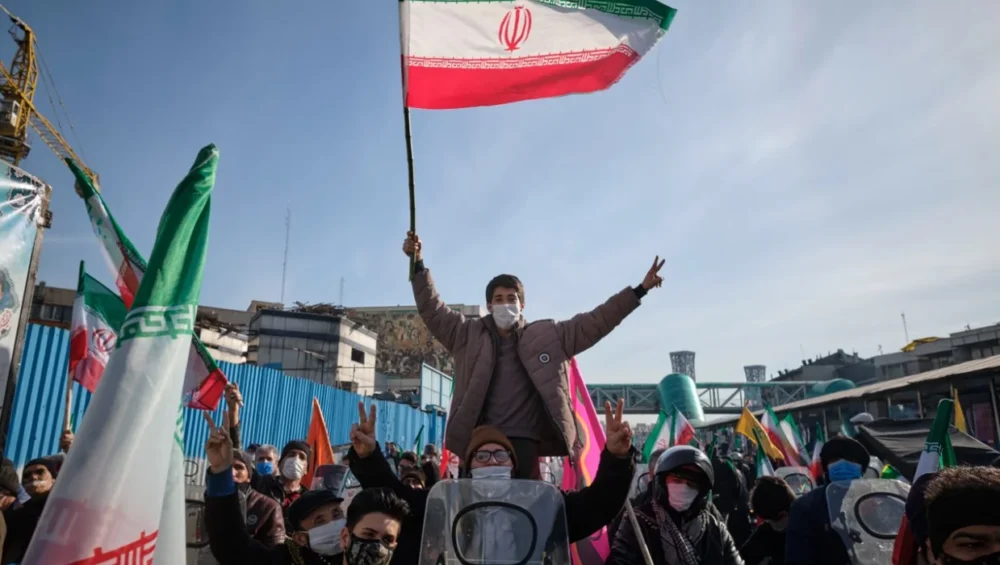
An Iranian youth protester is days away from having a death sentence carry out, as human rights organizations have warned that this could be a menacing portent of a new wave of oppression that Tehran has been resorting to regarding the ever- brazen defiance by the populace of clerical rule. The youth, a demonstrator, has been condemned for a series of offenses that carry the ultimate punishment.
A 26-year-old Iranian named Erfan Soltani, who lives in the town of Fardis, just west of Tehran, faces execution on Wednesday in connection with his activities in the recent protests, according to several human rights groups. Should he be executed, he would be the first person to be convicted and sentenced to death while participating in the recent wave of protests.
Soltani was arrested in his own home mere six days ago, and has now sped through the murky judicial system in Iran. According to the Hengaw Organisation for Human Rights, the execution was only communicated to his family members on Monday, leaving little to no time for appeals & international intervention in the process. Nothing seems to have been communicated with regards to the charges he was accused of, and he has also not been allowed access to his legal file, as well as access by his sister, who is also a legal professional.
This pattern of secrecy is not incidental. It reflects what rights groups describe as a deliberate strategy by the Islamic Republic to weaponise its judiciary as an instrument of political repression. Iran’s Revolutionary Courts, notorious for summary trials and near-automatic convictions, have reportedly been placed on emergency footing to fast-track cases linked to the protests.
Iran Human Rights (IHRNGO), based in Oslo, warned that the regime is deliberately seeking to “deal with protesters swiftly and severely” to instil fear and deter further demonstrations. According to sources close to Soltani’s family, he was denied access to legal counsel and may not have been granted a trial at all—raising serious concerns that his death sentence is a foregone conclusion rather than the outcome of due process.
Many instances of protest are prosecuted under loosely defined crimes such as “enmity against God” and “corruption on earth,” which are considered to be crimes that require the mandatory execution of the death penalty. International criminal lawyers have long pointed to the illegality of such crimes when measured against the standards of the universality of legality and the proportionality of punishment contained in the Universal Declaration of Human Rights.
“The widespread killing of civilian protesters in recent days by the Islamic Republic is reminiscent of the regime’s crimes in the 1980s,”
said Mahmood Amiry-Moghaddam, director of IHRNGO, referring to the mass executions of political prisoners that have since been recognised by UN experts as crimes against humanity.
“The international community has a duty to protect civilian protesters against mass killing.”
The analogy is anything but figurative. Back in 1988, Iran administered a secret mass hanging to execute about 30,000 political prisoners after a superficial questioning. Most of the perpetrators who committed the acts have become top leaders in the regime, establishing a code of impunity that remains in place to date.
This current suppression of these protests has already resulted in the deaths of hundreds of people. Although there are claims from the Iranian government that 2,000 people have already been killed in the last two weeks of protests, it is difficult to verify this information due to the complete internet shutdown throughout the country. This complete shutdown of the internet has inhibited any connection to the outside world by the use of social sites and private news sources.
According to the US-based Human Rights Activists News Agency (HRANA), at least 646 people were killed during the course of the unrest over a period of 16 days, including the death of 505 protesters. However, at least 133 members of the Iranian security forces were also killed during this period. Human rights groups emphasize the fact that the numbers may be only a fraction of the truth because of the difficulties involved in acquiring accurate information.
In addition to the deaths, the sheer scope of repression is staggering. HRANA reports that over 30,000 arrests have been made since the beginning of the protests, with many being held incommunicado. Former detainees have described mass torture sessions, including beatings, electric shocks, stress positions, and rape, especially directed at females and minors.
Despite mounting evidence of systemic abuse, Iranian authorities have doubled down, framing protesters as foreign-backed “rioters” and “terrorists.” State media has aired forced confessions widely believed to have been extracted under torture, a tactic routinely used by the regime to justify harsh sentences and discredit dissent.
International reaction has grown sharper. German Chancellor Friedrich Merz said on Tuesday that the world may be witnessing “the final days and weeks” of the current government.
“When a regime can only maintain power through violence, then it is effectively at its end,”
he said.
“The population is now rising up against this regime.”
The United States has also signalled a tougher stance. President Donald Trump has threatened to impose 25 per cent tariffs on Iran’s trading partners in an effort to further isolate Tehran economically, though the policy has yet to receive Supreme Court approval. The European Union is reportedly considering additional sanctions targeting senior judicial officials, prison authorities, and commanders of the Islamic Revolutionary Guard Corps (IRGC).
However, critics argue that international responses remain inadequate given the scale of abuses. Previous sanctions and condemnations have failed to deter Iran’s use of lethal force against its own population, raising questions about whether stronger measures—such as coordinated diplomatic isolation, UN-mandated investigations, or universal jurisdiction prosecutions—are necessary.
The impending execution of Erfan Soltani has become a symbol of this broader failure. Rights groups warn that if the execution proceeds without consequences, it could open the door to dozens or even hundreds of similar death sentences as the regime seeks to crush dissent through terror.
For many Iranians, the message from the authorities is unmistakable: protest will be met not with reform, but with bullets, prisons, and gallows. Whether the international community is willing—or able—to prevent another chapter of mass atrocities remains an open and urgent question.