
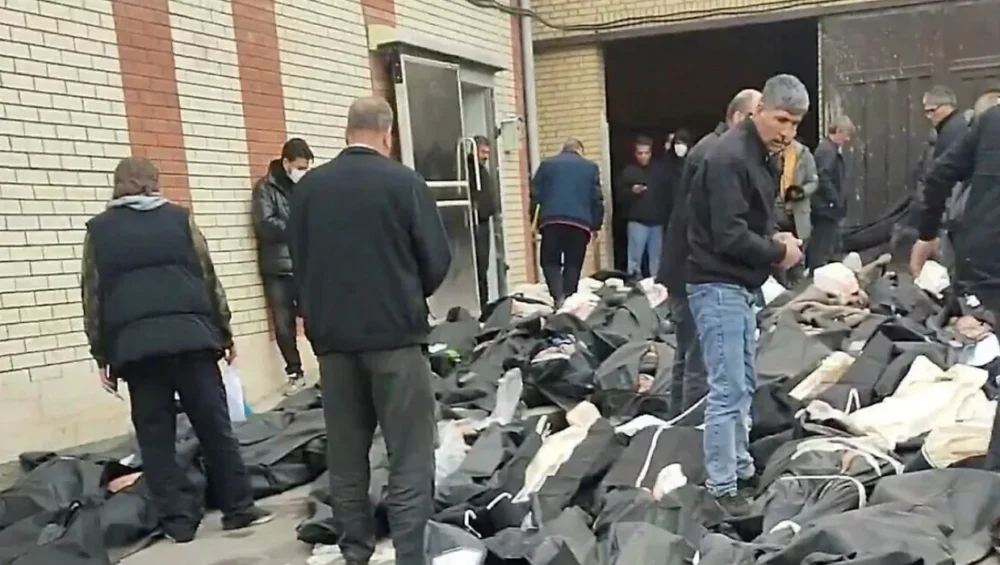
Unverified estimates of protest-related deaths in Iran have circulated widely since the January 8–10 crackdown, shaping global public opinion in ways that extend far beyond Iran itself. These figures have not only fueled calls for foreign military intervention but have also been deployed—often implicitly—to relativize and downplay the ongoing genocide in Gaza.
At the center of the controversy lies a vast discrepancy in reported casualties. Iranian authorities have stated that 3,117 people were killed, including civilians and members of the security forces. External estimates, however, range from roughly 5,000 to as high as 36,500 deaths.
A Death Toll with No Agreed Reality
This extraordinary spread reflects genuine difficulties in verification, but it also exposes how casualty figures can be politicized. Rather than converging toward a credible range, reporting has increasingly resembled a competition—what might be called a “death toll Olympics”—in which higher numbers gain more attention, urgency, and political utility.
Iran-focused human rights organizations, many led by dissident activists, have undertaken extensive documentation efforts. The U.S.-based Human Rights Activists News Agency (HRANA) has reported more than 6,000 confirmed deaths, with over 17,000 additional cases under review.
While such efforts are essential, the speed at which figures have risen raises methodological concerns.
Why Verification Takes Time
Each reported death must be verified through multiple steps: confirming identities, eliminating duplicate reports, cross-checking dates and locations, and establishing cause and circumstances of death. Visual evidence must be geolocated, authenticated, and corroborated by multiple sources.
From an investigative standpoint, death counts that grow rapidly on a daily basis—without transparent documentation—require caution. This is especially true given Iran’s severe internet restrictions, which further complicate independent verification.
The UN’s Cautious Assessment
The UN Special Rapporteur on Iran, Mai Sato, has cited a conservative estimate of approximately 5,000 deaths. She has also acknowledged receiving unverified reports from medical sources suggesting figures as high as 20,000.
Her position reflects a key distinction often lost in media reporting: acknowledging the existence of higher claims is not the same as endorsing them.
Media Amplification Without Evidence
Despite these uncertainties, major Western media outlets have published dramatically higher figures based on anonymous and unverifiable sources.
On January 25, the UK-based channel Iran International claimed that 36,500 people had been killed, citing unnamed security sources. The outlet provided no documents or methodology to support the claim.
The same day, Time magazine ran a headline suggesting deaths could exceed 30,000, citing two unnamed Iranian health officials. The article itself admitted that the figure could not be independently verified.
Two days later, The Guardian published a piece referencing “30,000 dead,” based largely on the testimony of an anonymous doctor who reportedly hesitated to provide any firm estimate.
In each case, editorial caution within the articles failed to restrain the headlines.
Partisan Sources and Political Agendas
Other outlets, including the Sunday Times and Piers Morgan’s television show, have relied on figures circulated by Amir Parasta, a Germany-based ophthalmologist who claims death tolls ranging from 16,500 to 33,000.
Parasta’s estimates rely on questionable extrapolation methods and are inseparable from his open affiliation with Reza Pahlavi, son of Iran’s deposed shah. Pahlavi’s political camp has been linked to extensive social media manipulation campaigns, as documented by Haaretz and the University of Toronto’s Citizen Lab.
In this context, such figures cannot be treated as neutral human rights documentation, but rather as partisan claims.
How Disinformation Multiplies
Once extreme figures appeared in major headlines, they were quickly recycled by other outlets citing those reports as primary sources. Activists and Western politicians then amplified them to advance political objectives, accelerating a feedback loop of misinformation across social media.
This process transformed uncertainty into assumed fact—and helped institutionalize the “death toll Olympics.”
Manufacturing Consent for War
The inflated casualty figures have served two principal political functions.
First, they have contributed to manufacturing public consent for foreign military intervention. During the protests, U.S. President Donald Trump repeatedly threatened military action against Iran if repression continued. Since then, U.S. military deployments around Iran have increased, intensifying fears of escalation.
Large, unverified death tolls create moral urgency—but when unsupported, they also risk being instrumentalized to justify war.
Relativizing the Genocide in Gaza
Second, the focus on speculative Iranian death tolls has been used by pro-Israel politicians and commentators to relativize Israel’s mass killing of Palestinians in Gaza. By juxtaposing unverified Iranian figures with well-documented Palestinian casualties, the scale and reality of the Gaza genocide are rhetorically diluted.
In this sense, inflated numbers become tools not of justice, but of deflection.
Iran’s Response and the Limits of Transparency
Under growing pressure, Iran’s President Masoud Pezeshkian ordered authorities to publish the names and personal details of those killed. His communications director announced the creation of a mechanism to examine and resolve conflicting claims.
Whether this process will be transparent or credible remains uncertain. What is beyond dispute is that thousands were killed—primarily by Iranian security forces—during a multi-day crackdown marked by brutal crowd control tactics.
Accountability Requires Accuracy
Structural opacity and restricted access for independent investigators mean the exact death toll may never be known. But greater transparency would increase the likelihood of accountability for those responsible.
A rigorous, methodical verification process is essential—not only to honor the dead, but also to prevent the manipulation of human suffering for geopolitical ends.
In this light, the “death toll Olympics” represents a profound disservice to victims—from Iran to Palestine—whose lives should never be reduced to numbers in a propaganda war.