
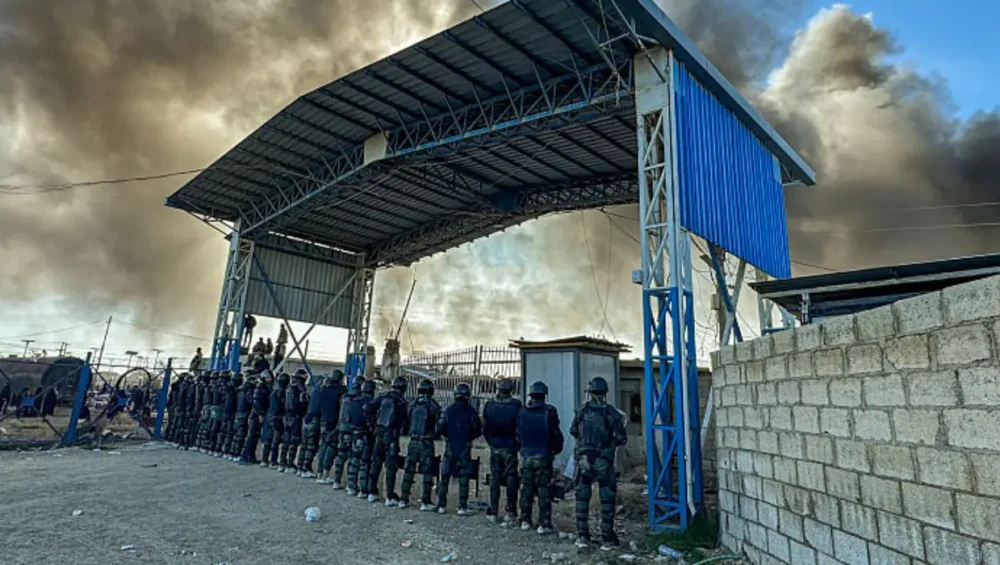
The uptick in conflict in north-east Syria once again underscores the vulnerability of civilian protection, the IS question, and the inadequacy of a human-rights-based approach to detention, displacement, and governance. The change of hands in governance of parts of north-east Syria, as well as detention centers of individuals associated with IS, does not terminate but rather heightens concerns about wrongful detention, exploitation, and immunity.
Since the fall of the prior regime of Bashar al-Assad in December 2024, the Kurdish-dominated Syrian Democratic Forces (SDF) remained in possession of large swathes of Syria’s north-east, where key detention centers and camps containing tens of thousands of people affiliates—erroneously or loosely—of the Islamic State Extremists are located. Yet, tensions arose quite rapidly in late 2025 and early 2026 between the SDF and the newly created Syrian authority. It is observable that these tensions manifested quite violently.
Between December 2025 and January 2026, conflict between government soldiers and SDF members in Aleppo City left at least 20 civilians dead or wounded, based on reports from monitoring groups in the region. The numbers likely are not reflective of actual figures, as inaccessibility and instability have over the years been accountable for underreporting of such incidents. The destruction of civilian infrastructure, such as housing and vital services, also aggravated existing humanitarian needs.
There seemed to be an opening for intervention when a new political window was created in mid-January 2026, with Syrian President Ahmed Al Sharaa issuing decree No. 13 of 2026, committing his government to protecting the rights of the Kurds. This was reinforced when, just days later, on 18 January, the Syrian government publicized an agreement with SDF leader Mazloum Abdi regarding civilian governance, border crossings, integration, and most pertinent, the transfer of government power for the IS detentions. This was to be a move towards Syrian unity.
However, the agreement was broken just 24 hours later. On the 19th of January, the hostilities were revived, reflecting the poor trust between the two sides and the lack of any guarantee of the safety of civilians and prisoners. According to the United Nations, the conflict resulted in the displacement of about 11,000 people to Qamishli City in the Al Hassake Governorate. Although there was a four-day ceasefire on the 20th of January, there were worries about the sustainable nature of this ceasefire following reports of sporadic clashes.
On that very same day, it was announced that the authorities in Syria took control of several detention centers and al-Hol, one of the most notorious camps in that part of the region. The rest of these detention centers remained in the hands of the Autonomous Administration of North and East Syria (AANES).
This fragmentation is considered worrying, especially in consideration of the massive detention problem. In 2024, Amnesty International noted that tens of thousands of individuals, both males and females, including children, are currently being held in detention camps in north-east Syria. For instance, the number of individuals housed at the Al Hol camp alone exceeds 40,000 individuals, the majority being women and children below the age of 12. In addition, the detainees are comprised of Syrians and Iraqis, not to mention individuals from 60+ countries who are considered to be stateless.
Most importantly, the persons held do not comprise a homogenous group of IS criminals. Instead, they comprise individuals victimized by the actions of IS, those victimized by human trafficking rings, forcibly conscripted children, and those held solely on the basis of familial or supposed group affiliations. Amnesty International and UN organizations have already pointed out the conditions of prolonged arbitrary detention without due process, limited legal representation, and substandard living situations such as the lack of proper health care, malnutrition, and violence within the detention camps.
Some of those held include hundreds of possible abducted persons of Yezidi descent, who were abducted by IS during their genocidal campaign of 2014, and others belonging to various ethnicities. Their detention, usually without identification, support, and integration, is of major concern under international humanitarian, human rights, and criminal laws.
In addition, in the year 2025, an international body called Amnesty International called upon the Syrian government, autonomous administrations, the US-led coalition, and the United Nations to develop urgent and sustainable measures aimed at providing solutions for the ongoing crisis. In other words, these include fair and individualized adjudicative procedures for Syrians, repatriation for foreign nationals, rehabilitation and integration for others, and accountability for crimes committed by the Islamic State. Yet, political and military events have continued to add complexity to an already desolate crisis.
Thus, as control over these detention sites changes hands, it is not merely a potential bureaucratic tangle but also, in reality, a risk of systemic abuse. Moreover, it seems as though civilians are likely to continue to be victims of political posturing and unresolved conflict over governance.
The picture from North East Syria is evidence of another universal truth – that stability is not secured through military accommodations and political arrangements that compromise human rights and international laws. The context for stability, management of integration of forces, or management of prisons is going to involve protecting civilians, upholding justice, and holding people accountable. The lack of this will not merely extend suffering but will plant further grounds for further wars of radicalism.