
One of the most violent episodes of ethnic violence in the region took place in a village called Bogoro in the Ituri province of the eastern Democratic Republic of Congo. Ituri (FRPI) militia, as well as their allies, targeted Hema civilians. Over 200 individuals lost their lives and most of the victims were women, children and the elderly. Houses were used to set fire and loot as well as sexual violence was a rampant issue.
The massacre was a part of a larger trend of war between Hema and Lendu groups on grounds of land ownership and political marginalization and disintegration of armed groups. Ituri then was a mosaic of militias in their quest to dominate territories and economies frequently with the assistance of regional actors. The demolition of Bogoro was symbolic of the weakness of civilian enclaves in militia controlled areas.
The nature and magnitude of the crimes would subsequently put Bogoro in the centre of the international legal action, which is to become one of the most far-reaching reparations proceedings in the annals of the International Criminal Court.
The Katanga case before the ICC
One of the earliest situations to be investigated by the ICC before was the Ituri situation in 2004, when the Congolese government submitted it to the ICC. Some of the accused included the FRPI commander known as Germain Katanga. The prosecutors made allegations about him having been at the core of the Bogoro attack by providing weapons and organizing militia troops.
Katanga was found guilty in 2014 by Trial Chamber II of one crime against humanity and four war crimes, as an accessory. He was placed on 12 years in prison, which was later released on credit in 2016. The ruling defined criteria of liability of accessories in direct accordance with Article 25(3)(a) of the Rome Statute, and asserted that indirect assistance to atrocities could be subject to criminal liability.
What the ruling did was not just to punish. It has brought the possibility of a full-scale restitution procedure to the victims and the responsibility of the victims would not be restricted to prison.
Victim participation and legal precedent
In the Katanga proceedings, over 300 victims acted in the proceedings with the help of legal representatives. Their role became one of the hallmarks of ICC practice: the fact that the victims are regarded as active participants of the process and are not just observers.
The court practice of separating Katanga case with his co-accused made the emphasis on the crimes against Bogoro simpler. The strategy of using the judiciary helped create a deeper evidentiary record that enhanced the foundation of following reparations orders.
Trust Fund for Victims and the path to reparations
The ICC reparations scheme is in collaboration with the Trust Fund of Victims (TFV). Article 75 of the Rome Statute provides that the court can direct the issuance of reparations and the TFV does this through individual and collective programs.
Katanga used a mixture of symbolic and material measures by way of reparations. There are hundreds of beneficiaries who were assisted in terms of healthcare, housing assistance, income-generating activities and psychological counseling. In January 2025, the ICC reported that full reparations delivery was completed in the case and it was one of the first complete closures in the history of the court.
The independent assessments in 2025 were also found to show that beneficiary satisfaction in Ituri was high, but the challenges still existed because of new insecurity. The TFV also spearheaded more trauma-support programs because gaps were also identified in the previous program reviews.
The monument of Bogoro became the ultimate symbolic act in the reparation architecture on a grander scale.
Monument inauguration amid renewed instability
The inauguration of the monument was originally scheduled as 2025 but was delayed by spillover violence in Ituri caused by North Kivu. The use of armed group activity, such as the works of CODECO militia, made it harder to plan logistics and security.
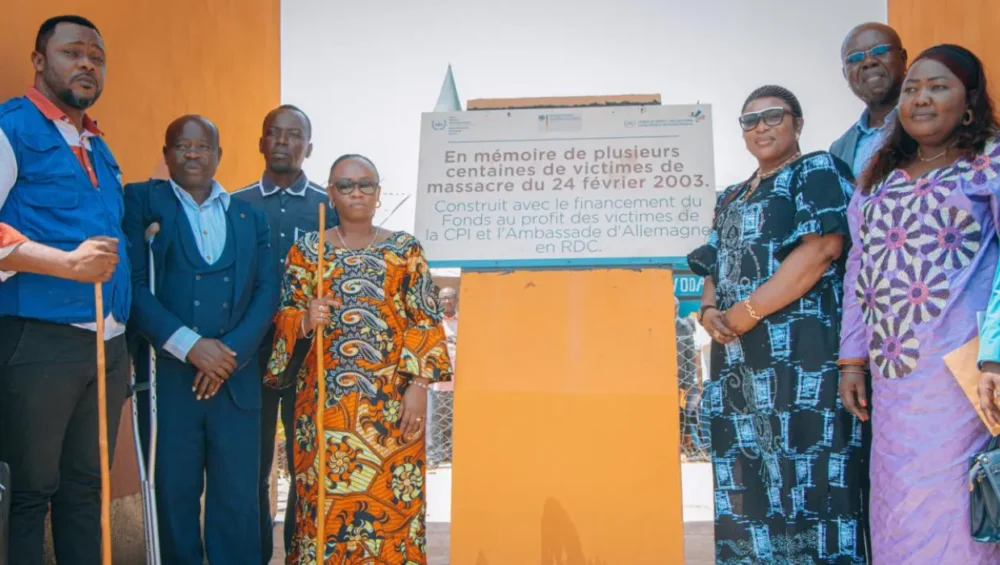
The monument was eventually unveiled in Bogoro on February 24, 2026, 23 years after the massacre took place. The structure was built with the direct involvement of the survivors and local leaders and thus, the structure comprises community-based memory as opposed to foreign imposition of symbols.
Financial support was provided by the TFV, the community of Bogoro people, and the government of Germany, the embassy of which stressed the need of remembrance as the means of preventing the repeated occurrence. German officials defined memory as a process that is continuing and their assistance is associated with the wider commitments to international justice.
Symbolism and survivor voice
To survivors the monument is the realization of recognition as well as commemoration. Henriette, who is a beneficiary of the reparations program, spoke of it as a historical monument which helps the community to build peace and co-existence. Her statements are dualistic: they are aimed at celebrating the dead and building up reconciliation.
In the ceremony, the TFV Board Chair, Andres Parmas, said that the location would act as a constant reminder of responsibility and no reiteration. The language reflected changing priorities of the ICC towards restorative aspects of justice.
Legal and policy implications in 2025–2026
The case of Bogoro monument ICC reparations process strengthens the pillar of reparations of the Rome Statute. The previous cases of ICC have also placed liability; the case of Katanga shows that there has been operational follow-through.
In 2025, Trial Chamber II officially recognized the reparations are finished and complimented the resilience of the victims. The ruling highlighted cooperation between states and voluntary donations as being essential facilitators. However, it also brought to the fore the structural constraints such as core budget constraints that put constraints on the capacity of the TFV.
The case has become a reference point as far as the current reparations in other ICC cases, such as Mali and Georgia are concerned. The participative design model that was tested in Bogoro has been used in guiding consultations in later proceedings.
Funding sustainability and diplomatic dynamics
The financial assistance of Germany is an indication of an overall tendency of bilateral support to ICC reparations. Other European countries added voluntary contributions in 2025, but it is estimated that in 2026 the overall programming in the DRC will be an estimated 40 percent short of financing.
In early 2026, the briefings of the United Nations Security Council mentioned Bogoro as a stabilizing movement in the volatile environment of eastern Congo. Policymakers are increasingly thinking of reparations and memorialization as a supplement to peacekeeping transitions as MONUSCO makes plans to phased drawdowns.
The nexus between diplomacy, donor interests, and judicial mandate is still one of the distinguishing characteristics of ICC reparative activity.
Reparations in a volatile regional context
Ituri still has periodic violence even though the progress is symbolic. The use of local grievances is being exploited by armed groups following the precedents of 2003. The fact that CODECO militias re-emerged in 2025 highlights how conflict is a cyclic process.
The need to implement reparations has hence necessitated flexible logistics. Security arrangements have been organized at national levels to secure the delivery sites of such programs and hybrid national-ICC strategies are designed to localize ownership.
The monument is located in this disputable landscape, and its functioning is that of the memory site and civic space.
Community reintegration and youth engagement
The grounds around the monument have now been turned into vocational training programs that are financed by the TFV. Programs are aimed at displaced youth and survivors, where symbolic redress is associated with socioeconomic reintegration.
The monument is part of intercommunal dialogue sessions by local leaders. The effort to instill the memory in the normal operation of civic life aims to undermine the discourses of ethnic mobilization that continue to play out in Ituri in some areas.
Such integration illustrates a broader transitional justice strategy: combining memory, material support, and forward-looking prevention.
A milestone with broader resonance
The Bogoro monument ICC reparations milestone signals a maturation of international criminal justice practice. It demonstrates that accountability mechanisms can extend beyond verdicts to tangible, community-shaped outcomes.
At the same time, the initiative reveals structural tensions. Voluntary funding, security volatility, and the scale of unmet victim needs across Congo test the sustainability of individualized models. Thousands affected by other massacres in Ituri and beyond remain outside completed reparations frameworks.
Yet Bogoro’s experience offers a template. It suggests that participatory memorialization, anchored in judicial findings and supported by international cooperation, can foster localized ownership even amid instability.
As eastern Congo navigates overlapping crises in 2026, the monument’s presence raises a broader question: whether sustained investment in victim-centered justice can gradually recalibrate cycles of grievance and retaliation. If Bogoro’s commemorative space endures as a forum for dialogue rather than division, its significance may extend well beyond a single case, shaping how transitional justice adapts to conflicts that refuse to remain in the past.