
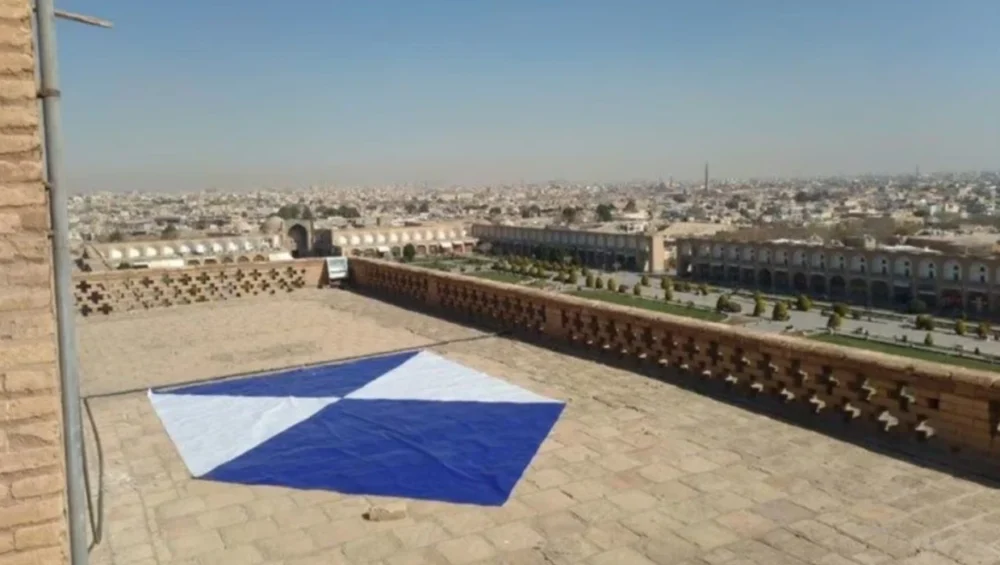
The renewed concern over the international regulations of cultural heritage in war, triggered by airstrikes connected to the developing confrontation between Iran, Israel, and the United States. Iran started affixing museums, monuments and historic complexes with the Blue Shield Emblems, which is a symbol created by the 1954 Hague Convention on Cultural Property in the Event of an Armed Conflict.
It is said that over 120 cultural sites were equipped with the unique blue and white shields after the eruption of hostilities at the end of February 2026. The marking is meant to communicate to the military planners and pilots that the buildings are identified heritage sites and not military targets. The relocation is indicative of increasing apprehension concerning collateral harm on historically important places as regional strikes escalate.
Emergence of the Blue Shield protection framework
The Blue Shield symbol acts as a protective signifier, which is similar in the aim of the humanitarian symbol by the International Committee of the Red Cross. In the Hague Convention, the icon is used to name those monuments, museums, libraries, and archives that are of cultural relevance to mankind.
The ratifying countries undertake a commitment to not attack such sites except in case of a clear imperative military necessity. The framework was created as the result of World War II, when many heritage sites were destroyed, and the international community decided to make legal protection codified.
Immediate deployment across Iranian provinces
Iranian cultural authorities moved rapidly after the first wave of strikes. The emblems were placed on the roof and the front of the buildings in the different areas by provincial offices of the Iranian Cultural Heritage, Handicrafts and Tourism Organization.
The officials affirmed installations in historic centers including Naqsh-e Jahan Square, which is one of the largest public squares of the Safavid epoch, and at the Jameh Mosque of Isfahan. Mausoleums, museums and archaeological sites were also marked in such provinces as Fars, Kerman, and East Azerbaijan.
Legal framework governing cultural property in wartime
The ruling to have Blue Shield Emblems shows not only a defensive gesture but another legal message to the international institutions as well. In violation of the Hague Convention, intentional destruction of cultural property may be a violation of the international humanitarian law.
The treaty extends to both parties of the ongoing confrontation given that the United States and Israel are signatories to the treaty together with Iran. This common legal obligation implies that the safeguards should be applicable irrespective of political affiliation in the war.
Treaty obligations and wartime conduct
The convention has article provisions that specify that the military forces must respect the cultural property by not engaging in acts that are hostile to the guarded sites. The regulations also prohibit that monuments or museums should be used by the military which may convert them into legitimate targets.
These commitments have become the new focus when the air campaigns become more dependent on long-range missiles and drones. The high accuracy of the weapons in recent times theoretically makes collateral damage less likely, but the high concentration of the population in cities and historical areas still poses a threat of operational risk.
War crimes standards under international law
The Hague Convention is not the only place of legal responsibility for cultural destruction. Intentional attacks on cultural and religious monuments are treated as possible war crimes by the Rome Statute of the International Criminal Court.
The prosecutors need to prove that a secured site was either targeted deliberately or accidentally hit when it was identified. As a matter of fact, the intent can be difficult to prove, especially when the damage is caused by the military strikes around the target and not the direct attack.
Damage reports and documentation efforts
Initial reports by Iranian officials suggest that some of their heritage sites have been affected by the blast of some strikes nearby. The damage of shrapnel in the Golestan Palace was one of the most notable cases of the same, as explosions were recorded in the nearby vicinities.
The palace complex is one of the most important examples of the architecture and rules of Qajar Iran, which is situated in the center of Tehran. Officials of the culture have also reported that there is damage to the exterior parts but the main structures have not been destroyed.
Heritage monitoring and evidence collection
The officials in the Iranian heritage have already started capturing damage in photographs, structure survey, and satellite images. It is anticipated that the information will justify the possible grievances presented to the international organizations such as UNESCO.
These documentation procedures are based on the practices that were worked out during previous wars in which the destruction of heritage was researched as a potential source of the war crime. Forensic evidence that may be collected by preservation experts includes the pattern of shrapnel and blast trajectories to identify the cause of damage.
Digital mapping and geolocation tools
Iranian officials have also mapped Blue Shield locations with the help of digital platforms and geospatial databases. With mapping tools and the use of site coordinates, the officials expect to make sure that military planners around the world can locate the position of protected monuments.
This approach is a manifestation of the changes in technologies of heritage protection. In the last ten years, the international organizations have been heavily relying on satellite images and open-source maps to monitor the destruction of historic sites in the Middle East during the conflicts.
International organizations respond to heritage risks
A number of global cultural organizations have been complaining of the risks to Iranian heritage following the current hostilities. The heritage groups say that monuments are not national assets only, but symbols of the common human past.
The Blue Shield International encouraged all fighters to adhere to the Hague Convention and prevent military interventions that may threaten the old architectural buildings. The group also demanded that the coordination of activities between armed forces and cultural experts be done when conducting operations in and around heritage areas.
Calls for precautionary military planning
The experts in the protection of cultural heritage allege that the destruction of heritage is a common problem when the military planners do not have the correct maps of the heritage sites. Such risks can be minimized by coordination of activities of defense institutions and cultural authorities.
These have been advocated by organizations such as the International Federation of Library Associations and Institutions which believe that the Blue Shield appeal is the right step to take as archives, museums and libraries are storing invaluable historic materials.
Lessons from recent conflicts
The arguments on the heritage protection have heated up following the loss of historic monuments in wars in the Middle East in the last ten years. Destruction of archaeological sites in previous wars in Syria and Iraq showed that cultural property is prone to destruction in case of military conflicts.
UNESCO later extended the monitoring programs in 2025 to monitor the destruction of heritage in conflict areas across the world. The organization indicated a considerable rise in the number of incidents involving historic structures, which also demonstrates the relevance of preventative actions.
Strategic symbolism and diplomatic implications
The widespread use of Blue Shield Emblems in Iran carries symbolic weight beyond their immediate protective purpose. Marking heritage sites publicly underscores the expectation that military forces will respect international legal norms.
At the same time, the markings create a potential evidentiary trail should disputes arise about responsibility for damage. If a clearly marked monument suffers a direct strike, investigators can examine whether the attack violated established protections.
Regional tensions and cultural narratives
Cultural heritage often plays a role in national identity, particularly in regions with ancient civilizations and historic landmarks. Sites such as Persepolis and Pasargadae carry symbolic importance far beyond their archaeological value.
Damage to such locations can influence public opinion and diplomatic narratives surrounding a conflict. Governments frequently highlight heritage losses to draw international attention to humanitarian or legal concerns.
Emerging technology and accountability
Advances in satellite surveillance, artificial intelligence, and digital documentation are transforming the way investigators analyze wartime damage. High-resolution imagery can reveal strike patterns, crater formations, and debris trajectories that help determine the cause of destruction.
These technological capabilities have already shaped investigations into cultural damage in other conflicts. Analysts increasingly combine satellite evidence with on-the-ground documentation to build detailed timelines of military activity.
As modern warfare becomes increasingly precise yet geographically widespread, the appearance of Blue Shield Emblems across Iranian cities illustrates how cultural heritage protection is evolving within contemporary conflict. Their visibility reflects both a legal reminder and a strategic signal, raising enduring questions about whether the laws designed to shield humanity’s shared past can remain effective amid rapidly changing forms of warfare and geopolitical rivalry.