
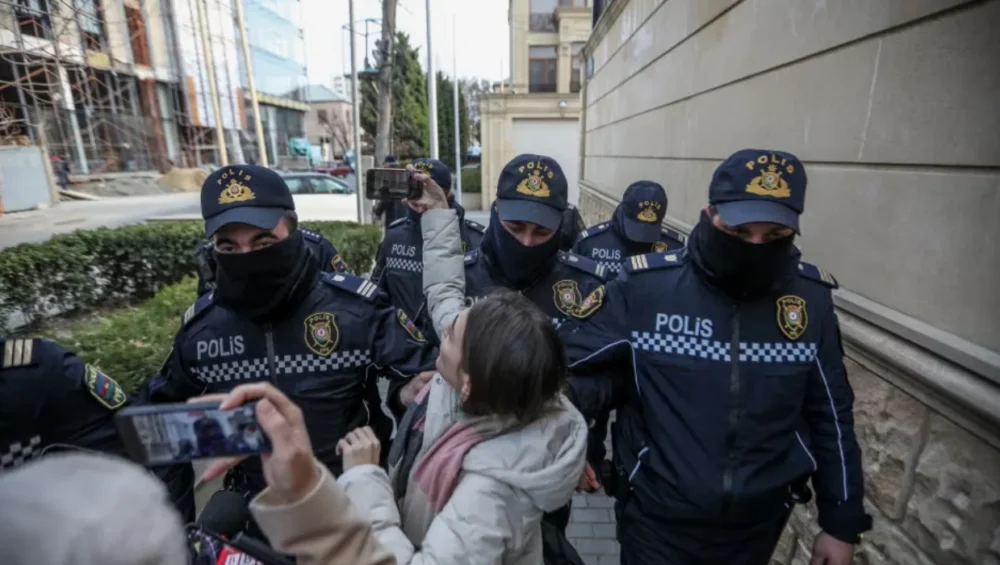
An Azerbaijani court on July 27 delivered the harshest verdict yet in the country’s yearslong assault on independent journalism, sentencing nine journalists, media workers, and civil society activists to between 12 and 15 years in prison in what rights groups have condemned as a politically motivated effort to silence critical voices. The ruling, handed down by the Baku Court of Serious Crimes in the so-called Toplum TV case, marks a new low for press freedom in a country already ranked among the world’s worst jailers of journalists and underscores the extent to which Baku is prepared to criminalize independent reporting under the guise of financial misconduct.
These convictions were made after a trial which was claimed by the lawyers for the defendants to be in violation of due process because all the nine defendants were convicted on counts of being part of an “organized criminal group” responsible for financial crimes such as currency violations, money laundering, tax evasion, and other financial crimes committed as a result of receiving Western aid. The charges originally focused on the issue of currency violations before they were expanded to cover other financial violations.
The Verdict and Those Sentenced
The case revolves around the co-founders and employees of Toplum TV, one of Azerbaijan’s few remaining independent online television stations which is famous for its coverage of corruption, public complaints and government malpractice. Akif Gurbanov, co-founder of Toplum TV and chairperson of the Institute for Democratic Initiatives (IDI) got 15 years in prison, the maximum sentence imposed in this case. Ruslan Izzetli, co-founder of Third Republic Platform and co-producer of Toplum TV programs received 15 years of imprisonment as well. Alasgar Mammadli, a co-founder of Toplum TV and a reputable media lawyer was also awarded 14 years of imprisonment. Ali Zeynal (also referred to as Zeynalov), a journalist trainer at IDI and Ilkin Amrahov, a project coordinator of IDI were each given 14 years of imprisonment.
The remaining defendants were handed terms ranging from 12 to 13 years: Ramil Babayev, an IDI project coordinator, was sentenced to 13 years; Mushfig Jabbar (Jabbarov), a Toplum TV video editor, to 13 years; and Farid Ismayilov, a Toplum TV reporter, and Elmir Abbasov, the outlet’s social media manager, each to 12 years. The court ordered immediate custody for Abbasov, the only defendant who had remained free pending trial, a move that rights groups said was intended to send a chilling message to any remaining independent media workers still operating in the country.
A Pattern of Financial Prosecutions
Toplum TV is just one case in a series of cases where the government has sought to crush independent media and NGOs through the misuse of financial legislation. Azerbaijani legislation dictates that foreign grants need approval by the state for any non-governmental organization, which has been used to block the registration and financing of opposition forces, making their activities illegal and liable to prosecution of all those involved. In March 2024, the police raided the offices of Toplum TV and IDI and arrested the vast majority of those convicted, confiscating equipment and papers.
The prosecutors first detained a number of people on smuggling charges, after which illegal entrepreneurship, money laundering, tax evasion, and forging of documents were added to the charges, which resulted in increasing the possible sentence from eight to 12 years to 15 years. The journalists working at Toplum TV are one of at least 18 journalists and media employees from the biggest independent media in Azerbaijan who have been charged with serious financial offenses due to alleged funding by Western donors.
The Broader Crackdown on Independent Media
The July 27 verdict comes against the backdrop of a widening crackdown that has seen at least 25 to 26 journalists and media workers currently imprisoned in Azerbaijan in reprisal for their work, according to the Committee to Protect Journalists (CPJ).
In 2025, Azerbaijan ranked as the world’s sixth-worst jailer of journalists, a distinction that underscores the extent to which Baku has moved to eliminate any semblance of independent media. The Toplum TV sentences exceed the 7½ to 9-year terms imposed in June 2025 on seven Abzas Media and RFE/RL-affiliated journalists, which were upheld by the Supreme Court in April 2026, totaling 57 years across that case. A separate, ongoing trial involves 12 Meydan TV journalists and media workers, while authorities have also pursued exiled journalists, including in absentia convictions and lengthy sentences.
International Condemnation and Calls for Accountability
The international reaction to the verdict was swift and unequivocal, with rights groups and press freedom organizations condemning the sentences as a blatant attack on media freedom and a warning to any remaining independent voices in Azerbaijan. The Committee to Protect Journalists described the ruling as a “textbook example of how an absence of international accountability emboldens autocrats,” calling on European states to stop prioritizing warm ties with President Ilham Aliyev over human rights and media freedom. Gulnoza Said, CPJ’s Europe and Central Asia program coordinator, said in a statement that
“the new charges against Toplum TV underscores an unprecedented media crackdown waged by Azerbaijani authorities,”
a sentiment echoed by organizations across the spectrum.
The International and European Federations of Journalists (IFJ/EFJ) were equally scathing in their assessment, describing the verdict as “outrageous,” “utterly disproportionate,” and “pure and simple government repression and intimidation.” In a joint statement, the federations demanded the immediate release of all those imprisoned and warned that
“those who contribute to this travesty of justice will be held to account,”
a clear signal that the international press community is prepared to pursue accountability for those responsible for the crackdown. Reporters Without Borders (RSF) denounced the trial as “bogus” and said the decision shows how Azerbaijan’s justice system has been
“brought to heel by President Ilham Aliyev to silence the country’s last remaining independent media outlets.”
Human Rights Watch (HRW) calls on Azerbaijan to revoke the convictions and free those behind bars,” the report by Human Rights Watch said, asking for condemnation from the international community on the verdicts. “The government has arbitrarily arrested dozens of people based on politically motivated and false criminal charges,” HRW reported in its latest report, saying further that the government has “arbitrarily applied repressive laws in order to marginalize independent organizations and media, making them vulnerable to criminal prosecution.
The Legal and Political Context
The current president of Azerbaijan is Ilham Aliyev, who came to power in 2003 and was re-elected in 2024, having won an election with 92% of the votes in a race that the Organization for Security and Cooperation in Europe claimed was devoid of any genuine political contestation, thus further reinforcing his regime’s authoritarian control over the country. This has been achieved through the use of strict media legislation and prosecution of people on financial grounds to suppress opposition voices. This is especially successful given the current strained relations between Azerbaijan and its Western sponsors. The government has not offered concrete proof for their allegation that the accused misappropriated foreign aid money from the West.
The lawyers representing the defendants called the trial politically motivated and said that there were no motions made in the defense’s favor, which is consistent with the overall trend of politically motivated cases in Azerbaijan. The defendants were found guilty of being members of an “organized criminal group,” an abstract concept, which has been utilized before against journalists and activists in regard to financial allegations, even though the actual criminal organization did not exist. As the European Court of Human Rights has emphasized, the failure to register foreign funds can only be penalized through monetary punishment and not through criminal prosecution since independent organizations are not being registered by the authorities.
What Happens Next and the Stakes for Press Freedom
However, defense lawyers have promised that they would appeal against the verdicts. Nonetheless, the chances of success are very low as the cases have obvious political connotations and Azerbaijani judiciary system lacks independence. At this point, the international community and the rights organizations continue to insist on the immediate release of journalists and other measures that would show that Azerbaijan takes the issues with freedom of speech seriously and is ready to implement certain changes in order to improve the situation.
As yet, the efforts made by international partners to help the local journalists have produced nothing more than a verbal declaration about the willingness to make some changes. Press freedom is at stake in Azerbaijan to the highest degree, because the case against Toplum TV is the culmination of the several year process of destroying all independent media in the country. The situation also has serious implications beyond the borders of Azerbaijan. The campaign against journalists shows an example to others in the region who also use the financial support provided by the West in order to conduct journalistic activities and support human rights advocacy.