
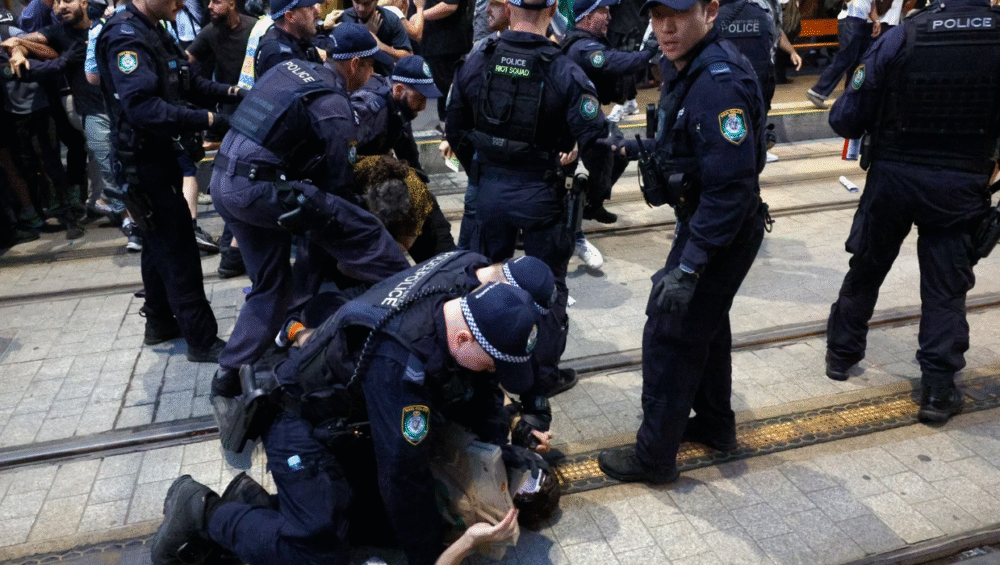
Video footage confirmed by the Human Rights Watch indicates New South Wales police used excessive force against demonstrators during protests against Israeli President Herzog’s visit to Australia on the 9th of February, 2026. For instance, the footage suggests police officers punched demonstrators who were lying down,beat and chased others who were kneeling and praying, and attacked and pepper-sprayed those who were protesting.
Human Rights Watch has called on the New South Wales government to investigate the alleged abuse and take appropriate disciplinary or prosecutorial measures against the officers responsible.
Herzog’s Controversial Visit
President Herzog went to Australia based on the invitation from the Australian government, motivated by the invasion of Jewish celebrants of their holiday at Bondi Beach in Sydney, Australia, in December. The visit was protested by persons across Sydney and Australia, who were against Herzog due to the happenings in Gaza.
Charges brought by the United Nations Commission of Inquiry have accused Herzog of “direct and public incitement to commit genocide,” which has not only sparked more anger among human rights advocates and Palestinian solidarity groups but also resulted in dozens of arrests due to special police orders issued by the New South Wales government to prevent demonstrations from marching.
Eyewitness Accounts and Video Verification
Human Rights Watch interviewed journalists covering the protests and independent legal observers. Videos posted on social media and directly shared with researchers corroborated allegations of police violence.
One video, captured from multiple angles near Sydney Town Hall, shows two officers repeatedly punching a protester pinned to the ground. Red marks on the protester’s torso and audible cries of “Stop it! Stop it!” underscore the severity of the attack.
Journalist Andrew Quilty described police actions as “definitely more aggressive than I’m accustomed to seeing from police in Sydney,” noting the use of pepper spray despite the absence of any clear physical provocation from protesters.
Legal Observers Targeted
Legal observers, who were easily recognizable as such by their high-visibility vests, complained of assault and pepper-spray.
Rebecca Payne said police sprayed her eyes and charged at the crowd, forcing her to seek shelter in a convenience store and later seek hospital treatment. She provided Human Rights Watch with video evidence and photographs of her injury.
Alison Whittaker also reported being punched, pushed, and pepper-sprayed, along with the complaint that officers seized her phone and threw it into the crowd, besides removing and discarding her protective goggles.
Police Justifications and Government Laws
The New South Wales police defended their actions, citing threats to officers and the need to enforce special “move-on” powers granted by the state government. Assistant Police Commissioner Peter McKenna said officers had been “threatened, jostled, and assaulted” during the rally, justifying their use of force to clear protesters from the central business district.
The New South Wales government recently expanded police powers, including new anti-protest laws restricting demonstrations in most of Sydney’s central business district. Critics argue that these measures erode fundamental democratic freedoms and disproportionately target peaceful assemblies, particularly those critical of government-aligned or foreign dignitaries.
International Law and Human Rights Concerns
The UN special rapporteur on human rights and counterterrorism, Ben Saul, has warned that the laws “clearly violate international law” by broadly restricting lawful protest activities. He added that such legislation undermines constructive collaboration between organizers and law enforcement, which could mitigate risks during public demonstrations.
Australia is a party to the International Covenant on Civil and Political Rights, which upholds freedoms of expression, association, and peaceful assembly. International standards, including the UN Basic Principles on the Use of Force and Firearms, require that nonviolent means must be exhausted before resorting to force, and that only the minimum force necessary should be applied.
Pepper spray, a chemical irritant, is intended for use against violent assailants or resisting suspects. According to UN guidelines on less-lethal weapons, such measures should only be employed when there is a clear and imminent threat of injury—criteria Human Rights Watch suggests were not met in Sydney.