
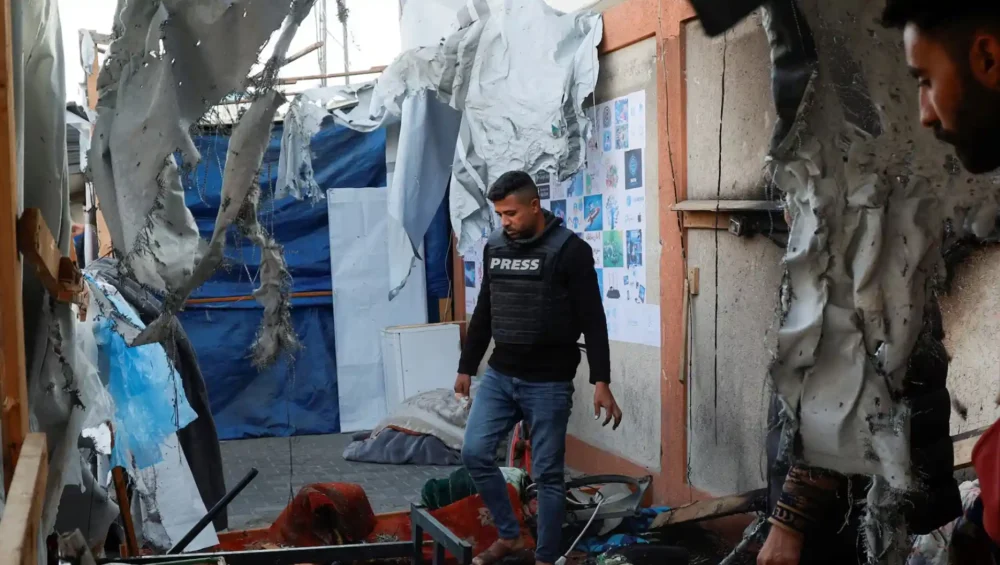
One year has passed since the Israeli air force conducted two air strikes against Nasser Hospital in Khan Younis, South Gaza, where at least 20-22 people were killed, including five journalists who were reporting about the first explosion. Currently, several critical details are still valid: the victims consist of named journalists working for international news agencies, the shooting pattern is consistent with a “double tap” strike, and there has still been no public, clear investigation, nor any evidence of any accountability for the crimes committed. This failure to provide an answer is not only a bureaucratic problem but a sign of systematic impunity in the ongoing conflict where journalists are being killed in record numbers.
What happened at Nasser Hospital on 25 August 2025
The bombing of the Nasser Hospital, the main healthcare institution in southern Gaza, occurred on 25 August 2025, by means of Israeli artillery. According to statements by health officials of Gaza, witnesses, and several news organizations, the first strike attracted attention and caused medics, first responders, and journalists to rush to the place of the tragedy. Thereafter, a second strike occurred at the same place, killing most people present there. A “double-tap” attack is what this combination of events is called by rights organizations and investigators, and the “double tap” pattern has been numerous times questioned for its war crimes implications in this conflict.
The number of fatalities in connection to the bombing of the Nasser Hospital was stated to be at least 20-22, which included health professionals, civilians and five journalists reporting on the event. The mentioned five journalists were reported to be Hussam al-Masri, a cameraman for Reuters; Mariam Dagga, also Mariam Abu Dagga, a visual journalist whose images were used by AP, The Independent and Middle East Eye; Moaz Abu Taha, an independent journalist whose reports were published by Reuters and other media agencies; Mohammed Salama (Mohamed Salama), who contributed to Middle East Eye and several other media agencies; and Ahed/Ahmed Abu Aziz, a journalist and producer, who was working for several media agencies.
Israel’s shifting explanations and the absence of a final report
Following the attack, various explanations were given by officials from Israel and the IDF in the following days and weeks. At first, the military stated that it “does not target journalists as such” and expressed regret about the injuries sustained by civilians and declared an initial inquiry by the chief of staff. In further briefings for journalists, the military claimed that the strike targeted a “camera station” or “observation post” belonging to suspected Hamas on the roof of the hospital. Some of the military officials mentioned “terrorists” in their explanation of the strike. Nonetheless, to date, no detailed report about the targeting decision, intelligence, precautions, and legality of the attack have been issued to explain the incident.
Up until August 2026, the IDF told The Associated Press that the event is “being examined” and the findings would be transferred to the Military Advocate General’s Corps to decide on opening a criminal case. At present, there is no timeline, methodology, or conclusions to this investigation. More importantly, no Israeli soldier or commanders have been disciplined or charged with any crime related to the killings of journalists at Nasser Hospital. For relatives of the dead, for news organizations employing them, and for organizations monitoring journalists killed in action, that lack of accountability has become an essential part of the story.
Newsrooms demand answers: “The information we have received… has fallen short”
On the first anniversary of the strike, 25 August 2026, two of the world’s largest news agencies broke ranks with routine statements to issue a joint, unusually pointed appeal. Reuters Editor‑in‑Chief Alessandra Galloni and AP Executive Editor Julie Pace released a shared statement recalling that the five journalists were at Nasser Hospital
“in their professional capacity, doing critical work to keep the world informed.”
They then delivered a direct verdict on the official response:
“The information we have received to date has fallen short of the clear answers and accountability that an incident of this gravity requires.”
The statement did not stop at criticism. Galloni and Pace called on Israel to
“explain the deaths of these journalists and take every step necessary to protect journalists covering the conflict.”
That language—“explain the deaths,” “take every step necessary”—is not rhetorical flourish; it is a precise demand for a transparent investigative process that meets international standards, and for operational changes that reduce the risk of further killings. For editors who normally avoid overtly confrontational phrasing, the decision to speak in such terms underscores how exceptional they view this case: five named colleagues, multiple major outlets, a protected hospital, and still no public accounting.
UN and rights bodies: “We have not witnessed any results or accountability measures”
The United Nations human rights office (OHCHR) has been equally blunt. In the immediate aftermath, OHCHR spokesperson Thameen Al‑Kheetan said the killings “should shock the world” and warned that
“condemnation must turn into demands for accountability and justice.”
A year later, that message has hardened into a critique of process. Al‑Kheetan noted that while Israel had announced investigations into such killings,
“we have not witnessed any results or accountability measures,”
and called for investigations that “yield results.”
The expression “yield results” is an understated way of referring to the fact that investigations that never end, do not publish any results, and have not led to any prosecution are not credible in the international world. UN authorities have also emphasized that hospitals are subject to international humanitarian laws, and attacking hospitals and people working there may lead to legal problems. When all this is considered with regard to the reports about the double-tap attack on Nasser Hospital, one can easily understand that regardless of whether Israel claims that there was a military target close by, a thorough investigation is necessary.
Press‑freedom groups: a record body count and a record of impunity
The Committee to Protect Journalists (CPJ) responded to the Nasser Hospital attack in August 2025 by calling for an “independent, international investigation” and listing specific questions Israel must answer: whether it knew journalists were present, what military threat was posed, what precautions were taken, and who would be held accountable. A year on, CPJ’s assessment has not softened. In its 2025 annual report, the organisation recorded a record 129 journalists and media workers killed worldwide, with about two‑thirds attributed to Israeli military actions in Gaza. On the accountability front, CPJ’s conclusion is categorical:
“no one has been held accountable in any of these cases.”
CPJ has gone further, stating that in 24 years of monitoring, no one in Israel has ever been held accountable for the killing of a journalist, and that very few transparent investigations have been conducted into targeted killings of journalists by Israel. That historical context transforms the Nasser Hospital case from an isolated tragedy into a data point in a long pattern: high numbers of journalists killed, minimal transparency, and virtually no disciplinary or criminal consequences. For editors and correspondents operating in Gaza, that pattern is not abstract; it shapes risk assessments, editorial decisions and the very calculus of whether to send reporters into certain areas.
Visual evidence and independent probes: “Upending” official narratives
Independent investigations have added another layer of pressure. In late September 2025, Reuters Investigations published a visual‑evidence analysis concluding that new details “upend Israel’s official story” about the attack. Even then, the report noted that the IDF had not fully explained how its fire hit the Reuters camera and killed Hussam al‑Masri. More recently, in August 2026, The Independent and Middle East Eye reported that their investigation found Israel “probably committed war crimes” in the double‑tap attack, given the targeting of a protected hospital and those responding to the first blast.
These facts do not substitute for any legal process, but they perform another equally vital function in the media environment. It is that they create an evidence-based counter-narrative to the official narrative. In cases where mainstream journalists, combined with independent investigators, arrive at the same conclusion—double-tap, secure location, no precautions taken, no accountability—the responsibility is squarely put on the government to produce its side of the story. This has not yet happened.
The wider picture: 207 Palestinian journalists killed since October 2023
However, the Nasser Hospital strike was not an isolated event. On the contrary, it fits into a wider gloomy statistics. According to CPJ and other sources, around 207 Palestinian journalists have been killed in Gaza since the outbreak of the war on 7 October 2023. The statistics of casualties, provided by UN and CPJ and including all journalists and media workers killed since 7 October 2023 in all territories and positions are estimated at about 247 people. In 2025, CPJ documented 129 deaths of journalists and media workers worldwide – the biggest number on record, with approximately two-thirds killed by Israeli troops, namely, Palestinians from Gaza.
Thus, against such background, failure to hold anyone responsible for these events does not appear accidental but represents a logical part of the overall picture. CPJ’s statement of the fact that, as of 2026, no one was ever held responsible for journalist killings in the 2023-2026 war only confirms journalists’ perception of the ineffectiveness of the present internal military inquiries. It is frightening enough to know that even when there are clear victims, they work for leading international outlets and were killed in a supposedly safe place, nothing will happen.
Legal stakes: protected sites, civilian status and the double‑tap question
In accordance with international humanitarian law, hospitals are considered protected civilian objects. Attacks against them are not permitted except when hospitals are used for military purposes, rendering them a valid military objective, but the attack on them should be made after taking feasible precautions and ensuring proportionality. Journalists are civilians; any intentional attacks against them constitute war crimes. While the existence of a military target near the Nasser Hospital may be possible, the reported pattern of double-tapping—killing those who responded to the first bombing attack—is highly suspicious from the perspective of laws of warfare since it implies that the people who helped rescue victims and journalists who documented the scene became a target themselves.
Human rights activists and UN representatives claim that such a combination of targeting of the hospital, hitting those responding to the first attack, and lack of a proper investigation and prosecutions shows a violation of international rules. This wording is intentional because the issue is viewed as a systemic problem rather than an accidental mistake in conducting the investigation. Legal scholars view the case of the Nasser Hospital as a starting point for debates on whether accountability procedures are suitable in this conflict.