
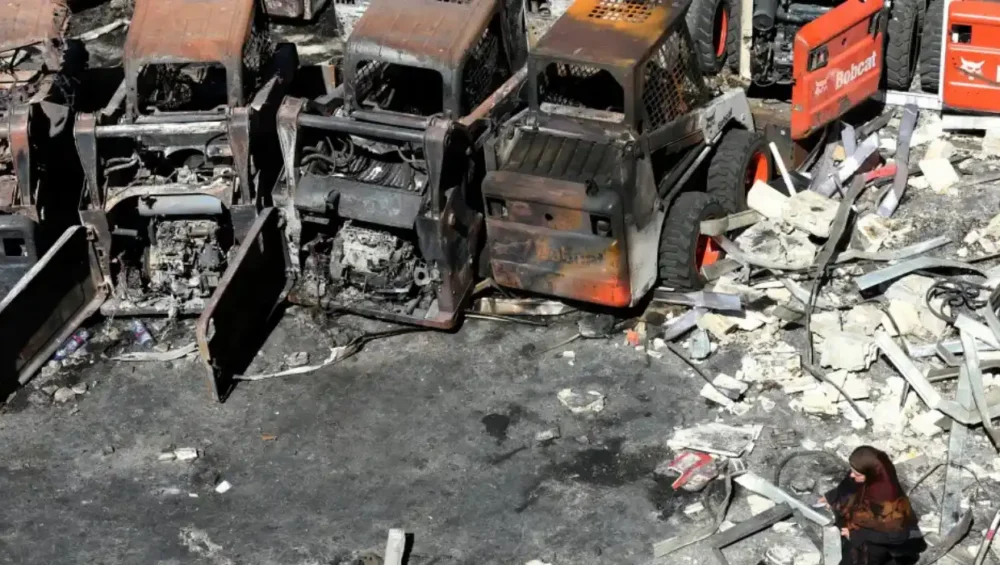
The ICC campaign by the Lebanon victims rally generated practical momentum after thousands marched in Beirut seeking to hold those responsible over the so-called atrocities perpetrated in the 2024-2025 Israel-Hezbollah conflict. The protest was not only organized by civil society groups, survivors, and legal advocates as a demonstration of grief, but as a systematic demand to connect international inquiries with plausible national indictments.
The number of reported civilian deaths more than 2,000 and almost one million displacements since hostilities began escalating in October 2024 were cited by organizers. A weak November 2025 ceasefire stopped massive exchanges but could not bring about judicial solutions. Survivors of the strike in Tyre and Nabatieh gave testimonies about destroyed hospitals and destroyed ambulances, which increased calls that alleged violations should be investigated by international humanitarian law.
Civilian casualty patterns under scrutiny
According to the Lebanese Health Ministry figures, the vast majority of the casualties of Israeli attacks were civilians, and this figure was mentioned several times at the rally. The Hezbollah rocket attack on the Israeli side was also reported to claim the lives of approximately 40 civilians in the towns that were in the North. The imbalance in the tolls has influenced the legal discourses, but responsibility requires protesters on both sides.
Cluster munitions became an issue. In southern Lebanon, the UN information as of 2025 outlined the contamination on close to 400 locations and displaced some 200,000 individuals form the affected regions. Even though Lebanon is bound by the 2008 Convention on Cluster Munitions and Israel is not, legal experts at the rally contended that the principles of customary international law apply to the consideration of indiscriminate injury.
Organizational dynamics of the rally
The February meeting was coordinated on sectarian and geographical lines. In 2025, southern village grassroot groups joined forces with the urban advocacy groups in Beirut, bypassing the state structures that were undermined by an extended economic crisis and judicial strikes. The number of attendees was estimated to be over 5,000, and banners demanded the investigations of both Israeli leaders and Hezbollah leaders.
The turnout was increased through digital mobilization. Online surveys spread throughout 2025 collected over a million signatures, an indication of long-term anger over a lack of action in the country. Amnesty International and other international bodies supported the demands to conduct independent investigations, which gave the rally even more global momentum.
ICC preliminary examination and legal thresholds
The key point on the Lebanon victims ICC agenda is the early investigation initiated by ICC Prosecutor Karim Khan in late 2024. The investigation focuses on 12 categories of the alleged war crimes, such as the use of disproportionate attacks, civilian infrastructure, and the so-called human shields use. By the middle of 2025, the investigators had collected satellite shots and testimonies of close to 500 witnesses.
The calculus used by the ICC is still complicated. Lebanon is not a State Party to the Rome Statute and this raises the admissibility issues in the context of complementarity and ad hoc acceptance. Non-membership in Israel also complicates the cooperation process, a similar situation with the procedural difficulties in other regional investigations. However, organizers of the rally also turned in more dossiers in February 2026 as a way of bolstering evidentiary thresholds that would allow a full investigation to be initiated.
Complementarity and domestic judicial paralysis
According to the complementarity principle of the Rome Statute, ICC can only intervene when the national courts cannot or do not want to prosecute. In Lebanon, judicial institutions, crippled by the economic meltdown and frequent strikes on unpaid salaries in 2025 have made very little progress on the thousands of war crimes complaints that are said to have been filed. According to protesters, this systemic inaction qualifies as admissible.
Legal experts observe that domestic military tribunals have charged a few rebels of Hezbollah, of which 15 have been convicted by 2025. Nonetheless, high-command accountability is not affected much. This difference breeds the view of partial responsibility and aids in the creation of reliance on The Hague as the venue of last resort.
War crimes definitions and evidentiary debates
Rally speakers used Article 8 of the Rome Statute, which proclaims purposeful assaults on civilians and harm out of proportion. The proportionality debate has been displayed in 2025 expert panels, especially in airstrike attacks on densely populated regions. Legal submissions claim that the cluster munition remnants and blast radial tests give objective measurements to gauge the adherence to humanitarian standards.
Meanwhile, the accusation of Hezbollah has been fired at the rockets at civilian locations, and this could lead to the ban on the use of human shields. The United Nations reporting in 2025 recorded that in 2025 there were around 150 launch points in schools and residential blocks making it hard to construct a story of individual responsibility.
National justice pathways and hybrid models
In parallel to ICC scrutiny, officials of Lebanon presented ideas in 2025 of a hybrid court with eminent judges of both national and foreign origin, inspired conceptually by the Special Tribunal to Lebanon. Draft structures spread inside the Justice Ministry provide an idea of a system that could be financed via international donor conferences, which may involve European Union and Gulf allies.
The realities of the economy, however, limit the implementation. Remediation of land including cluster-contaminated land is estimated at over 500 million alone, and the amount of money committed to it is hardly being paid out even by the next year, early in the year 2026. Reparations budgets are very minimal, and this has the victims associations consider civil litigation under the transitional justice provisions.
Political constraints and cabinet gridlock
The broken politics of Lebanon is a daunting challenge. The influence of Hezbollah in government institutions makes it difficult to pass the reforms in any legislative act, which would increase the scope of universal jurisdiction or broaden the mandate of civilian courts. The blocs that are opposed have used this platform to propose no-confidence motions, yet no agreement over structural reforms has been reached.
There may be international diplomatic pressure which can change incentives. In 2025, the U.S. and the European Union were coordinating sanctions against the financiers of Hezbollah, estimating about $200 million frozen assets. Although these measures are mainly to be discussed in the context of counterterrorism activities, they contribute to investigative activities indirectly, in the sense that they limit financial channels associated with alleged violations.
UNIFIL and ceasefire monitoring
The ceasefire in November 2025 stabilized the front lines, though sporadic violations continue to occur, displacing an estimated 500 people each month along the Blue Line. In 2025 with renewal of the United Nations Interim Force in Lebanon, forensic capabilities would be expanded, which could be helpful in preserving evidence to be used later in prosecutions.
The participants of the rally demanded to increase the monitoring of the suspected war crime locations and audit reconstruction transparently. Out of the 2 billion dollars promised in rebuilding, the amount disbursed was around 40 percent in the first quarter of 2026 as other watchdog bodies claimed that there was uneven distribution in geographical areas.
Civil society influence and regional implications
The ICC Lebanon victims rally initiative is an indication of a civil society advocacy maturation in the country that has had a long history of being limited by sectarian patronage. The networks of victims of Shia, Sunni and Christian communities declared the necessity of reciprocity in accountability, refusing the discourse of attributing blame to only one side. This cross-sectarianism affiliation increases the plausibility of the calls to unbiased justice.
On the international level, the documentation of the rally will be used to focus further briefings by Prosecutor Khan to the member states. It is indicated that the long-term involvement of the grassroots can hasten the process of procedural decision-making pursuant to Article 18 of the Rome Statute, which compels states to define the investigational purposes.
But the way between protest and prosecution is not clear. The draft of hybrid tribunals is politically vetoed, and ICC cases traditionally take years to be completed. The state of precarious ceasefire enforcement, reconstruction coupled with increased evidentiary submissions will determine the course of accountability. The sustainability of the justice demands in Lebanon could not be as dependent on the courtroom achievements as a cohesive civil society can sustain pressure both on diplomatic and domestic fronts where the legacies of war continue to linger.