
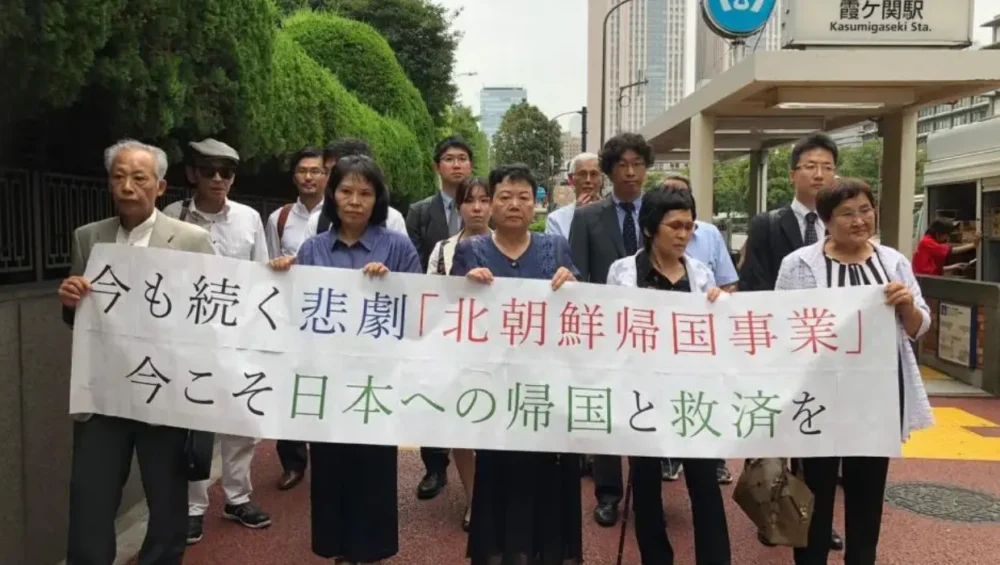
In a landmark ruling announced on January 26, a Japanese district court held the North Korean government legally liable for gross violations of human rights perpetrated against Koreans and Japanese citizens who were inveigled into going to Pyongyang as a result of its “repatriation” campaign under its “Paradise on Earth” banner. The court ordered North Korea to pay 22 million yen (142,000 US dollars) compensation to each of the plaintiffs, acknowledging decades of suffering.
The suit was originally filed in 2018 by the four plaintiffs, all of whom included the current 83-year-old plaintiff, Eiko Kawasaki, who claimed that the plaintiffs had been deceived into moving to North Korea and had lived there in conditions of utmost hardships.
The “Paradise on Earth” Campaign and Mass Deception
Between 1959 and 1984, an estimated 93,000 persons, including 90,000 Zainichi Koreans–an ethnic Korean minority residing in Japan—and 3,000Japanese nationals, were relocated to North Korea, an operation hailed as humanitarian in its intent but in practice backed by the State.
The movement was largely organized by Chongryon, a pro-Pyongyang organization in Japan, in collaboration with the North Korean authorities. The migrants promised a new, modern living environment, employment, free education, and plenty of food, and even promised living in a socialist utopia that was emerging from the wounds of war with dignity in their lives.
Yet, thanks to the human rights associations and the testimonies from the migrants themselves, it is since been made evident that these assertions were (in later days) knowingly false. These migrants found nothing less than a country in shambles owing to poverty, strict surveillance, and full political control.
Life Under Total State Control
Survivors have given repeated testimony that North Korean authorities moved rapidly to exert complete control over the most minute details of everyday life. Speech, movement, job assignments, education, and domicile were all sharply curtailed. Food was distributed based on political reliability, and correspondence with family members in Japan was strictly censored or banned altogether.
Human Rights Watch and Amnesty International say North Korea functions on a system of collective punishment, whereby perceived disloyalty by an individual can be extended to penalties against all family members. Migrant workers who asked any questions about the regime or tried to keep outside contact were frequently branded “hostile class” and subject to extreme repression.
Eiko Kawasaki arrived in North Korea in 1960 when she was 17 years old. She then spent 43 agonizing years in forced labor, hunger, and under the constant watchful eye of the state before escaping in 2003.
Political Prison Camps and Enforced Disappearances
Those suspected of disloyalty and deviation in ideology have to suffer extreme punishment. It is reported that the most prevalent case is the practice of political prison camps, also known as kwanliso, which forces the detainees into hard-labor conditions, starvation, torture, rape, and summary execution.
A 2014 report by the UN Commission of Inquiry (COI) on North Korea found that the country has committed crimes against humanity, such as extermination, enslavement, confinement, torture, rapes, the forced disappearance of people, and the persecution based on political, religious, and racial grounds. According to the report, the country’s government has not committed crimes against humanity by accident, but rather deliberately.
Also, Amnesty International states, tens of thousands of people today are still being detained in these camps, some even without trials, while relatives of victims never know what really happened to their family.
A Reversal in Japanese Judicial Recognition
In 2022, the Tokyo District Court initially rejected the plaintiffs’ claims, citing a lack of jurisdiction over North Korea and the expiration of the statute of limitations. However, in a pivotal reversal, a high court ruled in 2023 that Japanese courts did have jurisdiction and that the plaintiffs’ suffering constituted violations of fundamental human rights under international law.
The case was returned to the district court to determine damages, resulting in the January 26 ruling. The North Korean government refused to participate in the proceedings, making enforcement of compensation highly uncertain.
Legal experts note that while financial recovery may be unlikely, the ruling carries enormous symbolic and legal significance by formally recognizing North Korea’s responsibility for systematic abuse.
North Korea’s Persistent Record of Repression
North Korea remains one of the most repressive states in the world. Freedom House consistently ranks it at the bottom of global freedom indices, awarding it the lowest possible scores for political rights and civil liberties.
Human Rights Watch’s most recent reports describe a country where arbitrary detention, forced labor, restrictions on movement, and information blackouts are pervasive. During periods of food shortages, the regime has prioritized military and elite consumption while ordinary citizens face chronic malnutrition. The World Food Programme estimates that more than 40 percent of North Korea’s population is food insecure.
The UN COI warned that accountability is essential, stating that the international community has a responsibility to pursue justice through international mechanisms, including referral to the International Criminal Court.
Human rights advocates argue that the Japanese government should use this ruling as a foundation to intensify diplomatic pressure on Pyongyang. This includes pushing for the resettlement of remaining “Paradise on Earth” victims and their descendants, many of whom remain trapped in North Korea, as well as seeking accountability for responsible officials.
The ruling also reinforces broader international efforts to document and prosecute North Korea’s crimes, challenging decades of impunity. While enforcement remains elusive, the judgment sends a clear message: state-sponsored deception, forced confinement, and systematic abuse do not disappear with time, and legal accountability—however delayed—remains possible.
For survivors like Eiko Kawasaki, the ruling is less about compensation than recognition. After decades of silence, it represents an official acknowledgment of suffering inflicted not by circumstance, but by deliberate state policy.