
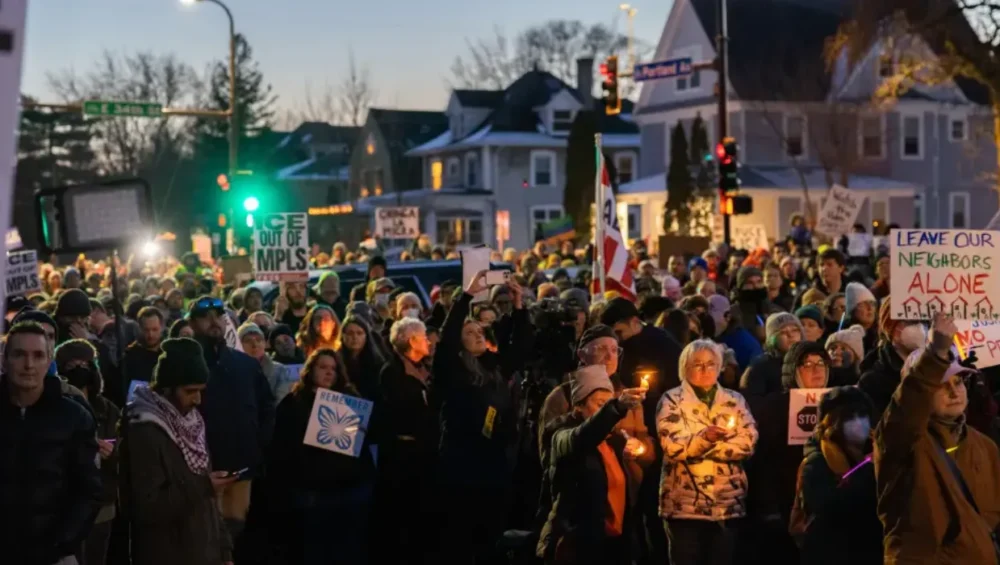
The killing of 37-year-old U.S. citizen Renee Nicole Good through gunshots by a federal immigration officer in Minneapolis on January 7, 2026, has triggered widespread condemnation among human rights activists and communities in the USA. Contrary versions from video evidence and eyewitness accounts dispute arguments raised by the authorities about Good using her vehicle as a weapon and an anticipated threat against law enforcers.
Such an incident highlights the ever more aggressive attitude that has been adopted by the federal enforcement of immigration laws in the United States and gives cause for grave concern regarding responsibility for such behavior and the human rights that are being systematically infringed.
Contradictions in federal accounts and video evidence
According to multiple verified videos and witness testimonies analyzed by Human Rights Watch and major media outlets, Good was attempting to drive away from ICE officers when an agent fired three shots at close range.
One video shows Good’s vehicle stationary in the middle of a residential street while unmarked ICE vehicles blocked her path. She signals vehicles to pass, reverses briefly to create space, and then attempts to leave. At that point, the officer fires through the windshield and driver’s side window. Good’s car then crashes into a parked vehicle.
Video footage recorded soon after the shooting revealed Good bleeding and unconscious inside the vehicle, but the police failed to render her timely medical aid. Paramedics were obstructed by ICE cars from entering and treating Good. However, local police finally gave her some medical attention. Good died soon afterward in a hospital.
Human Rights Watch director Ida Sawyer said:
“This horrific incident is the latest sign that abusive ICE tactics put lives at risk, including people not subject to immigration enforcement.”
The federal Department of Homeland Security’s (DHS) framing of Good’s killing as “domestic terrorism” directly contradicts the visual evidence and violates principles of proportionality and necessity under both U.S. and international law.
Patterns of excessive force in immigration enforcement
Good’s death is not an isolated incident. Recent months have seen a troubling pattern of federal agents using lethal force under dubious circumstances. In December 2025, ICE officers shot Tiago Alexandre Sousa-Martins in Glen Burnie, Maryland, allegedly for “weaponizing” his vehicle, though local police statements contradicted DHS claims about the circumstances of the crash.
Likewise, Customs and Border Protection officer Marimar Martinez was shot at least five times in the month of October 2025 in the city of Chicago and the federal charges were dismissed the next day. In the month of September, ICE shot Silverio Villegas-Gonzalez because he drove at the officers with his automobile; however, the surveillance cameras proved otherwise.
United States Department of Justice policy bars the use of firearms to immobilize oncoming vehicles except when there is no alternative to save lives and avoid grave injury. International humanitarian laws also state that the use of deadly force will always be the last option, and the wounded will receive instant medical attention. Good’s killing of Omachi did not comply with either policy because of the visible footage that showed Omachi trying to escape and not attack.
The Trump administration’s broader immigration enforcement campaign has exacerbated risks. The use of unmarked vehicles, agents obscuring their identities, and the dismantling of internal oversight bodies like DHS’s Office for Civil Rights and Civil Liberties (CRCL) has created an environment where federal officers can act with impunity. Staffing cuts have severely limited CRCL’s ability to investigate unlawful shootings or other abuses, leaving immigrant communities increasingly vulnerable.
Accountability, oversight, and human rights implications
The Minneapolis Police Department, the FBI, and the Bureau of Criminal Apprehension (BCA) were initially involved in investigating Good’s death. However, the BCA was later barred from accessing evidence by the FBI, leaving the federal agency to lead the investigation alone. Human rights advocates argue that this centralization raises serious concerns about transparency and impartiality.
Ida Sawyer emphasized:
“Good’s death is a horrifying example of the dangers posed by law enforcement agencies empowered to act recklessly. It sends a chilling message to immigrants, protesters, and bystanders alike.”
Human Rights Watch and other observers are calling for thorough public investigations, congressional oversight hearings, and reforms to prevent future incidents.
The broader context highlights systemic human rights violations: the right to life, the right to due process, and protection against excessive use of force are all jeopardized when federal agencies operate without effective checks and balances. In Minneapolis and other cities, thousands have expressed outrage through vigils and protests, reflecting widespread fear that ICE’s growing militarized presence threatens not only immigrant communities but U.S. citizens as well.
Renee Nicole Good’s death exemplifies the urgent need for accountability in U.S. immigration enforcement. Video evidence contradicting federal narratives, coupled with past incidents of questionable shootings, underscores the pattern of excessive force and lack of oversight. Human rights organizations argue that federal authorities must face strict scrutiny, implement independent monitoring mechanisms, and ensure immediate medical response in enforcement operations.
Congressional DHS committees, local law enforcement, and human rights bodies should collaborate to investigate this case transparently. Failing to act risks normalizing state violence, undermining public trust, and perpetuating a climate where immigrants and residents alike live under threat of arbitrary lethal force. Good’s killing is more than a tragic incident—it is a warning sign for systemic reform in immigration policing.