
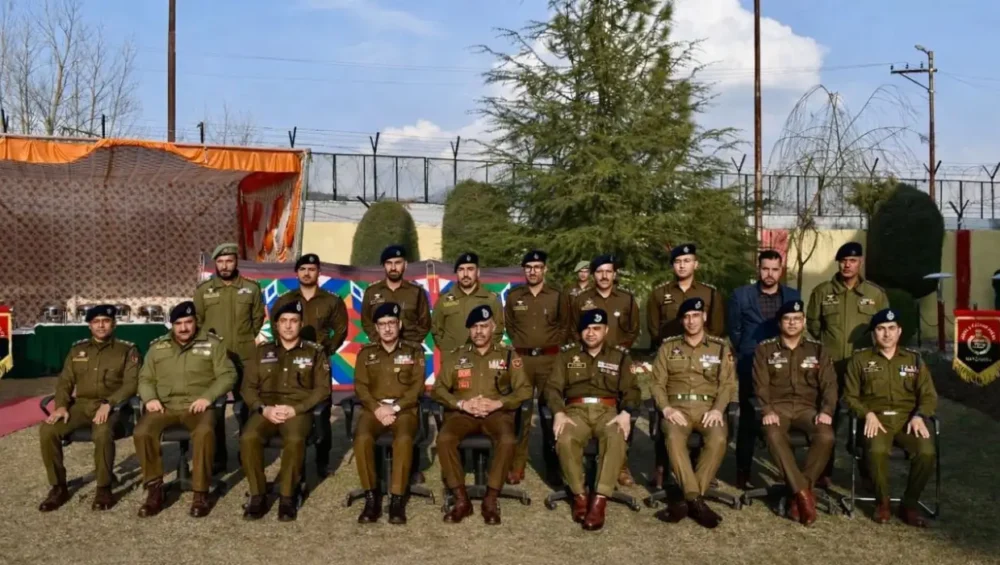
This HUMINT imperative DGP model has experienced a new level of urgency after an assessment of high-level security in Sopore by Director General of Police Nalin Prabhat on February 24, 2026. Having been convened in the conflict sensitive area by the center of north Kashmir, the meeting involved the Inspector General of Police Kashmir V.K. Birdi and district commanders of Baramulla and Kupwara. The task was specific: counter-terror strategy had to be re-tuned to dismantle the leftover terror cells working within the northern areas.
The location of Sopore ensures long-term operational value due to its closeness to the Line of Control (LoC). In 2025, the attempts of infiltration were lowest in the history compared to the levels of 2019, but according to intelligence evaluations, the foreign military presence is still strong. This two-sidedness that has been decreasing recruitment but active external cadres has fashioned the HUMINT imperative DGP blueprint in such a way that puts significant emphasis on deep-source penetration and not on visible force projection.
Infiltration patterns and seasonal shifts
Security briefings at the Sopore review made the point that Pakistan-supported forces still seize the opportunities of seasonal LoC. Thaws and snowmelt provide openings and small and well trained forces can attempt to enter during winter. Even though successful infiltrations were cut almost by half in 2025 by enhanced border grids, an operational command reported that such limited infiltration keeps a symbolic and tactical presence.
The mandate of the DGP placed importance on proactive interference instead of responding to the offensive. Intelligence-led ambushes and forward area domination plans are being re-set to spring of 2026, and special operations groups will have the responsibility of eliminating infiltrators before they can consolidate.
Overground ecosystem resilience
Although the infiltration means thins down, the ecosystem that supports militancy among overground workers, couriers of logistical systems, and radical enforcers exists in pockets of north Kashmir. In 2025, coordinated sweeps across Baramulla and Kupwara districts questioned more than 500 people and the conviction rate increased to 60 percent due to increased scrutiny of laws.
This overground architecture is the point of vulnerability identified in the HUMINT imperative DGP doctrine. In the absence of breaking down safe houses, narco-financing connections, and recruitment pipelines, kinetic victories will only be episodic, but not structural.
Human intelligence prioritization over tech saturation
The increasing complexity of encrypted communications and low signature operations has weakened the independent utility of signals intelligence. Internal 2025 evaluations have shown that almost 70 percent of high value arrests in Baramulla are initiated by human sources and not by technical intercepts.
The decision by Prabhat to ask people to take a concentrated and long-term action against factors that favor terrorism is a calculated shift. Instead of massive cordon-and-search operations that have the potential to cause friction among the populace, the approach is more precise and is based on informant networks and community interaction.
Hybrid militants and remote radicalization
Locally embedded individuals that are triggered by remote handlers pose a difficult challenge to hybrid militants. Such actors usually do not fail to leave a physical presence of the organization and thus are hard to detect using electronic surveillance. Radicalization effects of social media especially in urban Sopore clusters are an issue that has been identified in 2025 in operational reviews.
Human intelligence with particular integration with village level outreach has proved to be more effective in detecting behavioral change prior to operationalization. According to police statistics at the end of 2025, the number of community tips increased by 35 percent as a result of informative actions targeting the alienation of extremist discourses.
Village Defense Guards integration
Since the successes of South Kashmir in 2025, Village Defense Guards have been perfected in relation to local police patrols. This model is being extended to north Kashmir to increase rural coverage particularly in fringe hamlets where the terrain makes patrol difficult at all times.
Anti-narcotics drives became one front that Senator Superintendent of Police Iftikhar Talib emphasized on. The recruitment and safe-house provisioning are interlinked with drug smuggling that is estimated to finance up to 30 percent of the local militant logistics. Mapping of these narco-terror intersections using HUMINT has made possible the targeted seizures interfering with about 2 million illicit flows in 2025.
Kinetic operations within a calibrated framework
Although the HUMINT imperative DGP blueprint centers on intelligence, it does not reduce kinetic determination. Prabhat also commanded ruthless and offensive kinetic actions against terrorists in Pakistan and kept the foreign cadres under pressure.
Later in 2025, North Kashmir neutralized 15 foreign militants. These missions that were frequently carried out by small-team ambushes based on source inputs reduced the operational space but did not result in the extensive collateral disruption.
Precision strikes and special operations groups
Special operations forces within the Jammu and Kashmir Police have increased twofold since 2024 with the aid of the central agencies and cross-agencies. They have been more involved in carrying out raids that are source based, especially in infiltration prone belts in Kupwara.
Plans of area domination are now spread to micro- pickets in desperate hamlets. This is not seen as the objective of visible militarization but continued denial of safe consolidation zones. Operational commanders have reported that neutralization measures have improved by 40 percent because of proactive ambush strategies that are associated with human-source validation.
Cyber and psychological dimensions
Deviant strategies constitute a supportive unit. In 2025, cyber surveillance of propaganda systems and psychological work to discourage the recruitment of young people was tested and proved to have a quantifiable effect. In Jammu and Kashmir, the numbers of recruiting changed to single-digit numbers in 2025, as compared to the triple-digit numbers with which Article 370 was previously abrogated in 2019.
There is an urgent need to disrupt the online glorification stories as it is the same requirement as is the case with interrupting weapons deliveries. The intelligence organs have entered into close coordination with cyber cells in monitoring cluster radicalization processes before they are converted into the actual acts.
Multi-agency coordination and central directives
The HUMINT imperative DGP solution fits with wider guidelines issued by Union Home Minister Amit Shah in January 2026, in which he demanded that state police, central armed police forces, and intelligence agencies have to be entirely compatible with one another. The centrality of command has been codified to avoid redundancy and intelligence silos.
Intelligence sharing through LoC is made possible via Northern Army Command liaisons, so that the cross-border movement information is directly integrated into the district-level planning. As per the internal coordination reports, in 2025, joint operation was successful by 80 percent in hybrid threat neutralization.
The grid-strengthening blueprint, which was put in place by a parallel security assessment of Budgam earlier this year, is projected to add 20 new posts by mid-2026 to seal any gaps still present in the surveillance system.
2025 benchmarks shape 2026 objectives
The HUMINT imperative DGP strategy has quantifiable context with the operational data of 2025. In Jammu and Kashmir, 25% increased the number of encounters that killed 180 terrorists. The number of foreign militant influx was managed at about 20 a year, which is an indication of better border control.
More importantly, intelligence-based interventions minimized civilian collateral cases, increasing the confidence of people. The indicators of community engagement imply that the informant base has grown since the informants have been built over time, not because of crackdowns that occur occasionally in the sensitive districts.
As 2026 unfolds, the blueprint projects further decline in militant footprint through sustained ecosystem disruption rather than isolated tactical victories. The strategic calculus now rests on whether deep-source penetration, combined with calibrated kinetic action and narco-financial disruption, can outpace adaptive adversaries who continuously recalibrate infiltration routes and recruitment techniques. The next operational cycle in north Kashmir will likely test the durability of this HUMINT-centric architecture, revealing whether intelligence dominance can decisively erode the residual networks that have long leveraged terrain, transnational sponsorship, and local complicity.