
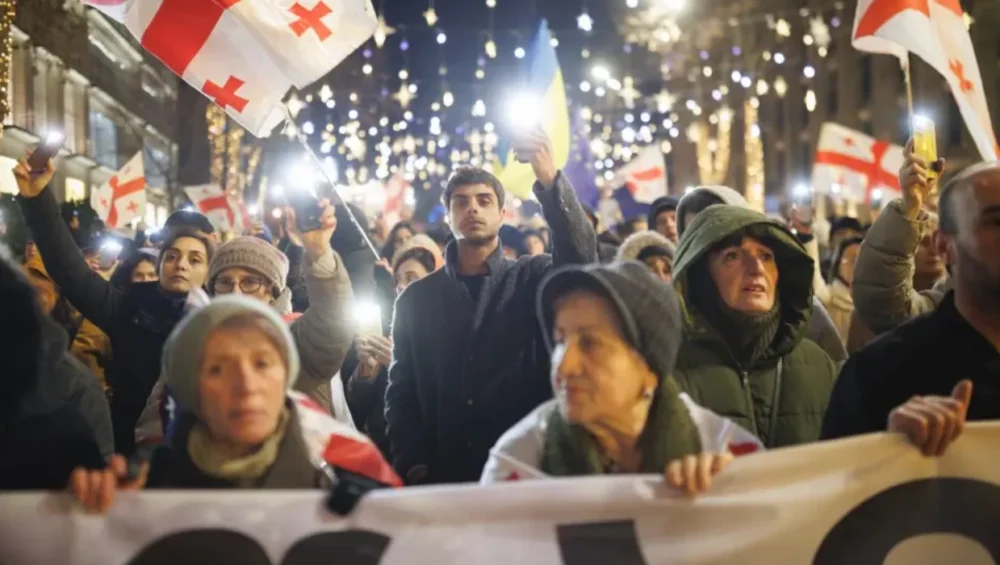
The authorities in Georgia are misusing the restrictions on the right to assemble in public places by holding those who engage in peaceful protests arbitrarily. This has become an almost unsurmountable barrier to the right to protest peacefully. Since the law was passed, the police have instituted dozens of legal proceedings against peaceful protesters for peacefully standing on a sidewalk near the parliament.
Such a crackdown marks a disconcerting shift towards oppressive enforcement action while calling into question Georgia’s respect for global human rights standards.
Amendments to the Law on Assemblies and Manifestations adopted on the 12th of December, 2025, confer the police with significant discretionary power concerning the regulation of roadways and sidewalk gatherings while imposing harsh penalties for failure to adhere.
It is important to understand that the enabling legislation provides powers to police to issue summary orders that are vague and excessively broad in their application and intent. There have been dozens of prosecutions instituted since the promulgation of this legislation, including protesters who had simply chosen to be around parliament without any other substantial reason to be in that area, which is seen as the improper and unlawful exercise of authority and powers vested in such officials.
Police Given Unlimited Power to Restrict Protests
Since this is not the case, a person who plans to organise a gathering or a demonstration in a roadway area or any of the pedestrians’ areas shall have the duty of informing the Internal Affairs’ Ministry at least five days prior, and the authorities shall have the right to issue orders about moving a protest to a different time or a different location within three days if they believe that the protest has the potential to cause a slowing down of the traffic.
According to the law, it grants power to law enforcement agencies to offer instructions on the spot in the course of an assembly, but opponents of the law say the law allows for arbitrariness.
Failure to notify authorities or to comply with police instructions is now considered an administrative offense punishable by up to 15 days of detention, or up to 20 days for organizers. A repeat offense may trigger criminal liability, with prison sentences of up to one year. Human rights defenders argue that these penalties are excessively harsh and designed to intimidate citizens exercising their constitutional rights.
Protesters Detained for Standing on a Sidewalk
Thus, to exemplify this further, on the 23rd of January in the year 2026, Sandro Megrelishvili, a 35-year-old international relations specialist, faced a four-day detention as pronounced by the Tbilisi City Court for allegedly obstructing the movement of pedestrians by staying on a sidewalk in front of the parliament building on the 17th of last December. As per a report by a local human rights organization, the HRW claimed to have received an account from the arrested Sandro as such:
“The police called me. informed me. that I violated the law without specifying to me whom I allegedly obstructed and in what way?”
During the court hearing, police cited surveillance footage showing several individuals stepping into the roadway nearby, but neither the footage nor the officers’ testimony proved that Megrelishvili himself obstructed anyone. Evidence submitted by the Interior Ministry showed other pedestrians moving freely in front of Megrelishvili without difficulty.
Megrelishvili also said he arrived after police had issued a general verbal warning to vacate the area — suggesting the punishment was arbitrary and politically motivated.
More Sentences Reveal Systematic Repression
Furthermore, on the same day, four other court decisions regarding individual activists were handed down, each sentencing a protester to detention for four and five days on charges of the same violation. Numerous others have also been scheduled to appear before the court in the coming days, including a 30-year-old activist, Giorgi Bulia, who has been accused of the same violation on December 17. He is scheduled to appear before the court on January 26, 2026.
According to his lawyer, Merab Kartvelishvili, there is no evidence in the file that he had interfered with the movement of pedestrians.
“The material evidence before us from the law enforcement agency shows that he simply stood there near the Parliament Building as citizens moved freely in front of him,”
says his lawyer.
Three lawyers representing multiple protesters said that police submitted video recordings at trials showing officers making general announcements instructing people peacefully standing near parliament to leave the pedestrian area, without specifying who the instructions applied to, which area had to be vacated, or where people were expected to relocate.
Police Deny, But Evidence Shows Widespread Abuse
The police issued a public statement denying reports that people were detained merely for standing on a sidewalk, claiming instead that the individuals were punished for deliberately obstructing pedestrian movement during a protest in front of parliament. Yet the evidence presented in court — including footage showing other pedestrians moving freely — contradicts the authorities’ narrative and indicates a deliberate strategy to criminalize peaceful dissent.
International Law: Georgia’s Obligations Are Being Violated
Georgia’s international human rights obligations, including under the European Convention on Human Rights, require the authorities to protect freedom of expression and peaceful assembly. Any restrictions must have a lawful purpose and comply with the requirements of necessity and proportionality. These safeguards are designed to ensure that people can participate in public life without fear of abusive policing, arbitrary arrest, or disproportionate sanctions.
International human rights law also requires Georgia to apply criminal due process safeguards to any offense that in substance attracts criminal liability, even if it is labelled administrative under domestic law. This means examining the nature of the offense and the severity of the potential penalty. This standard prevents governments from evading due process obligations by mischaracterizing offences and criminalizing behavior that should be protected as legitimate political participation.
ECHR Confirms Georgia’s System Is Broken
In a recent ruling, the European Court of Human Rights found that Georgia violated a protester’s rights to a fair trial and peaceful assembly after convicting him during the March 2023 protests based solely on uncorroborated police testimony and without meaningful judicial scrutiny of police orders. The ruling confirmed structural deficiencies in Georgia’s administrative offenses system that undermine fair trial guarantees and enable abusive protest policing.
Human Rights Watch has said the ruling highlights the systemic nature of the problem, demonstrating that Georgia’s new law and its enforcement are not isolated incidents but part of a broader pattern of repression.