
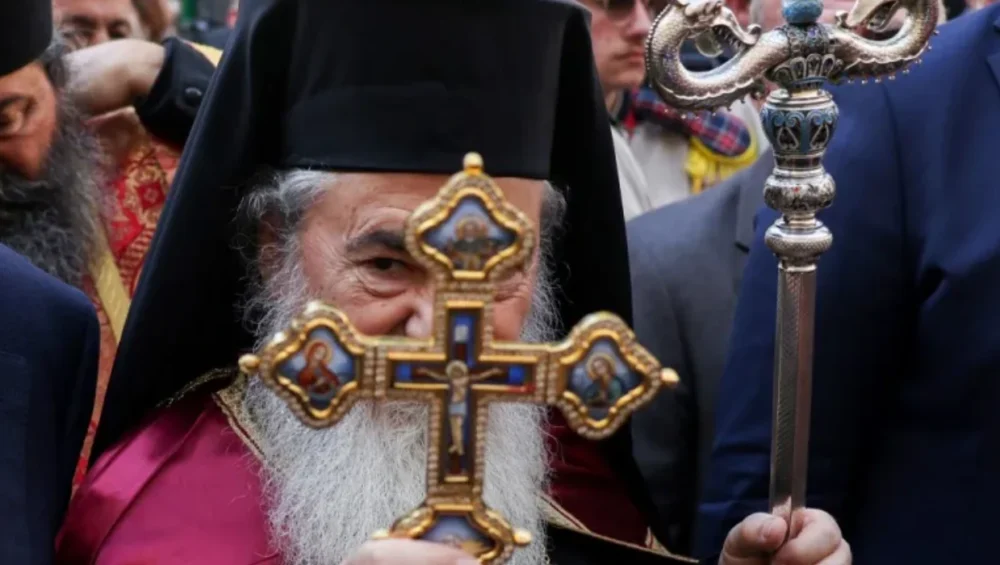
The Patriarchs and Heads of the Churches in Jerusalem have made a dire prediction that the existence of Christianity in the Holy Land is threatened not only by demographic change and political turbulence but also by ideologically motivated and government-supported actions that destroy the coexistence of religious traditions. The Patriarchates and Heads of the Churches in Jerusalem also made a rare and bold statement in decrying the rising power of “Christian Zionism” in a position that undermines the unity of the world’s oldest Christian community.
In a statement released on Saturday, the church leaders cautioned that local actors advancing “damaging ideologies, such as Christian Zionism,” are misleading the faithful, sowing confusion, and weakening the authority of historic churches that have safeguarded Christianity in the Holy Land for nearly two millennia. They warned that these efforts enjoy backing from “certain political actors in Israel and beyond,” raising serious concerns about coordinated interference in the internal life of Christian institutions.
Christian Zionism and Political Power
Christian Zionism, a powerful current within evangelical Christianity—particularly in the United States—frames unwavering support for Israel as a religious obligation. Many adherents believe that Jewish sovereignty over all of historic Palestine is a prerequisite for biblical prophecy, often disregarding the presence and rights of Indigenous Christian and Muslim communities.
Church leaders in Jerusalem argue that this theology is not merely abstract belief but a political force with tangible consequences. Financial donations and lobbying efforts linked to Christian Zionist networks have bolstered Israel’s settlement enterprise in the occupied West Bank and East Jerusalem, entrenching occupation while marginalising Palestinian Christians who trace their roots to the earliest followers of Jesus.
Many Christian Zionists also promote the “prosperity gospel,” which teaches that blessing Israel will yield personal and financial rewards. Critics say this belief system commodifies faith, transforms theology into political endorsement, and sidelines the lived reality of Christians enduring displacement, discrimination, and violence.
Outside Interference and Erosion of Church Authority
The patriarchs expressed deep concern that individuals promoting these ideologies have been “welcomed at official levels both locally and internationally,” describing such engagement as an intrusion into ecclesiastical affairs.
“These actions constitute interference in the internal life of the churches,”
the statement said, warning that external political agendas are eroding the authority of Jerusalem’s historic Christian leadership.
For centuries, Christian institutions have played a central role in preserving religious coexistence in the Holy Land. Church leaders now fear that this delicate balance is being deliberately destabilised, not only weakening Christian unity but threatening Christianity’s future presence across the Middle East.
A Pattern of Pressure on Christian Life
This warning follows growing fears among Palestinian Christians of Israeli policies of land expropriation, settlement expansion, discriminative taxation, as well as pressure on church-owned property that are contributing to the degradation of their presence. Palestinian Christians currently account for less than 2% of the total population of the birthplace of Christianity.
A recent report published by the Council of Patriarchs and Heads of Churches in Jerusalem has pointed out
“threats to Christian heritage—notably in Jerusalem, the West Bank, and Gaza—alongside unjustified taxation,”
warning that
“such activities are threatening the very survival of Christian institutions. This is what we are going through in these sensitive lands. We are being tested in these places of special importance to us and to the world’s Christian heritage.”
Education Under Attack
On Wednesday, the Higher Presidential Committee for Church Affairs in Palestine condemned Israeli restrictions preventing teachers from the occupied West Bank from reaching Christian schools in occupied East Jerusalem. Israeli authorities have sharply reduced work permits for teachers, disrupting education and denying hundreds of students their right to schooling.
Church officials reported that at least 171 teachers and staff have been affected, with permits suspended outright or reduced to a few working days per month. Military checkpoints and bureaucratic delays have paralysed classrooms, delayed the academic calendar, and weakened Christian educational institutions that serve both Christian and Muslim students.
The committee described these measures as collective punishment and racial discrimination, prohibited under international law, warning that they form part of a broader strategy to exhaust Palestinian communities and entrench Israeli control over Jerusalem at the expense of its Indigenous Christian population.
Oppression Beyond Christianity
Church leaders stress that the pressures facing Christians are part of a wider pattern of religious oppression under Israeli rule. Muslim communities face routine restrictions on access to the Al-Aqsa Mosque, including age-based bans, permit regimes, and repeated raids by Israeli police during religious holidays. Jewish extremist groups, often under police protection, have increasingly entered the Al-Aqsa compound to perform religious rituals, undermining the long-standing status quo.
Meanwhile, Armenian Christians in Jerusalem have reported land grabs, harassment, and legal pressure on community property in the Armenian Quarter. Ultra-nationalist settler groups have targeted monasteries, churches, and cemeteries, with vandalism, spitting incidents against clergy, and “price tag” attacks becoming increasingly common. Investigations into these attacks rarely result in prosecutions, reinforcing a culture of impunity.
In Gaza, Christian institutions have not been spared from destruction during Israeli military operations. Churches, schools, and hospitals run by Christian organisations have been damaged or destroyed, further accelerating the displacement of one of the region’s smallest and most vulnerable religious communities.
An Existential Warning
Kurdish, Druze, Muslim, and Christian leaders alike have warned that Israel’s policies increasingly privilege ethno-national dominance over religious pluralism. For Jerusalem’s Christian patriarchs, the issue is no longer abstract theology or diplomatic rhetoric—it is survival.
They warn that the convergence of Christian Zionism, settler extremism, and state power threatens to erase the multi-faith character of the Holy Land. If current trends continue, they caution, Christianity risks becoming a museum relic in the land of its birth, rather than a living faith rooted in its people.
“This is not only about Christians,”
church leaders have repeatedly stressed.
“It is about the moral and spiritual future of Jerusalem itself.”