
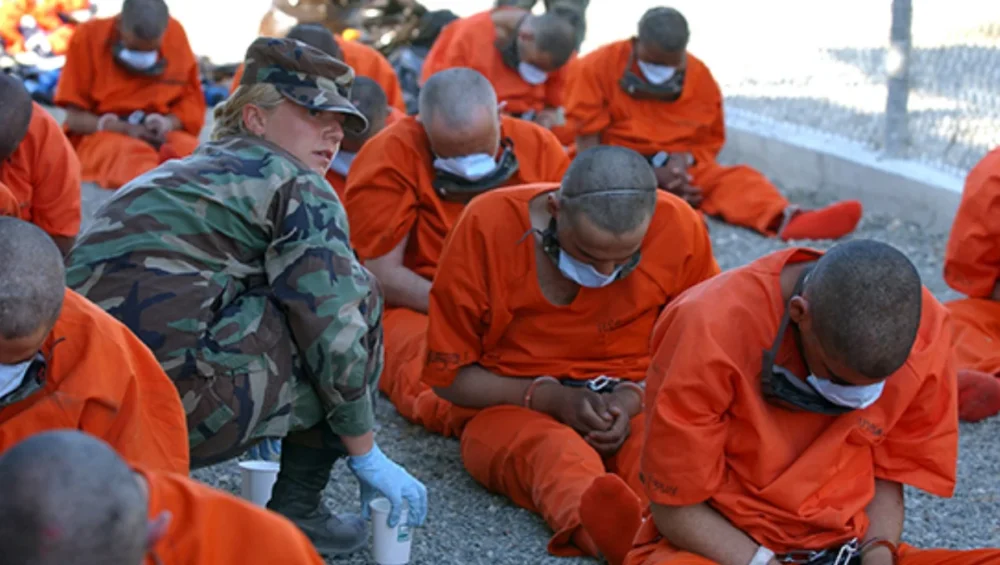
The Guantánamo Bay detention facility has remained among the most debated exemplars of the United States’ foreign and domestic policies during the 21st century. Opened shortly after the attack of September 11, 2001, the facility was intended to be a “safe” place to keep those known as “enemy combatants.” Twenty years on, the facility still maintains 35 prisoners, most of whom have been held without so much as an official indictment and trial.
According to human rights professionals, Guantánamo Bay is one such egregious example of the contravention of international human rights, encapsulating torture, indefinite imprisonment, and the denial of legal rights. As Agnès Callamard, Ex-SR on Extrajudicial, Summary, or Arbitrary Executions, stated in a report,
“Few of these men have ever been tried for a crime, and not one of them has had a fair trial.”
The persistence of Guantánamo, despite widespread condemnation, raises urgent questions about U.S. commitment to human rights, accountability, and the rule of law.
The origins of Guantánamo: bypassing the law
In January of 2002, under the leadership of President George W. Bush, the United States opened its offshore detainment facility at Guantanamo Bay in Cuba as a part of its so-called “war on terror.” The thinking was that since Guantanamo was outside of United States territory, it would put those detained beyond the jurisdiction of United States courts and international law.
The initial inmates were brought into the base on January 11, 2002, marking the start of a process intended to evade judicial review. It can be noted that the United States Government carried out this process with a justified claim that their security required not being bound by standard judicial systems, which would otherwise impede counter-terrorism efforts. This, in practice, led to a legal vacuum in which the inmates were held without charge and subjected to torture.
Torture, abuse, and the failure of military commissions
In the years since, there have been numerous accounts of the widespread detainee abuse at Guantanamo Bay. The detainees were subjected to beatings, sleep deprivation, stress positioning, and waterboarding, which fall under the legal classification of torture as defined under international law—and they were subjected to it all. In addition, they were exposed to other sources of trauma in the form of the lack of any access to their families.
Moreover, the military tribunals, which are designed specifically to try some of these detainees, also demonstrate consistent failure in providing fair trial processes. Such trials also deny the defendants full access to evidences, confrontation of accusers, as well as fair trial. It is cited that in 2023, according to UN reports, only seven out of 780 males and youths arrested in Guantánamo have been convicted.
This leaves victims of terrorism with little justice in sight, and their human rights are in gross violation by the detainees. The further detention of 16 males who are already approved for release but do not require further elucidation of charges depicts further lack of justice in this system.
High-profile cases highlight systemic abuse
A case that stands out among others in terms of human rights abuses in Guantanamo is that of Shaker Aamer, a British resident who was detained in Afghanistan in 2001 and later transferred to Guantanamo in 2002. Aamer spent 13 years in detention without trial despite being cleared for release in 2007, and it appears that this was due in part because of his observation of U.S. and UK agents torturing other inmates.
This is evident in the case of detainee Aamer, who experienced both the randomness of detention in Guantánamo as well as the complicity of other countries within the allied forces in disregarding human rights standards. His release in 2015 was well-welcome, although it also symbolizes the suffering caused in detaining people without trial for so long..
Hunger strikes: a desperate plea for justice
The inmates in Guantánamo Bay have used hunger strikes when complaining about their conditions, indefinite detention, and abuses. At a certain point in the regime, there were inmates who took hunger strikes in excess of 100. Force-feeding, using either a nasally or oral tube, has been recorded, contrary to the ethics used in the medical field, termed torture.
Shaker Aamer reported several “Code Yellow” incidents, in which inmates collapsed or lost consciousness. Such incidents and others of their type reflect the inhumane treatment of which detainees were subjected.
International and domestic pressure for closure
Calls for the closure of Guantánamo Bay have persisted across multiple U.S. administrations. President Barack Obama promised to shutter the facility, but bureaucratic inertia, political opposition, and concerns over transferring detainees to U.S. soil prevented this.
President Biden has reiterated the commitment to closure, yet, as of 2026, Guantánamo continues to operate. In the UK, the All-Party Parliamentary Group for the Closing of the Guantánamo Detention Facility has been actively campaigning for closure, citing the ongoing violations of detainees’ human rights and the need for accountability for past abuses, including alleged UK complicity.
Legal and human rights implications
International human rights standards stipulate that lethal or coercive force may only be used when strictly unavoidable to protect life, and that detainees must have access to prompt medical care. The indefinite detention and torture at Guantánamo violate these standards.
Moreover, dismantling of internal oversight bodies such as the DHS Office for Civil Rights and Civil Liberties (CRCL) has weakened accountability mechanisms, leaving detainees with little legal recourse. The ongoing operation of the facility sends a chilling message about the U.S. commitment to human rights, due process, and rule of law, undermining its credibility on the global stage.
Guantánamo Bay remains an enduring symbol of human rights violations in the name of national security. Decades of abuse, torture, and indefinite detention have left deep moral and legal scars. Cases such as Shaker Aamer’s highlight both the arbitrary nature of detention and the urgent need for independent investigations into allied involvement in torture.
The continuation of Guantánamo undermines the United States’ standing in the international community and violates basic principles of justice. Human rights organizations, international bodies, and domestic advocacy groups continue to press for its closure. For the United States, Guantánamo is more than a detention facility—it is a moral and legal failure that urgently needs rectification.