
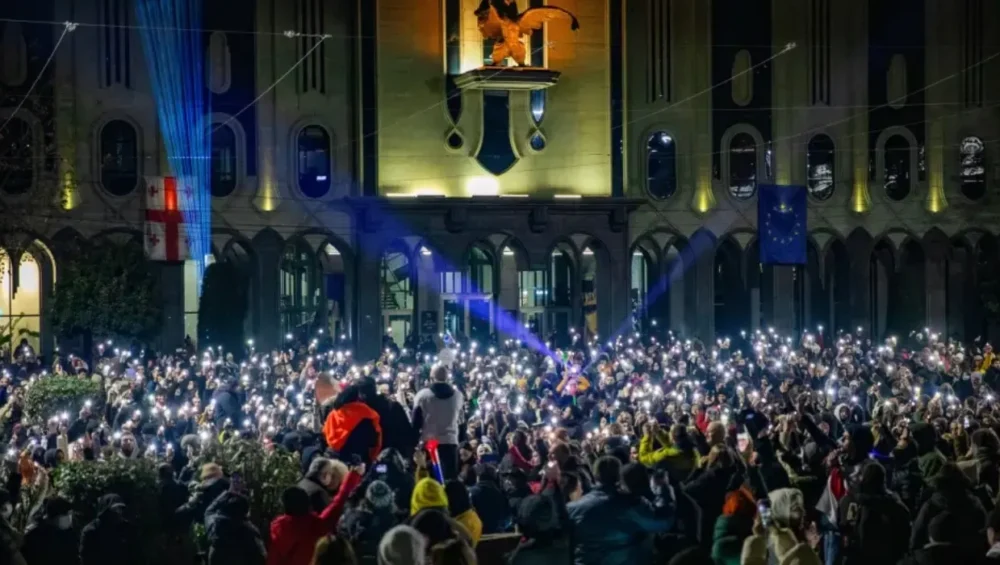
The move by Georgia to put off talks with the European Union (EU) on accession until 2028 has led to a disturbing deterioration in human rights standards, including brutal suppression of protests, restrictive laws, and attacks on civil society. The decision, announced by Georgian Prime Minister Irakli Kobakhidze on November 28, 2024, follows criticism by the EU of Georgia’s democratic regression and problematic laws, such as the “foreign agents” law.
EU Accession Timeline and Political Context
Georgia submitted its membership application to the EU in March 2022 and received candidate status in December 2023 after a series of rapid democratic reforms in the post-Soviet era. The initial enthusiasm about the prospect of membership by 2030 has waned because of democratic setbacks.
The progress has been stalled, especially since May 2024, when the foreign agents law was adopted by parliament, requiring all NGOs and media organizations that receive more than 20% of their budget from abroad to register as “agents of foreign influence.” The law immediately sparked condemnation from the EU, which suspended talks on accession in June 2024, citing threats to civil society, media freedom, and the integrity of democracy.
Prime Minister Kobakhidze’s 2024 statement suspending talks until 2028 came despite assertions that domestic reforms to meet a 2030 EU entry commitment would continue. Reports from EU monitors later characterized Georgia as a candidate “in name only,” noting that the country was drifting away from European standards of democracy.
Key Repressive Measures Implemented
Since the EU suspension, the Georgian government has enacted a series of laws curbing political dissent, freedom of assembly, and the rights of minorities. Key measures include:
- Criminalization of peaceful protests: Laws banning masks, road encroachments, and traffic disruptions, with penalties reaching criminal prosecution levels.
- Anti-LGBT amendments (September 2024): Restrictions on education, health, expression, and assembly for LGBTQ+ communities; media portrayal of LGBTQ+ issues now prohibited.
- Foreign Agents Law Enforcement: Asset freezes and fines against seven NGOs accused of funding protests as of August 2025, creating a chilling effect for civil society actors.
These legislative steps have effectively eroded freedoms guaranteed under Georgia’s constitution and international human rights commitments, including obligations under the Universal Declaration of Human Rights (UDHR) and the European Convention on Human Rights (ECHR).
Crackdowns on Protests: Data and Analysis
Since 2024, police and security forces have violently suppressed demonstrations, arresting thousands and committing acts of abuse. Key statistics include:
| Incident Period | Arrests | Ill-Treatment Reports | Hospitalizations | |
| Nov–Dec 2024 protests | 357+ (up to 460 by Dec 24) | 225+ (300+ alleged torture) | 80+ | |
| Post-Oct 2024 election | 224 | Severe injuries (broken bones, fractures, concussions) | Multiple | |
| Apr–Jun 2024 (pre-law attacks) | N/A | 12+ activists attacked | Hospitalizations common |
Police reportedly used batons, stun devices, and physical assaults to disperse crowds, while detainees were beaten inside police vans and stations. Over 1,000 fines were issued during protest events, yet no officers faced prosecution.
UN experts documented mass prosecutions and stigmatization of youth and activists by December 2024, highlighting the systematic targeting of civic engagement and dissent.
Impact on Civil Society
The foreign agents law has created a climate of fear among NGOs and human rights defenders (HRDs), with numerous organizations facing operational barriers and asset freezes. Consequences include:
- Increased hostility toward HRDs and activists, fostering impunity for attacks.
- Media freedom erosion: Journalists reporting on protests, government corruption, or human rights violations faced prosecutions and physical assaults.
- Suppression of minority rights advocacy, especially for LGBTQ+ communities, limiting access to education and healthcare initiatives.
- Human Rights Council Universal Periodic Review (UPR) warnings in 2025 explicitly cited the repression of civil society and curtailed freedoms.
International Response and Pressure
Georgia’s backsliding has drawn widespread criticism:
- European Union: Diplomats warned of democratic regression in November 2025 reports, questioning Georgia’s suitability for accession.
- Human Rights Watch: Called for sanctions against officials responsible for abuses and independent investigations into protest crackdowns.
- United Nations: Special rapporteurs condemned violence against protesters, highlighting arbitrary arrests and judicial shortcomings.
- Amnesty International: Documented torture, mistreatment, and flawed trials targeting activists.
- PEN International: Advocated in January 2026 for UN oversight and accountability for violations against journalists and civic actors.
The cumulative effect of these measures has undermined Georgia’s international standing, weakening the credibility of its democratic institutions and threatening its EU aspirations.
Why the Backsliding Matters
Georgia’s situation illustrates the risks of EU candidate countries straying from democratic norms without tangible consequences. Key points include:
- Legislative repression as a tool of control: Criminalizing protest and restricting civil society undermines citizen engagement, a core requirement for EU accession.
- Targeting NGOs and media: The foreign agents law mirrors tactics used in Russia and other authoritarian states to weaken independent oversight.
- Erosion of minority rights: Anti-LGBT legislation, combined with police brutality, signals selective enforcement of freedoms, violating international human rights law.
- Implications for regional stability: Political repression may fuel unrest, increasing migration pressures on neighboring EU states and threatening security in the Caucasus region.
Data from local NGOs suggest that over 60% of civil society organizations report a decrease in operational capacity, while protest participation has declined sharply due to fear of violence and arrest.
Human rights organizations and international observers recommend:
- Immediate repeal or reform of the foreign agents law and anti-LGBT amendments.
- Independent investigations into police violence and prosecutions of offending officers.
- Restoration of civil society funding and protections for NGOs and media outlets.
- EU conditionality linking accession progress to demonstrable improvements in democracy and human rights.
Without significant reforms, Georgia risks further international isolation, domestic unrest, and the potential normalization of authoritarian practices under the guise of governance.