
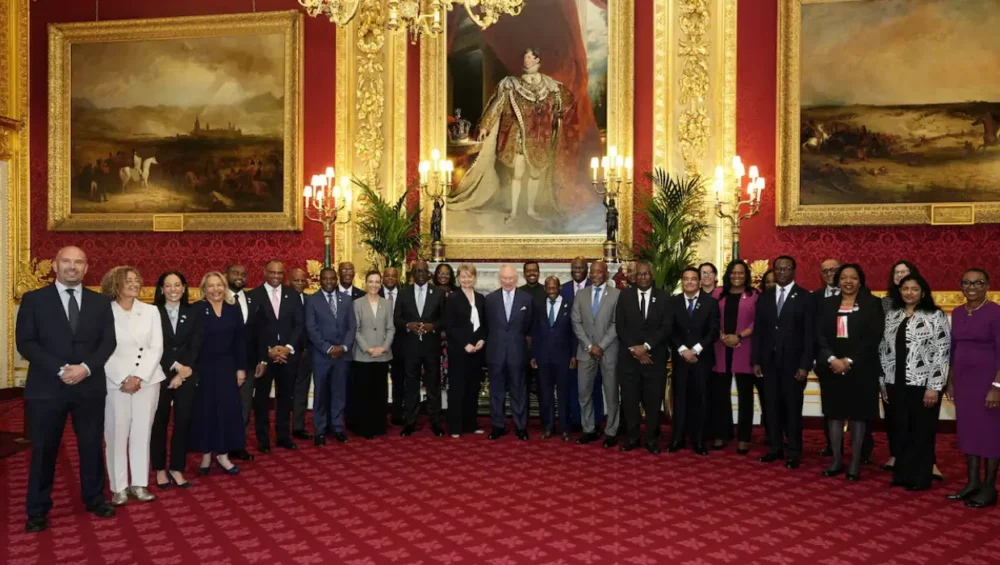
The controversy surrounding a Commonwealth Day reception photograph in March 2026 illustrates how ceremonial moments can acquire political meaning far beyond their initial intent. The image showed Charles III standing with Caribbean officials beneath a portrait of George IV inside St James’s Palace. What might once have been seen as a routine diplomatic setting quickly became a focal point for debates about slavery, imperial memory and the evolving expectations placed on the modern monarchy.
Observers across the Caribbean interpreted the composition through the lens of historical hierarchy. Representatives from states whose economies were shaped by plantation slavery appeared positioned under the likeness of a monarch associated with Britain’s imperial past. In a period when reparations discussions have become a structured part of regional diplomacy, the symbolism resonated strongly. The Caribbean backlash to King Charles’ image did not arise from the photograph alone; rather, it reflected an accumulation of historical grievances that continue to shape how official gestures are interpreted.
The Role of Visual Symbolism in Diplomacy
Diplomatic imagery often conveys messages that words alone cannot capture. Photographs from high-level receptions are widely circulated, forming part of the narrative about relationships between states and institutions. In this case, critics argued that the visual hierarchy unintentionally echoed the historical power structures that Caribbean societies have spent decades attempting to reassess and reinterpret.
The controversy also underscores how symbolism in royal settings has acquired new sensitivity in the digital era. Within hours of its circulation online, the photograph was debated by historians, journalists and policymakers who viewed it not simply as a ceremonial image but as a reflection of unresolved imperial narratives embedded in official spaces.
Caribbean Reactions and Regional Commentary
Several Caribbean commentators and policy advocates framed the incident as a moment that captured longstanding frustrations with how colonial history is acknowledged in international forums. They emphasized that the region’s governments now approach diplomatic engagements with a stronger awareness of historical representation.
For many analysts, the intensity of the response reflects how reparations discourse has matured in recent years. Where earlier debates focused primarily on academic or activist circles, the conversation has increasingly entered official political discussions and intergovernmental negotiations.
The George IV Backdrop and Historical Legacy
At the center of the debate stands the historical figure depicted in the portrait dominating the reception room. Research published over the past few years has examined connections between members of Britain’s royal family and wealth generated through colonial economies. These findings have circulated widely since 2023 and gained renewed attention during 2025 as scholars continued tracing links between royal finances and plantation systems.
The presence of George IV’s image therefore carried symbolic weight beyond the decorative. Critics argued that placing Caribbean officials beneath a portrait associated with a period when Britain profited heavily from slave labor inevitably invited scrutiny. Within the Caribbean backlash to King Charles image, this historical association became a focal point for discussions about how royal institutions engage with newly documented research.
Archival Research and Public Awareness
Historians and investigative journalists have increasingly explored financial ties between royal estates, trading companies and colonial enterprises. Their work gained prominence in 2025 when new studies highlighted the complexity of how royal patronage intersected with plantation wealth and imperial governance.
This research has influenced public debates across both the Caribbean and the United Kingdom. The growing awareness means that visual references to earlier monarchs are no longer interpreted solely as heritage elements but as reminders of economic systems tied to colonial expansion.
Cultural Memory in Royal Spaces
Royal palaces contain artwork and historical artifacts accumulated over centuries, many of which were originally intended to reflect prestige and continuity. However, contemporary audiences are reexamining these objects through different historical lenses. Critics of the reception setting argued that institutions hosting international leaders must increasingly consider how such imagery resonates with visiting delegations.
The incident demonstrates how heritage spaces once regarded as neutral diplomatic venues now operate within a more complex environment of historical accountability and reinterpretation.
From Personal Sorrow to Institutional Accountability
Over the course of his reign, King Charles has acknowledged the legacy of slavery using language that emphasizes empathy and reflection. During previous international gatherings, he expressed what he described as “personal sorrow” regarding the suffering caused by the transatlantic slave trade. His remarks were widely seen as part of an effort to signal awareness of historical injustice while maintaining the constitutional boundaries of the monarchy.
For many Caribbean observers, however, the language of personal regret has increasingly been viewed as insufficient when set against calls for institutional recognition. The Caribbean backlash to King Charles image revived debates over whether symbolic expressions of empathy should evolve into formal acknowledgment by the Crown as an institution.
Language and Expectations in Royal Statements
Diplomatic language used by monarchs traditionally reflects caution and continuity. Statements are often carefully crafted to acknowledge historical events without implying policy commitments that belong to elected governments. Yet as reparations discussions have expanded, the expectations placed on royal rhetoric have also evolved.
Some commentators argue that the distinction between personal sentiment and institutional responsibility has become harder to maintain. When historical research highlights connections between royal institutions and colonial economies, the question arises as to how such findings should influence contemporary messaging.
Reparations Debate in the Commonwealth Context
The reparations movement across the Caribbean has developed structured proposals over the past decade. Regional organizations have outlined plans that include formal apologies, economic partnerships and cultural initiatives aimed at addressing the long-term consequences of slavery and colonial exploitation.
Within this environment, symbolic moments such as royal receptions acquire added importance. Officials attending Commonwealth events now do so while representing governments that have publicly endorsed reparations discussions, meaning that gestures and imagery are evaluated in relation to those diplomatic positions.
Caribbean Diplomacy and Shifting Regional Expectations
The Caribbean backlash to King Charles image also reflects a broader transformation in how Caribbean states approach relations with former colonial powers. Regional diplomacy increasingly integrates historical awareness into policy frameworks, especially as younger generations of policymakers engage with questions of identity, economic justice and historical accountability.
This shift became more visible during 2025, when Caribbean leaders raised reparations and historical justice in multiple international forums. The debates signaled that discussions once viewed as symbolic have become part of formal diplomatic agendas.
Role of Regional Institutions
Regional bodies have played an important role in coordinating the reparations conversation. Policy documents and joint statements have emphasized that historical injustices continue to influence economic development and social structures across Caribbean societies.
As these frameworks gain traction, Caribbean officials attending international events are expected to demonstrate alignment between diplomatic behavior and the region’s evolving policy priorities.
Public Opinion and Political Mandates
Domestic political dynamics within Caribbean countries have also contributed to the intensity of the reaction. Public debates about colonial history have expanded in schools, media and academic institutions, shaping how citizens interpret international engagement with the British monarchy.
Leaders are therefore increasingly aware that symbolic moments abroad can resonate strongly at home. The photograph controversy illustrates how domestic expectations and international diplomacy are now closely interconnected.
Palace Optics and Commonwealth Politics
The episode has also drawn attention to decision-making processes within royal institutions responsible for organizing state events. Choices about venue arrangements, portrait placement and photographic framing may appear routine but can carry significant diplomatic implications in a global environment attentive to historical narratives.
Buckingham Palace has not publicly elaborated on how the reception setting was selected, leaving analysts to interpret the image through their own perspectives. In the absence of clarification, the photograph has become a case study in how symbolic choices can influence perceptions of institutional awareness.
Domestic Debate in the United Kingdom
The reaction from Caribbean commentators coincides with renewed scrutiny of the monarchy within the United Kingdom itself. During 2025, public discussions intensified regarding the historical role of the Crown in empire and how institutions should respond to new historical research.
Parliamentarians, historians and civil society groups have engaged in debates about the potential for official apologies or broader conversations on historical accountability. The international dimension of the backlash therefore intersects with domestic reflection on Britain’s imperial legacy.
Commonwealth Relations and Symbolic Sensitivity
Commonwealth diplomacy has always balanced tradition with evolving political realities. As member states reassess their relationships with the monarchy, symbolic gestures increasingly require careful consideration.
The photograph incident illustrates how Commonwealth events must now navigate a more complex environment in which historical interpretation and political messaging overlap.
Future Pathways for Royal Engagement With Caribbean States
The ongoing debate surrounding the Caribbean backlash to King Charles’ image is unlikely to end with a single controversy. Instead, it may influence how future interactions between the monarchy and Caribbean governments are planned and presented.
Analysts suggest that diplomatic engagement may gradually incorporate greater consultation with historians, cultural experts and regional representatives when organizing official encounters. Such collaboration could help anticipate how imagery and symbolism will be interpreted by audiences both within the Caribbean and internationally.
As discussions about reparations, historical recognition and Commonwealth identity continue to evolve, the reception photograph has become more than a moment captured in time. It now functions as a reference point in a wider conversation about how institutions rooted in centuries of history adapt to contemporary expectations, and whether the language of empathy, symbolism and diplomacy will continue to evolve as the debate over historical accountability gains new momentum.