
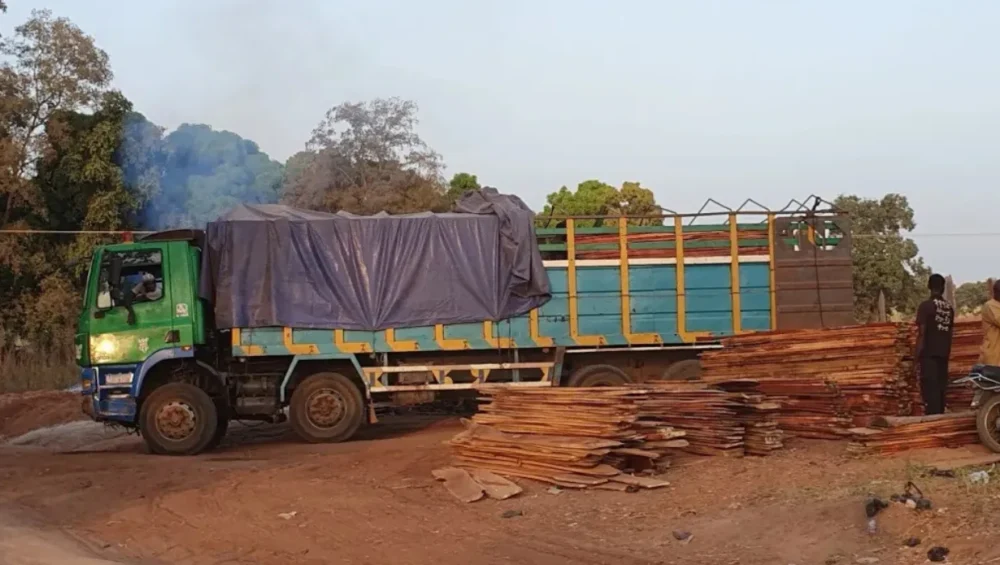
Illegal logging has increasingly formed an important source of revenue to the larger politics of conflict in West and Central Africa. Forest reserves which had previously been discussed largely in terms of conservation are increasingly being incorporated in security discussions as locations where environmental crime meets organized violence. Logging into the forests under protection would provide significant revenues and could hardly be tracked, which is a desirable option for armed groups and criminal networks in search of an untraceable source of income.
In Nigeria in the north central and along Ghana-Cameroon borders, recent investigative journalism has revealed how timber flows through byzantine supply networks across remote reserves to local trading centres and export pathways. Profits along these lines are shared among the transporters, middlemen, traders and in certain instances armed actors who have control over land or infrastructure. Natural-resource crime became one of several informal economic systems that analysts studying trends in financing conflict persist in identifying as sustaining non-state armed groups in 2025.
The timber markets are beneficial as opposed to more visible illegal actions. Logs have been ferried with some honest produce, transactions are often done in cash and law enforcement agencies are often not well represented in forested regions. These features ensure that illegal logging has become a dependable source of funding in areas where the lack of governance is overlapped with insecurity.
Legal frameworks protecting forests but struggling in practice
The legal system of Nigeria offers good formal security to the national parks and forest reserves. The legislation that governs the Nigeria National Park Service prohibits any type of activities that can alter the landscapes or destroy the vegetation such as logging, mining, agriculture, grazing, and construction of infrastructure. Like protections, state forestry laws have lists of forest reserves and outline these illegal actions as cutting wood without permission or turning forest land into other types of land.
These laws hypothetically provide a tight limit on commercial logging within the forested regions. In actuality, though, it is still not enforced consistently. Environmental conservation organizations and civil society reports are also showing that conservation rules are at times compromised due to the loopholes in regulation and overlapping institutional mandates. The cases of other government agencies issuing licences in the areas under protection characterize the fact that competing priorities in policies may leave the open space that may be exploited.
Enforcement limits in remote forest regions
Most of the reserves are too distant to administrative centers making it hard to monitor. Ranger units are often poorly equipped and understaffed, which means that other forest areas are not patrolled. In the regions where gangs of highly armed criminals are on the loose, lightly equipped guards have very limited chances to interfere since their safety is at serious risk.
These circumstances allow the networks of organized logging to work with relative freedom. Research on timber trafficking in the Cameroon-Nigeria border has recorded the trend in which extraction crews go further into the forested areas as local resources get depleted. After the trees are cut, a transport route tends to be taken via remote roads that lack much supervision.
Timber supply chains linking forests to international markets
Timber that was harvested in the forest under protection usually goes through various processes before it is exported to the markets. The trees were cut by local workers or villagers, and in some cases with armed guards around them or a certain degree of complacency of local dealing-men in authority. The logs are then moved to the consolidation points where they are packaged by traders and prepared documentation and long-distance transportation.
This trend is depicted in research mapping of timber cross-border flows between Cameroon and Nigeria. The logs harvested in Donga-Mantung in Cameroon have been followed into Nigeria via Bissaula into Takum in Taraba State. The trucks move on to trading posts in Benue and Kogi states before moving to bigger business centers like Obollo-Afor or Sagamu.
When collected in these centers, timber consignments can hence be shipped via trade routes that have been created between West Africa and furniture production destinations in East and Southeast Asia. These pathways make visible how environmental crime of remote reserves is integrated into the world commodity supply chains.
Armed actors taxing transport and extraction
The timber markets are involved in a number of ways with armed groups. In the areas of the militants or bandit groups with territorial influence, they can impose informal fees on the trucks passing through the forest paths. In other scenarios, armed parties provide security to logging crews at a fee or a portion of the earnings.
Security experts who observe armed groups in north-central Nigeria report that the policy of diversification of illegal economic activity is becoming more frequent. Organizations that want to stay at the level of functionality often bundle revenues through kidnappings, livestock robbery and exploitation of natural resources. This trend is applicable to timber trafficking since it offers a steady source of income and the infrastructural needs are not high.
The conflict financing studies tracking the situation in 2025, underlined the idea that this type of economic activity helps to empower armed factions and allows financing the recruitment of new members, buying weapons and supporting informal mechanisms of governance in remote regions.
Regional examples reveal economic and security consequences
The example of Cameroon is a good illustration of the magnitude of losses associated with illegal logging. The country has been estimated to be losing tens of millions of dollars every year because of illegal timber harvesting. These losses make up a larger regional market of billions of dollars that exists in conjunction with honest forestry exports.
Analysts have cautioned that some of these revenues could end up in the hands of militant or insurgent groups that are active in areas that are bordering. In places where state authority has not been established yet, criminal gangs and militia groups tend to run side by side, either through the same transport chains or due to mutual defense agreements.
The actors involved are also identified in the structure of the trade. When timber is smuggled out of forests, it may pass through local markets of traders, freight movers, exporters and foreign purchasers. The sustenance of these markets is facilitated by corruption within local officials and a high demand made by the foreign manufacturing industries.
Nigeria and Benin within emerging conflict corridors
The most recent studies on the region of north-central Nigeria including the neighbouring Benin depict the same dynamics of the situation emerging along the new conflict lines. The forests of the middle belt of Nigeria are now regarded as the high-value areas where the criminal groups would be found together with the militants groups that would move southwards along the Sahel.
The departments of Benin, to the north, are pressured accordingly. They border on Nigeria, Niger, and Burkina Faso, forming a border point whereby smuggling pathways overlap with insecure security settings. The observers of instability in the region have noted that forests in these areas are becoming the more and more frequent bases of logs, where they can hide, and where they can make profits out of the forests by the armed groups.
Investigative reporting published in 2026 highlighted how illegal timber extraction in these forests may contribute indirectly to militant financing. While precise revenue flows remain difficult to quantify, the investigations demonstrate how environmental crime can reinforce broader patterns of insecurity.
Policy responses linking environmental crime and counterterrorism
International institutions have increasingly acknowledged the relationship between natural-resource exploitation and conflict financing. Discussions within multilateral security forums during 2025 frequently emphasized how commodities such as gold, wildlife products, and timber can sustain armed groups operating outside formal economic systems.
Policy researchers now argue that counterterrorism strategies must consider these revenue sources. Traditional financial tracking tools often focus on bank transfers or formal transactions, yet commodity trades like timber frequently occur through cash payments or informal networks. This makes them difficult to detect without specialized monitoring mechanisms.
Regional cooperation and financial intelligence strategies
Governments in West Africa have begun exploring collaborative approaches to address cross-border timber trafficking. Proposed measures include shared documentation systems for timber shipments, coordinated patrols in border forests, and joint investigations targeting organized crime networks.
Financial intelligence units are also being encouraged to examine commodity supply chains alongside conventional financial data. Mapping how timber profits circulate through transport companies, export firms, and local markets may help identify points where enforcement actions could disrupt illicit financing.
Governance challenges and livelihoods shaping forest frontlines
Efforts to disrupt illegal timber markets face a deeper challenge rooted in local governance and economic conditions. Many rural communities living near forest reserves rely on natural resources for income. When legal forestry opportunities remain limited, illegal logging can become one of the few accessible economic activities.
Weak institutional oversight further complicates the situation. Corruption, insufficient monitoring capacity, and fragmented authority between national and regional agencies allow trafficking networks to operate with limited interference. These structural weaknesses often persist even where strong environmental laws exist on paper.
Forest reserves across north-central Nigeria, Benin, and neighbouring states therefore represent more than ecological assets. They are becoming strategic spaces where environmental governance, economic survival, and security pressures intersect. Tracking timber money into terrorism increasingly reveals how protected landscapes can evolve into financial corridors sustaining instability, raising deeper questions about whether future security strategies will treat forests not only as environmental priorities but also as critical frontlines in addressing conflict economies.