
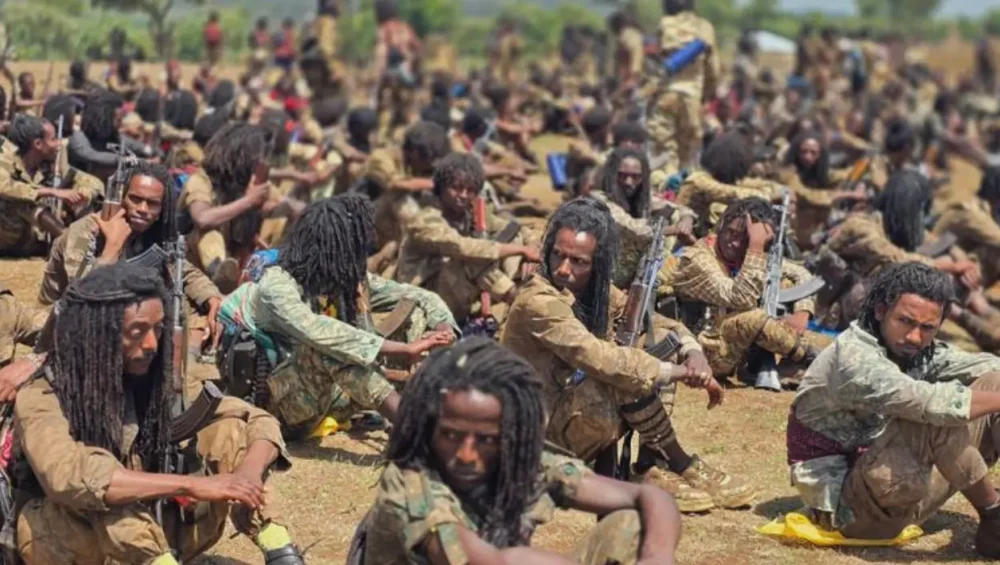
Hunted by government drones, Oromo Liberation Army (OLA) commander Jaal Marroo rarely stays in one place. Wanted by Ethiopian authorities and forced into constant movement, the rebel leader operates from remote forest hideouts across Oromia — Ethiopia’s largest region and home to an estimated 40 million people.
The government has designated Marroo, a former student activist, as a terrorist, accusing the OLA of carrying out ethnically motivated massacres against civilians. In a rare interview from one of his hideouts, however, Marroo rejected those allegations.
“Our war is not against the people,”
he told The Associated Press.
“It is against the brutal regime that has occupied and oppressed the nation for generations.”
Marroo said the group’s objective is political reform rather than civilian harm.
“We are fighting to correct a system that treats the Oromo as subjects, rather than citizens,”
he said, adding that the OLA seeks a
“democratic, inclusive political order based on the will of the people.”
A Long-Running Insurgency Overshadowed by Other Wars
The OLA has been fighting Ethiopia’s federal government since 2018, though the conflict has often been eclipsed by larger crises, most notably the devastating 2020–2022 war in the northern Tigray region.
United Nations investigators have accused the OLA of grave abuses, including killings, kidnappings, and sexual violence. But rights groups stress that government forces have also committed widespread violations as part of their counterinsurgency operations.
Indiscriminate drone strikes, extrajudicial killings, and enforced disappearances have increasingly defined the state’s military response, according to human rights monitors.
‘Atrocities by Both Sides’
Amnesty International says civilians are paying the heaviest price.
“The research that we conducted puts both the OLA and the government forces in the middle of the conflict in terms of summary executions, torture, abductions, and rape of women,”
said
Sarah Kimani, Amnesty’s regional spokesperson. She said a forthcoming Amnesty report, due to be published in March, documents abuses by both sides in Oromia.
“Our report is able to point to both groups having been responsible for atrocities that continue to be carried out against civilians in the region,”
she told the AP.
Families Caught in the Crossfire
For many Oromo civilians, accusations of rebel affiliation can be a death sentence.
Ayantu Bulcha was in Addis Ababa when she learned that soldiers had arrived at her family’s home in Oromia in early December. Her cousin was shot outside the house, she said. Her father and uncle were then taken to a nearby field and killed after being accused of supporting the OLA.
“There have been threats against my family since the killing, and even before that,”
said Bulcha, who is affiliated with an opposition party. She denies that her relatives had any connection to the rebels.
Lensa Hordofa, a civil servant from Oromia’s Shewa region, described constant harassment and extortion by armed men demanding food and supplies. Her uncle was detained and released only after a ransom of 100,000 Ethiopian birr (around $650) was paid.
“Movement from place to place has become increasingly restricted,”
she said.
“It’s almost impossible to travel.”
Bulcha said fear has kept her from returning home.
“My frail mother is left alone in an empty house, grieving. I can’t even go there to grieve with her,”
she said.
“I am afraid for my own safety.”
A Conflict Hidden From View
Access to Oromia is heavily restricted for journalists and independent human rights organisations, leaving much of the conflict undocumented.
“Unfortunately, the human rights situation — as well as the overall humanitarian crisis in Oromia — is underreported,”
said Getu Saketa Roro, co-founder of the Human Rights League of the Horn of Africa. Regional and federal authorities did not respond to requests for comment.
Schools Shut, Aid Blocked, Health Facilities Attacked
The humanitarian consequences are severe. In January 2025, the United Nations reported that 3.2 million children across Ethiopia were out of school due to ongoing violence, with Oromia among the worst-affected regions.
In Wollega district, where Bulcha’s family lived, aid groups struggle to deliver assistance, contributing to widespread malnutrition. Health infrastructure has also been devastated.
In 2023, the International Committee of the Red Cross reported that “nearly all” of the 42 health posts in Oromia’s Begi district had been looted or damaged.
Livelihoods Destroyed and Communities Displaced
Tulu Getachew, a coffee farmer from Wollega, has been unable to return home for three years because of insecurity. Although he hired workers to harvest his coffee beans, armed men stole the crop.
“One party hurts you because they say you belong to the other,”
he said.
“You suffer because they say your family member is affiliated with the government or the OLA.”
Ethnic Marginalisation and Rising Insecurity
Despite Prime Minister Abiy Ahmed being from Oromia — and the Oromo making up roughly 35% of Ethiopia’s population — many Oromo say they remain politically and economically marginalised under Ethiopia’s ethnic-based federal system.
Recent government offensives have weakened the OLA, analysts say. In late 2024, authorities persuaded one of the group’s key commanders to defect, further degrading its operational capacity.
The government says hundreds of thousands of displaced people have returned home. Yet violence persists, and civilians remain trapped between armed actors.
Members of the Amhara ethnic group, Ethiopia’s second-largest, have been targeted in Oromia, according to rights monitors. At the same time, Amhara-based insurgents have carried out attacks inside Oromia, further complicating the conflict.
‘Oromia Is Very Insecure’
Beyond the insurgency, criminal violence is rampant. Armed banditry, extortion, and kidnappings are widespread, and responsibility is often unclear.
“Oromia is very insecure, not simply because of the OLA,”
said Magnus Taylor, Horn of Africa director at the International Crisis Group.
“Other groups are operating as criminal enterprises, engaging in extortion, kidnapping, and robberies.”
As Ethiopia grapples with multiple overlapping conflicts, Oromia’s war remains largely unseen — but for the millions living there, its consequences are inescapable.