
Ethnic cleansing and crimes against humanity in Darfur can be traced to the rebellion in 2003 during which rebel groups accused the Sudanese government of systematic negligence and discrimination. The resultant militarisation, in the form of the deployment of militias what later came to be known as the Janjaweed, took what started as a local insurgency to one of the most recorded atrocity scenarios in the world. Villages which were non-Arab ethnic groups were attacked using organized attacks characterized by arson, forced displacement and massive civilian casualties.
These initial moves solidified the essence of the conflict, which was the identity-based violence that was used to control territories and politics. Disintegration of military forces and rivalry among tribal societies increased the crisis to form the foundation of the reprisal cycles that can be heard today, 2025. The war changed into a battle over state resources into a leading humanitarian crisis that is characterised by mass victimisation and displacement in the long run.
Escalating patterns of ethnic cleansing in 2025
Today, the events of ethnic cleansing and crimes against humanity in Darfur are still being witnessed through organized violence against ethnic communities. According to the recent evaluations, the scorched-earth campaigns continue to be applied in various regions of West and Central Darfur, with armed groups being able to destroy homes, farmland, and water sources in order to provoke demographic changes. The very fact that the civilians continue to be displaced over and over again within the last twenty years is an expression of the mere stubbornness of these strategies.
According to reports by regional monitoring bodies in early 2025, the murder of civilians is being reported in towns like El Geneina where coordinated attacks were reported using heavy weaponry and automated fire. The excessive attention paid to other non-Arab communities supports the old accusation that the violence is still based on the idea of purifying the strategic spaces of certain ethnic groups. Although these acts differ in terms of magnitude, they have the characteristics that are similar to the thresholds outlined under the international law in the crimes against humanity.
Human rights abuses documented across the region
The deliberate violence towards civilians is also one of the characteristic aspects of the conflict. Firsthand reports that were captured in February 2025 detail the attacks on settlements where people claimed to have been hunted down and they tried to escape. The character of these attacks proves the intentional attack on non-combatants and the purposeful victimization of a great number of people.
Sexual violence as a coercive tool
Rape has remained a tool of war and those who have experienced it have reported incidences of rape as a means of inflicting terror and severing community ties. Humanitarian organisations working in the neighbouring Chad have reported instances of refugees arriving in 2025 with many of them reporting rape and other gender-based violence as they fled the militia-controlled areas.
Arbitrary detentions and torture
Arbitrary arrests have been on the rise in the disputed regions, and the arrestees are kept in deplorable conditions and subjected to a form of interrogation that does not conform to the international humanitarian law. Although national authorities do not accept direct participation, the testimonies of the affected communities indicate that the local armed groups were organized and there were political interests in any way to suppress the dissidents.
Challenges in the international legal response
The global reaction to ethnic cleansing and atrocities of humanity in Darfur has been widespread but constrained due to political factors and change within the Sudan government formations. The warrants issued by the International Criminal Court of former leadership bodies, including Omar al-Bashir, have not been enforced but are legally standing in 2025, in spite of political transitions and insecurity.
The new governmental system developed by the 2019 uprising first of all demonstrated readiness to cooperate with the international justice systems. The momentum was however undermined by the instability that ensued after the 2023-24 power struggles. Some ICC suspects are still at large and this is partly because the central authority of Sudan has been disintegrated and revival of rival military groups is possible.
The level of humanitarian access is very limited. In 2024 and 2025, aid organisations working in Darfur made reference to heightened bureaucracy and security blockades that hindered their efforts to provide aid and check on human rights abuses. Lack of effective monitoring systems gives armed actors the leeway to act with relative impunity, making it difficult to document or convict abuses.
Impact of political transitions on conflict dynamics
The political situation in Sudan has grossly influenced the course of the Darfur conflict. Although the 2020 Juba Peace Agreement included some rebel groups into political activities, the ongoing development of armed groups undermines its success in the long term. The situation in 2025 will be quite unstable, as there have been conflicts of power between the military and the paramilitary, which continue to define hotpoints in this region.
The violence in Darfur has been escalated by the instability caused by the increase in the rift between the Sudanese Armed Forces and the Rapid Support Forces (RSF). Regions that were deemed to be fairly stable experienced new conflicts in April 2025, which were caused by rivalry over territorial dominance. Civilians have been constantly caught in the crossfire on the frontline of battle and certain armed groups attacking specific ethnic groups has increased fears of further mass atrocities.
Diplomacy has failed by the African Union and regional actors, and this is mainly because of geopolitical interests. The influence by neighbouring states across the borders is also a root cause of the conflict, considering that weapons and fighters are transported across porous borders. This makes it difficult to negotiate and brings in some extras that spoil the efforts towards sustainable peace.
Humanitarian fallout and displacement pressures
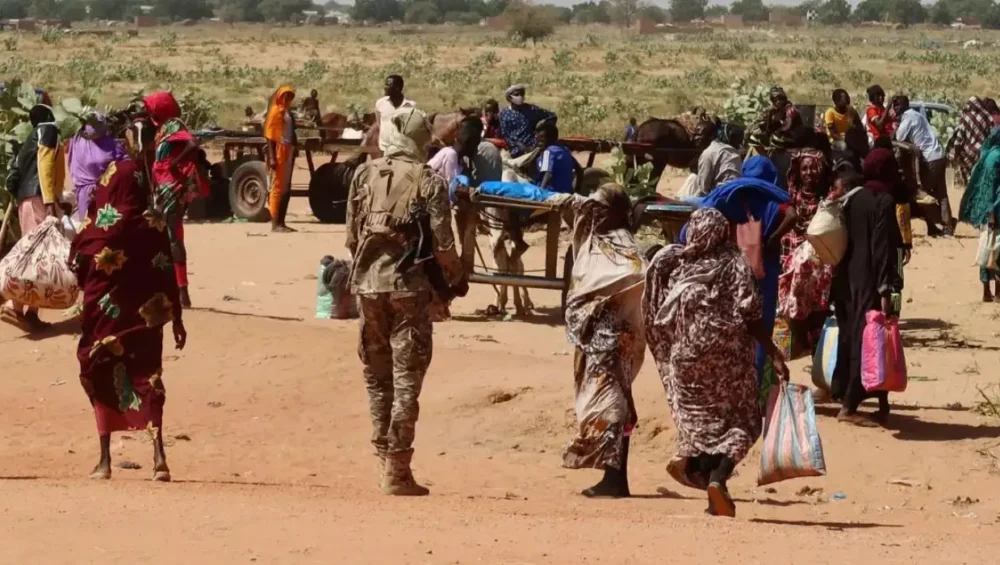
The humanitarian price of ethnic cleansing and crimes against humanity in Darfur is unbelievable. By May 2025, the UN estimates that more than 4 million people are still internally displaced, with almost 700,000 people having fled the country to Chad and South Sudan. A big number of displaced people are in congested camps with no dependable food, health, and safeguarding facilities.
In 2025, the situation has only gotten worse as international aid funding gets interrupted and aid convoys are attacked. In January 2025, a sequence of armed robberies prompted a number of humanitarian groups to temporarily stop operations in West Darfur. Lack of safe routes has a serious effect on the civilian population in receiving the necessary help.
Prospects for accountability and long-term reconciliation
Sudan has a lot to do to implement domestic accountability. Reform in the judiciary has been moving very slowly due to political interference and unavailability of resources. Nevertheless, the groups of civil societies still insist on the idea of hybrid courts that should compare local and international experience in prosecuting the major crimes.
Community-led peacebuilding
In part of the localities, the efforts of grassroots mediation have demonstrated some potential to decrease violence. The traditional leaders and the community groups have been able to negotiate between feuding tribes but these efforts are still prone to increased political instability.
International pressure and support
Accountability is still being promoted by foreign governments and multilateral bodies as important to any long-term peace in Darfur. The 2025 renewed diplomacy is an indication that there is a worry that uncontrolled violence would disrupt the larger region.
The enduring patterns of ethnic cleansing and crimes against humanity in Darfur underscore the complexities of securing justice and stability in a protracted conflict shaped by decades of political turmoil, identity-based violence, and regional interference. As new developments in 2025 reshape the balance of power across Sudan, the unresolved grievances of Darfur continue to influence the wider national trajectory, prompting questions about how accountability, reconciliation, and political restructuring might eventually converge to break the cycle of violence that has defined the region for more than two decades.