
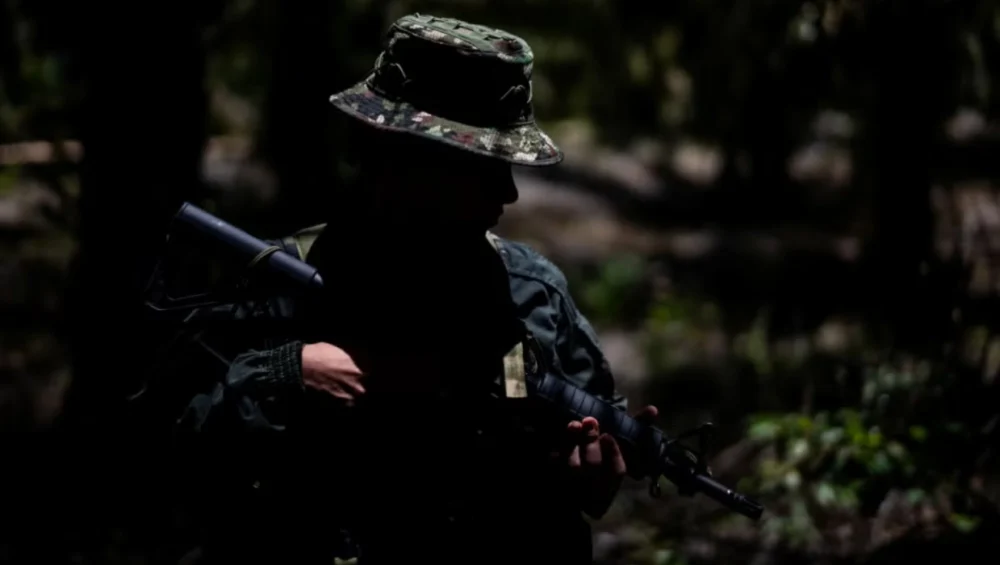
One of the gravest humanitarian crises that is plaguing Colombia at the moment can be described as a trend of an increased recruitment and use of children by armed groups in the country. Such practices rely on exploitation of poverty and lack of social inclusion, dysfunctional education systems, and even the growing role of social media in reaching out to minors in order to use them as cannon fodder for the conflict raging in Colombia. According to UNICEF, the recruitment and use of children by armed groups in Colombia has increased by 300 per cent during the last five years, with the verified cases of child recruitment and use growing from 116 in 2020 to 453 in 2024.
UN reports on children and armed conflict highlight the speed with which the crisis has unfolded. Specifically, the situation is such that in 2024 one child in Colombia is being recruited every 20 hours. Indeed, there has been a marked growth of violence in rural regions of Colombia, leading to armed groups – including the ELN, FARC dissidents, and criminal groups like the Clan del Golfo – recruiting children as fighters, informers, drug traffickers, and sometimes even sex slaves.
The Scale: From Hundreds to Thousands
The most reliable tracker within Colombia, the office of the country’s ombudsman (Defensoría del Pueblo), reported 625 cases of child recruitment in 2024, which represents an 81% increase compared to the 342 recorded cases in 2023. According to reports by Human Rights Watch based on Defensoría del Pueblo data, there have been at least 1,500 children who have been recruited in the country since 2021. Other estimates place the number of children involved in such recruitment between 2021 and 2025 at over 1,200 cases.
These numbers do not represent static figures; they point out a pattern that has extended into 2025 as in the first half of the year, there were 578 cases of child recruitment and exploitation according to UNICEF humanitarian situation reports. The human costs are immense; UNICEF has pointed out that at least 78 children, 58 males and 20 females, have been either killed or wounded due to the recruitment and use in armed conflict situations.
How Armed Groups Lure Children: Poverty, Prestige, and Platforms
The drivers of this surge are both structural and tactical. On the structural side, recruiters exploit intensified violence, pervasive poverty, limited access to education, and weak social services, particularly in rural and conflict-affected regions where the state’s presence is thin. In these environments, armed groups offer what the state often does not: a sense of belonging, a promise of income, and the illusion of power. Children are lured with false promises of employment, income, status, and a “better life,” according to UNICEF and Human Rights Watch analyses of recruitment dynamics.
The tactics used have changed over time. Even though coercion, bribes, and even kidnapping are still being used, social media is a significant part of the new recruitment process involving children. According to a report by Human Rights Watch, 44% of the children and teenagers recruited by armed groups in 2025 were reached via social media, or more specifically, via TikTok and Facebook, based on the information provided by Colombia’s Special Jurisdiction for Peace. The recruiters use these platforms to circulate misinformation about how glorious life is when one is armed or to publish fake job openings or just send direct messages to the children in their chats.
Who Is Recruiting, and Where
The landscape of perpetrators is fragmented but well-documented. The ELN, FARC dissident factions, and criminal gangs such as the Clan del Golfo (Autodefensas Gaitanistas de Colombia) are the primary actors. In 2025, the UN Secretary-General’s annual report on children and armed conflict newly listed the Clan del Golfo alongside the ELN and FARC-EP dissident groups for the recruitment and use of children, signaling the breadth of the problem.
Domestically, the Ombudsperson’s Office has identified the Estado Mayor Central (EMC) as the presumed responsible party for the largest share of forced child recruitment cases in 2025, accounting for 47.1% of registered cases. In the first four months of 2026, the Defensoría linked recruitment cases primarily to the Estado Mayor de los Bloques y Frentes (44%), followed by the ELN (24%), unidentified dissidences (12%), the EMC (8%), and other smaller factions. These attributions matter: they show that recruitment is not the preserve of a single group but a widespread practice across multiple armed structures.
Geographically, risk is concentrated in rural and conflict-affected departments where armed groups exercise de facto control and where schools, social workers, and protective services are scarce. In these zones, the boundary between civilian life and armed life blurs, and children become both targets and tools of war.
The State’s Response: Data, Gaps, and Political Pressure
The Colombian authorities have not remained oblivious to this crisis. The Ombudsperson’s office has been updating their registry of children victims, with an increase in annual figures and even corrections at certain times. The estimates of the security forces only strengthen this picture: Colombian policemen state that almost half of the recruits joining any armed organization are children, while the defense ministry statistics reveal that in seven months of 2025, the number of members of armed organizations has grown by about 3,300 people, which shows the growth of these structures. But the government’s answer to the problem lacks consistency.
Human Rights Watch has already addressed the administration of President Abelardo de la Espriella demanding it to introduce a comprehensive security and justice policy aimed at ending these human rights violations; namely, the policy should address issues of prevention, protection, rescue, rehabilitation of children and punishment of recruiters. At the end of August 2026, HRW has directly appealed to the president and stated that the increase of the number of child combatants can be seen as a litmus test of the respect for children’s rights in the face of serious security threat. The position of UNICEF is similar to that one of HRW: it has described the situation as a humanitarian crisis requiring immediate attention, as well as preventive work on protection of children from recruitment and rape, among other violations; in addition, poverty, absence of education and low level of service delivery are crucial factors that must be taken into account in this situation.
Age, Gender, and the Human Face of the Crisis
The demographics of recruitment reveal who is most vulnerable. Between 2020 and 2025, armed groups recruited most frequently children aged 15 and 16, according to Ombudsperson data cited in recent reporting. The Ministry of Defense notes that between January 2016 and October 2025, the average age of recruitment was 15 years for both boys and girls. This is not a phenomenon of very young children alone; it is a systematic targeting of mid-adolescents who are old enough to be useful in combat and logistics roles but still legally and developmentally children.
Gender patterns are shifting but remain skewed. In 2026, the Defensoría reported that of the cases recorded in the first four months of the year, 60% were boys and adolescents, while 40% were girls and adolescents. Girls face particular risks, including sexual violence and exploitation, and are often recruited into roles that combine domestic labor, intelligence gathering, and combat. The UN has verified cases of girls as young as 11 being recruited and used by armed groups, highlighting the breadth of the abuse.
Social Media as a Recruitment Frontline
The increasing use of social media for recruitment purposes represents a qualitative change in the way that armed groups function. Almost half of all the children recruited by armed groups in 2025 had been reached through social media, based on data obtained from the Special Jurisdiction for Peace and cited by Human Rights Watch. This is no coincidence; rather, it is deliberate. Social networks such as TikTok and Facebook provide the possibility to present a romanticized story of life as an armed combatant and to open up a dialogue in private spaces.