
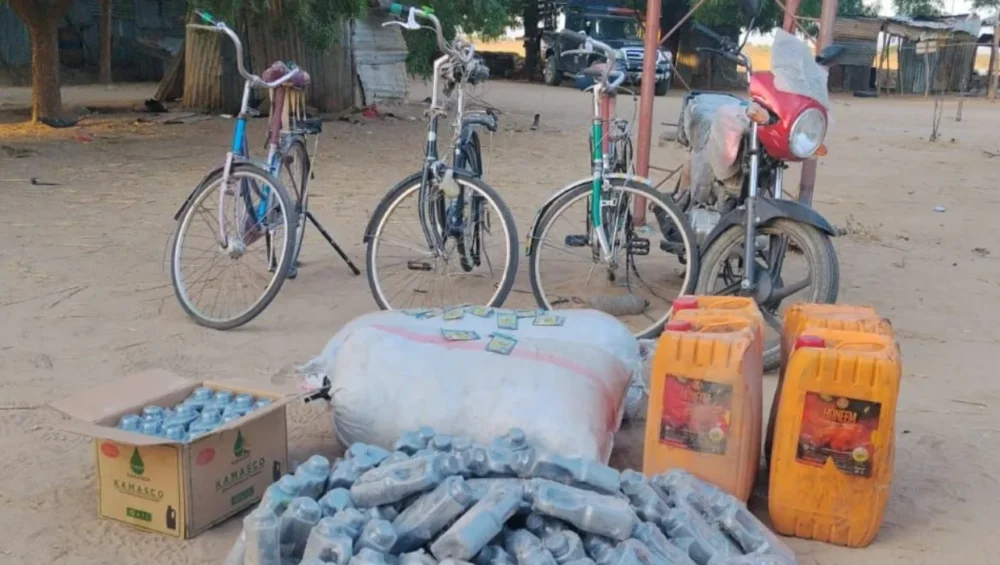
The operation of Hadin Kai by army troops against insurgents in Nigeria reached a new financial stage as insurgently acquired N37 million at a Forward Operating Base at Chabbal in the state of Borno. The seizure of the mobile phones, together with five suspects and the seizure of numerous mobile phones, serves as a clear shift in the direction of destroying insurgent financing linkages and not just on the usage of the targets on the territories alone.
The operation was carried out on the backdrop of the changing militant tactics in the North East. As the traditional strongholds diminish, military groups like Boko Haram and Islamic state West Africa Province have turned to decentralized sources of funds, the flow of ransoms, and informal systems of value transfer. The arrest at Chabbal is an indication that the security agency in Nigeria realizes that insurgency does not just survive by the sword but also the liquidity.
Operation Hadin Kai’s Strategic Financial Pivot
Operation Hadin Kai was initiated in 2021 and was a collaboration of security operations in the states of Borno, Yobe, and Adamawa. As early as 2025, its working structure started to incorporate the financial intelligence into the field deployments in a more systematic way. This process of maturation is depicted by the Chabbal checkpoint action, as it combines tactical interdiction and economic disruption.
The military intelligence as of late 2025 showed that there was a quantifiable increase in monetary interventions related to alleged terror funding. The emphasis has been changed on clearing the enclaves in the Sambisa and Mandara mountains to attacking the arteries that provide recruitment and procurement, as well as cross-border resupply. The Chabbal interception adheres to this recalibration, and it is intended to compress the bandwidth of the insurgents.
Intelligence-Led Checkpoint Interdiction
During regular checks on the movement, troops were said to have flagged a suspicious vehicle at the Forward Operating Base. Investigating, it was found that there was N37 million cash hidden in travel bags. Several mobile devices had also been found, which were suspected to have communications or records of transactions.
The amount is not big in macro economic terms but has big operational impacts in low cost insurgent ecosystems. Translated at the official rates, the sum is enough to purchase weapons, materials of improvisation explosive devices, fuel, and stipends of fighters in the remote land, not to mention, the figure is approximately 23 thousand dollars.
Logistics Strangulation Doctrine
Security analysts note that insurgent movements increasingly rely on decentralized courier systems rather than formal banking structures. By intercepting physical cash in transit, the military disrupts immediate operational cycles. Payments for informants, supply runners, and safe-house operators are often cash-dependent.
In 2025, the Nigeria Financial Intelligence Unit reported freezing over ₦2 billion tied to suspected terror financing across hundreds of accounts. Field seizures such as the Chabbal operation complement these institutional measures, creating a dual pressure mechanism on both formal and informal channels.
The Chabbal Seizure
The Forward Operating Base in Chabbal occupies a strategically sensitive corridor linking rural supply routes to larger transit hubs in Borno. Its positioning enhances the probability of intercepting funds destined for insurgent enclaves.
The same operational window reportedly saw Sector 1 forces repel an attempted ISWAP incursion from the Cameroon axis. The linkage between financial movement and cross-border maneuvering underscores how liquidity and mobility intersect within insurgent strategy.
Regional And Cross-Border Dimensions
Borno State remains the epicenter of insurgent activity, hosting a significant proportion of displacement camps in Nigeria’s North East. Cross-border flows between Nigeria, Cameroon, Chad, and Niger complicate enforcement efforts, particularly in areas adjacent to Lake Chad.
Cameroon Axis And Transnational Supply Lines
ISWAP factions have repeatedly leveraged porous border zones to reposition fighters and material. Cash couriers often exploit these routes to avoid formal scrutiny. Interceptions like the Chabbal seizure signal improving ground intelligence and surveillance coverage along these corridors.
In 2025, multinational coordination under the Multinational Joint Task Force reportedly increased joint patrol frequency and intelligence sharing. Financial interdictions in Nigeria mirror parallel seizures in neighboring states, reflecting a broader regional tightening of enforcement.
Digital Adaptation And Emerging Risks
While physical cash remains dominant in rural insurgent transactions, security officials have acknowledged experiments with cryptocurrency and trade-based laundering schemes. The mobile phones recovered at Chabbal could provide insight into encrypted messaging platforms or informal exchange networks.
Investigators are expected to analyze contact chains, transaction histories, and geolocation metadata. Such digital trails may reveal facilitators embedded within civilian commerce structures, expanding the scope beyond the immediate suspects.
Civilian Intelligence And Local Partnerships
Community-level intelligence is gradually becoming the most critical in operation Hadin Kai. Groups of Civilian Joint Task Forces have traditionally furnished granular awareness of a suspicious traffic movement or an unknown carrier.
In war-torn states exhausted by more than 10 years of war, collaboration has slowly increased as the state of territorial control became stable in some localities by the end of 2025. Elevated small-scale attacks have left room for more accurate, intelligence-comprehensive measures.
The use of checkpoints, however, sensationally increases sensitivities too. The issue of balancing between strong scrutiny and the mobility of civilians is a very fine line especially in areas that rely on informal trade networks.
Broader Counter-Financing Architecture
The counter-financing structure of Nigeria has developed a lot in the last two years. Scrutiny of bureau-de-change operators by the regulator and stricter reporting requirements of financial institutions have also helped in freezing of suspect accounts.
The Financial Action Task Force, as well as international observers, have been checking on Nigeria on the path of compliance. Advancement of enforcement and prosecution is key in the advancement of the country to improve its position in the world in reference to anti-money laundering regimes.
This institutional push goes in line with the Chabbal seizure. Although one interception cannot effectively shut down insurgent financing operations, it is an indication that there is operational unity between field and financial intelligence agencies.
Operational Benchmarks And Attrition Pressures
Increments, even though present, do not stop insurgent violence. Military supply lines are still put to test by improvised explosive devices and occasional ambushes especially in the Maiduguri- Gubio corridor. The fact that security staff members were killed in early 2026 highlights the fact that instability of the theater is permanent.
But the trend of capitulations announced up to 2025 in the hundreds of them creates an impression of adverse cumulative pressure on militant logistics and morale. Attrition of the battlefield is exacerbated by financial constraint, which is slowly reducing the manoeuvrability of the insurgents.
The success of the interception at Chabbal is therefore not just a success at the checkpoint. It is a paradigm of a doctrine that views money as a strategic weakness as opposed to a marginal issue.
The more subtle blow may come silently as the intelligence agencies crack data gathered on phones and track down the source of the N37 million, as broken payment networks and canceled purchasing schemes. The sustainability of this strategy will be determined by the ability of financial pressure to keep up with insurgent adaptation and turn tactical interceptions into long-term systemic restraint throughout the shadow economy of the Lake Chad basin.