
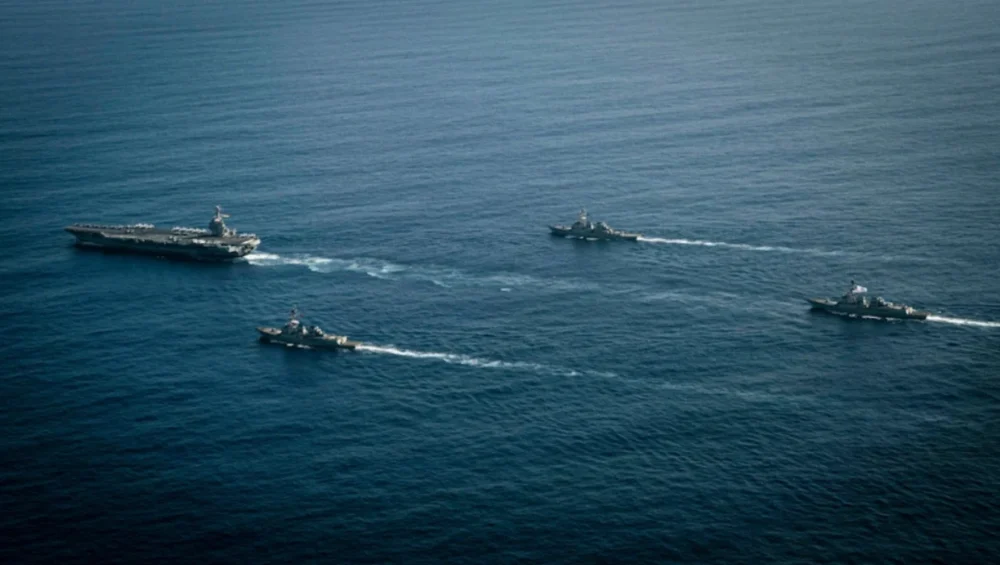
The United States’ 2025 drug-boat campaign has unfolded largely in the Caribbean Sea and the eastern Pacific, targeting small vessels suspected of narcotics trafficking. These operations have taken place far from conventional battlefields and without a declared war or acknowledged non-international armed conflict. By mid-December 2025, publicly available reporting suggested that dozens of vessels had been destroyed and close to one hundred individuals killed, often through air- or drone-based strikes rather than boarding or arrest.
What distinguishes these operations legally is not only their lethality but their setting. No state has formally claimed that the individuals targeted belong to an organized armed group engaged in sustained hostilities against the United States. Instead, officials have framed the campaign through the familiar political language of the “war on drugs,” a metaphor that does not itself trigger the application of the law of armed conflict. That framing places the campaign in a legally ambiguous space between military action and law enforcement.
International law draws a firm boundary here. The law of armed conflict applies only once violence crosses the threshold of an armed conflict, assessed through intensity and organization. When that threshold is not met, states remain bound primarily by international human rights law, even when they deploy military assets. This distinction shapes how necessity, proportionality, and accountability are evaluated.
Why does the war crimes framework fall short?
The use of terms like calls declaring the strikes as war crimes, shows that the country is outraged but may lack precision in analysis. By definition, war crimes are severe breaches of the international humanitarian law that are carried out during an armed conflict. The legal ground of the label falls apart without a qualifying conflict, however destructive and controversial the conduct might be.
The lack of chronic hostilities and an organized armed resistance to the drug-boat scenario destroys the armed-conflict prerequisite. The very fact that anti-trafficking operations are treated as warfare has threatened to overstretch humanitarian law and make it less coherent and thus less protective in the long term.
Risks of conceptual expansion
This has more far-reaching implications when the war-crimes term is extended to non-conflict cases. When the intensive policing campaigns are routinely repackaged as warfare, states will start to insist on combat-style targeting regulations in situations that have historically been regulated by more stringent human rights. This change would reduce the standard of lethal force and undermine that which is meant to protect civilians.
To legal analysts, the problem resides in the need to have the right framework of accountability without perverting the foundational categories. The severity of the murders is not based on the fact that it is a war crime; international law has other mechanisms to deal with unlawful violence by the state.
Crimes against humanity and systematic maritime violence
International law has a different place that is occupied by crimes against humanity. They do not presuppose an armed conflict, but rather depend on the commission of criminal offences, including murder, as a component of a general or regular attack on a civilian population and with the intention of such an attack pursuant to a state policy and aware of that attack. The applicability of this framework to the drug-boat campaign is that it is concerned with patterns and not individual incidences.
The execution of one person in the sea would otherwise be considered an extra-judicial killing according to the human rights law. Regular deliberate attacks sanctioned via a centralized chain of command and explained by the existence of a formulated policy that opposed suspected traffickers might, however, become similar to a planned assault. External communications that focus on targeting and destroying traffickers in all their locations can support that reading.
Civilian status at sea
The other major concern is the legal position of the targeted. Other than in armed conflict, people are assumed to be civilians even when they are suspected of committing severe crimes. However dangerous the drug trafficking may be, it is not turning the civilians into soldiers, nor can they be treated as legitimate military targets.
In case ships are not armed, and the crews do not present any immediate danger to life, then the deliberate use of lethal force is subject to serious legal questions. The international law does not have any doctrine that allows pre-emptive killing of suspected criminals exclusively on the basis of intelligence analysis. In this respect the demolition of ships and the loss of human life is not so much a self-defense as a punishment.
Human rights law and extraterritorial obligations
The international human rights law has a binding effect on states to uphold the right of life of individuals under their jurisdiction or effective authority. The jurisdiction is not limited to the national territory but may be extraterritorial in case a state uses lethal force to implement its powers. The US-approved and implemented maritime strikes thus are a part of human rights concerns, no matter the location.
The use of lethal force under this framework is only allowed when the use of force is deemed to be necessary to preserve life and no other alternatives that are less harmful exist. The traditional tools of maritime law enforcement are interception, warning, and arrest. The excuse of lethal strikes is undermined significantly when these alternatives are available though they may have been circumvented.
Intelligence errors and foreseeability
Foreseeability and risk are also the subject of human rights analysis. When the intelligence-based profiles upon which the authorization to strike is granted are known to have a high possibility of mistakenly identifying the wrong fishers or low-level couriers then the continued use of such a technique may be considered as a careless negligence towards life. This is increased by past maritime interdiction data which has shown false positives.
Openness and research are also at the core. The law on human rights mandates the need to have immediate independent investigations on the subject of possible unlawful killings. The lack of publicity on the basis under which it targets post-strike review and means to claim provides concern regarding the adherence to these requirements.
Due process and the militarization of crime control
Another effect of the drug-boat campaign is that it replaces the use of lethal force with a trial by court. Drug trafficking is a criminal activity that has always been dealt with by arrest and prosecution and sentencing. The states that take the approach of executing the suspected traffickers instead of arresting them have in effect superseded due process provisions.
This is a strategy that replicates previous counterterrorism strategies and extends them to transnational crime. The danger of such practices being normalized is that it will lead to the erosion of the boundary between security activities and penalizing, with long-term implications on legal responsibility and human rights standards.
Impact on affected communities
The result is the increased fear and insecurity among communities in the maritime routes. Connection to the likely traffic routes can put individuals at mortal risk without prior warning and a chance of refuting the charges. Human rights wise, such a dynamic intensifies the issues of profiling, discrimination, and collective punishment.
Strategic and normative consequences
The US drug-boat campaign will have an impact on world practice based on its legal interpretation. Once the mighty nations claim to have the right to make lethal attacks on suspected criminals at sea, other nations might do the same, using the same reasoning to migrants, pirates, or political parties that have been designated as a security risk. These precedents may lead to a tremendous expansion of extraterritorial force.
In its turn, the long-term investigation based on the human rights law and the theory of crimes against humanity might strengthen the restrictions on the violence against the state. International bodies influence expectations even without direct jurisdiction through reports, resolutions and jurisprudence to elucidate legal boundaries.
Rethinking maritime enforcement frameworks
The campaign also leads to re-evaluation of the current regimes of maritime cooperation. The international conventions of drug control and the law of the sea focus on boarding, seizure, and coordination between countries, but not unilateral destruction of ships. When states feel that such structures are not satisfactory, there might be pressure to make an interpretation or change.
It remains unknown whether that development enhances the enforcement of the law or triggers a shift towards militarized solutions. What is evident is that the legal lens to be used is important. A more accurate analysis of human rights and crimes-against-humanity analysis instead of the rhetoric of war crimes presents a more accurate view of what is at stake. With the changing nature of maritime security issues, the controversies on whether the seas are governed by rules of interdiction and accountability or governed by doctrines that grow progressively more accepting of lethal force as a normal instrument of transnational crime control will change accordingly.