
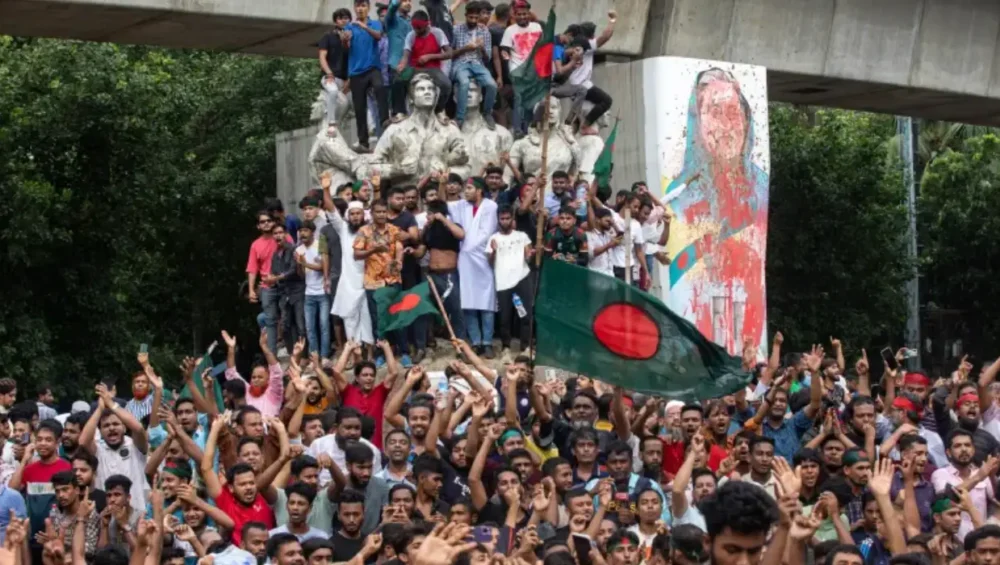
Student-led rebellion in Bangladesh in mid-2024 constitutes direct defiance of the traditional and longstanding tradition of the patronage-well-entrenched-corruption-modeled authoritarianism under the leadership of the Prime Minister of Bangladesh, Sheikh Hasina. In seeking jobs to be hired on the merit of the individuals, there has been a national rebellion.
The demonstrations that gripped the country were successful in removing Hasina’s government, replacing it with an interim government that has commenced an unprecedented anti-corruption drive, even though, it is argued, repression of dissidents and violations of human rights are prevalent in the new government.
Origins in Quota Reform and Systemic Discontent
It was driven to action after June 5, 2024, when Bangladesh’s High Court reinstated the contentious quota of 30 percent for descendants of independence war freedom fighters in government jobs, following its removal in 2018. Students of leading educational institutions, like the famed Dhaka University and Begum Rokeya University, rose in protest under the appellation Students Against Discrimination (SD) and called for meritocracy in public sector hiring.
The protesters’ demands were explicit and data-driven:
- 93% of government posts should be filled through merit-based recruitment.
- Quotas for minorities and persons with disabilities should be capped at up to 7%, reflecting fairness rather than political favoritism.
- The government should ban the Awami League’s Chhatra League, a student wing accused of violence, intimidation, and political coercion.
Notably, the transition of the movement into the public domain faced an economic downturn. Bangladesh is faced with more than 40% of its population in the age range of 15-24 years being out of jobs. Bangladesh has the highest youth unemployment in the world. This has prompted frustration among the young population since civil jobs are perceived to be available. The level of perceptions of corruption has also deteriorated. Bangladesh scored position 149 out of 180 in the Corruptions Perceptions Index in 2023.
As July began, demonstrations began bubbling outside of Dhaka City. Students started “Bangla Blockades,” an all-encompassing movement, by shutting off roads and rail lines in Bangladesh on July 7. This encompasses such cities as Chittagong and Rajshahi. The scale of such an uprising implied an important political concern, rather than any issues with quotas.
Escalation and the July Massacre
The government’s move toward the demonstrators was immediately marked by highly violent and disproportionate action. The situation was at its climax when the Bangladeshi prime minister, Hasina, made a comment in public on July 14 in which she identified all those protesting as “Razakar” descendants—the term “Razakar” being somebody who collaborated with the colonial authorities in Bangladesh at the time when Bangladesh fought for its freedom in the early 1970s’ war for independence from its colonial
Furthermore, according to reports, attacks by the Chhatra League were launched on July 15. The attacks were conducted simultaneously at Dhaka University and Dhaka Medical College Hospital. The police action even contributed to the killing of a student, Abu Sayed, at Rangpur on July 16.
The state then moved into full repression mode:
- A nationwide internet blackout began on July 18.
- Curfews and “shoot-on-sight” orders were imposed.
- Police and paramilitary forces carried out widespread arrests and detentions.
While the casualty numbers are disputed, independent sources estimate the numbers to be many more than the reported ones. By the time of the August 2 reports, official casualty numbers were recorded as 215 dead, but unofficial numbers were estimated to range from 300 to 500 people killed. Even the United Nations Children Fund, commonly known as the UNICEF, reported the killing of only 32 children.
The death toll was confirmed by a UN investigation to be about 1,400, which occurred with extrajudicial executions and torture. The investigation revealed that it was a systematic killing linked to certain agencies of government, which raised concerns with international human rights organizations.
Key Casualty Figures (July Revolution)
| Category | Official / Interim Reports | UN Estimate (Feb 2025) |
| Deaths | 834 confirmed (Jan 2025 gazette) | ~1,400 |
| Injuries | >20,000 | Extensive, including 400+ blinded |
| Arrests | >11,000 | Widespread arbitrary detention |
| Children Killed | 32 (UNICEF) | Included in totals |
The scale of the crackdown indicated a state willing to use extreme violence to suppress dissent—an approach that echoed previous authoritarian tactics in Bangladesh’s history but on a far larger scale.
Hasina’s Ouster and the Interim Government
Finally, the demonstrations were able to achieve political change in Bangladesh. Non-cooperation, therefore, took root with increasing intensity after August 4, with Prime Minister Hasina finally resigning on August 5. Furthermore, Hasina finally sought refuge in India, highlighting an acute lack of political acceptability with the people of Bangladesh.
Economist Muhammad Yunus, a Nobel Peace Prize recipient himself and a former banker, assumed office to head an interim government on August 8. He filled several key positions in this cabinet with notable figures from the SD Party. One example of this is Nahid Islam for the ministry of ICT and Nasif for Youth & Sports. This marked a dramatic shift away from decades-long dominance by the Awami League.
In September 2024, the interim government formed six key commissions to examine and revamp the nation’s election, judiciary, police, anticorruption, and constitution systems. A “July Charter” was also created to forge a consensus prior to the 2026 elections, which promises to launch reforms.
Post-Uprising Anti-Corruption Drive
The interim government initiated an aggressive anti-corruption campaign targeting the former ruling elite. Sheikh Hasina was sentenced to death in November 2024 for crimes related to the protest crackdown and later received 21 years in November 2025 for land-grabbing cases in absentia.
The Anti-Corruption Commission (ACC) also filed charges against Hasina’s family, alleging Tk 800 billion ($6.6 billion) in irregularities and $300 million in smuggling. These charges represent some of the largest corruption cases in Bangladesh’s history.
Major Corruption Cases (Post-2024)
| Case | Details | Status |
| Sheikh Hasina (Land Grabs) | 8 cases involving Purbachal plots | Charge sheets approved (March 2025) |
| Hasina Family (Projects / Smuggling) | Tk 800B ($6.6B) irregular projects + $300M abroad | Probes ongoing |
| UK Minister Tulip Siddiq | Named in corruption probe | Resigned |
These prosecutions demonstrate the scale of alleged state corruption under Hasina’s administration, but also highlight the risk of politically motivated trials in a country with weak judicial independence.
Ongoing Student Activism and Lingering Repression (2025–2026)
Although there was a government change, student activism plays an important role in Bangladesh’s politics. In February, 2025, student leaders of SD formed National Citizen Party, whose intention was to compete in the 2026 elections on an anti-corrupt platform.
Protests continued to persist in the country until the end of 2025. For instance, in July, an air force jet crash resulted in the death of 31 people, mostly children, which demanded the need to hold people accountable for acts of violence and to be transparent about the actions being taken in the country. In December 2025, the country experienced violence once again owing to the death of the SD leader, Sharif Hadi.
Human rights concerns remain acute. Although the interim government has promised reforms, reports continue to emerge of abuses and rights violations, including:
- arbitrary detention,
- surveillance and intimidation,
- restrictions on press freedom,
- and continued political interference in the judiciary.
Students continue to demand tribunals for the July killings, justice for minority communities, and purges of state officials linked to repression. With the 2026 elections approaching, Bangladesh faces a pivotal moment: either a genuine transition toward democratic governance and accountability, or a renewed cycle of repression under a different leadership.