
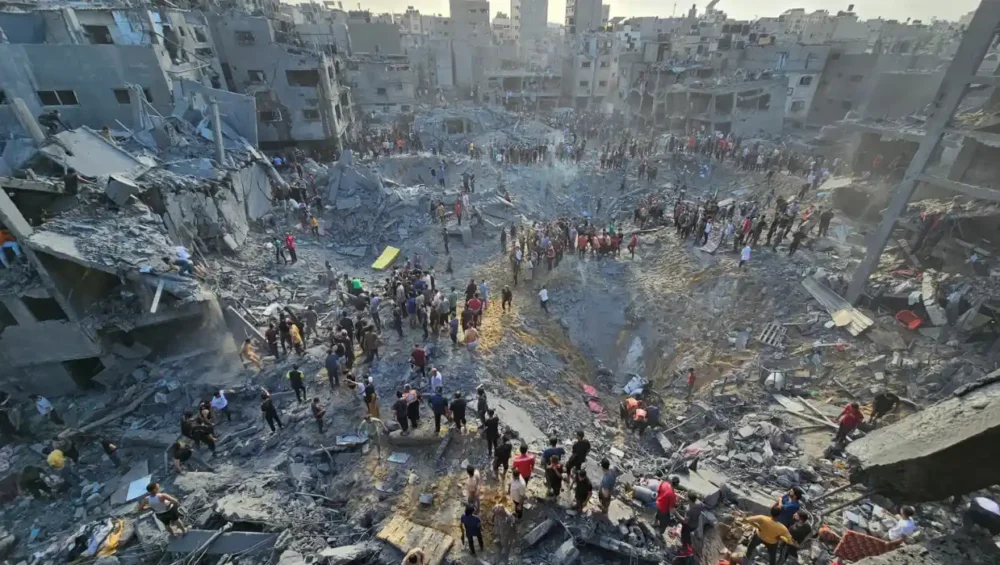
By 2025, pressure and scrutiny by the UN into the Gaza conflict had grown with the accumulating evidence compiled by the Independent International Commission of Inquiry under the Human rights council. On September 16, it released a report on the activities of the period between October 7, 2023, and July 31, 2025, the most detailed UN evaluation of the behavior of the Israeli military. An outcome of the Commission that the Israeli actions amounted to war crimes was the legal basis of the expansion of the inquiry to genocide determinations by a June 2025 Human Rights Council conclusion that Israeli actions were war crimes.
Genocidal acts documented
In the September 2025 report, it was established that four out of five acts of the 1948 Genocide Convention were fulfilled. These involved killing of members of a group, causing severe bodily or psychological harm, intentional imposition of conditions of life to cause physical destruction and birth prevention measures. UN death counts showed that at least forty-six percent of the death toll recorded in Gaza as of July 15, 2025, were children. In the report, Israeli intelligence estimations indicated that 83 percent of the people killed were civilians. The destruction of the heavily populated areas through the application of unguided, wide-impact munitions by the OCHA estimated 60,199 casualties by July 31.
Commission findings reported that Israeli forces were still using such weapons even though they were known to kill many civilians. Investigators concluded that decision-makers anticipated large-scale civilian fatalities and proceeded without modifying operational methods. The total obstruction of aid, which contributed to starvation conditions, along with the systematic collapse of healthcare and education infrastructure, reinforced the assessment of deliberate infliction of destructive conditions.
Siege and starvation policies
The Commission documented conditions consistent with enforced famine. Restrictions on aid convoys intensified between May and July 2025, with reports of civilians killed while attempting to access food distribution points. Investigators recorded patterns of sexual and gender-based violence, targeted attacks on children, and strikes on religious and cultural sites, suggesting broad forms of harm beyond battlefield engagement. Pillay emphasised that Israel’s actions persisted despite the ICJ’s provisional measures ordering protection of civilians, describing nearly two years of sustained siege as demonstrative of intent.
Evidence of genocidal intent
The report cited multiple statements by senior Israeli officials among them President Isaac Herzog, Prime Minister Benjamin Netanyahu, and former Defense Minister Yoav Gallant as contributing to the determination of intent. These statements, which Commission analysts described as dehumanising or exclusionary, were evaluated alongside the operational conduct to establish a coherent pattern indicating genocidal motive.
Conduct escalation and lack of mitigation
The Commission found no meaningful efforts to reduce civilian casualties despite widespread international warnings. Instead, the continuation of bombardment, siege conditions, and infrastructure destruction led investigators to conclude that intent could be inferred from a consistent pattern of behaviour.
Failures of accountability
Israeli authorities did not initiate significant investigations or prosecutions relating to alleged atrocity crimes, a failure the Commission interpreted as a breach of obligations to prevent and punish genocide. Israel rejected the UN findings as unfounded and maintained that its operations were self-defensive.
Rhetoric aligned with operational patterns
Commission analysis linked public statements to operational decisions on the ground. Bombardment strategies, restrictions affecting reproductive health, and targeted destruction of essential infrastructure were assessed collectively to determine continuity of intent. Pillay argued that the actions formed part of a “ruthless, prolonged, widespread attack” with historic roots dating back to 1948, framing the events as part of a broader governmental trajectory.
International legal ramifications
The findings carry significant implications for state responsibility under the Genocide Convention. ICJ orders issued earlier in 2025 directing Israel to expand humanitarian access and halt operations in Rafah highlighted concerns about non-compliance. Continued military operations despite these orders may compound legal exposure.
Criminal accountability and universal jurisdiction
The report’s conclusions could facilitate referrals to the International Criminal Court. Several member states have expanded universal jurisdiction frameworks, creating potential for prosecutions in domestic courts for atrocity crimes. Legal debates through 2025 reflected a widening divide between states advocating enforcement and those prioritising diplomatic negotiation.
Obligations of third states
Member states have duties to prevent and punish genocide, which the Commission argued may necessitate arms embargoes, sanctions, or suspension of military cooperation. The report’s authority, derived from integration of previous UN investigations, strengthened calls for policy reassessment among allies.
Accountability mechanisms
The Commission identified failures in internal Israeli oversight mechanisms, arguing that the lack of credible investigations pointed toward involvement by senior officials. Public discussions following the report, including legal analysis aired on PBS and other platforms, revealed contrasting interpretations of intent requirements but acknowledged the gravity of the Commission’s findings.
Shifts in global diplomacy
Through 2025, UN voting patterns signalled emerging geopolitical shifts. Several European states recalibrated positions on arms transfers and humanitarian access. Many Global South states intensified calls for accountability, contributing to deeper divides between Western and non-Western blocs.
Humanitarian access debates
Continued aid blockages remained central to diplomatic discussions. The Commission’s documentation of fatalities linked to food distribution sites contributed to increased scrutiny over humanitarian law adherence. Media assessments, including remarks by BBC correspondent Jeremy Bowen describing the findings as a “blunt indictment,” amplified international attention.
Secretariat involvement
Guterres’ December 2025 remarks signalled a strengthened role for the UN Secretariat in monitoring compliance with humanitarian obligations. The comments reflected broader institutional concern about the conflict’s trajectory and the implications of prolonged disregard for ICJ directives.
Diplomatic pressure points
Non-compliance with international legal orders has reinforced Israel’s growing diplomatic isolation. Military operations continued into late 2025, placing additional pressure on allies who must balance strategic ties with legal obligations. This dynamic has shaped bilateral and multilateral engagements, influencing policy deliberations in multiple capitals.
Policy and enforcement challenges
The Security Council remains limited by vetoes, particularly regarding enforcement measures. This structural barrier complicates implementation of Commission recommendations, especially those requiring coordinated international action.
Atrocity-prevention frameworks
The demands of the Commission to stop the hostilities at once are consistent with the changing atrocity-prevention schemes of the UN and the regional organizations. States have been encouraged to align national policies with international law requirements, which has hitherto been an unbalanced process in alliances.
Anticipated 2026 agenda shifts
The authors foresee that, by 2026, UN institutions will continue investigation and debates of the Gaza issue. The results have turned out to be the main center of the debate on the future of accountability systems and conflict-prevention policies.
The transition to the categorization of war crimes to that of genocide is a major legal and diplomatic shift. The combination of recorded acts, implied intent and the failure to enforce it has brought more profound questions on whether international institutions were able to stop continued harm as evidence has continued to build up through 2025. The question as to whether raising legal standards can produce a significant restraint or whether to the law geopolitical inertia will be the limitation to action continues to be a challenge to the world order systems.
The Commission relied on the International Court of Justice’s “only reasonable inference” threshold articulated in Bosnia v. Serbia, focusing on both actus reus and dolus specialis. Commission Chair Navi Pillay asserted that the evidence demonstrated genocide, attributing responsibility to senior Israeli officials accused of orchestrating a campaign aimed at the destruction of Palestinians in Gaza. Reinforcing this view, UN Secretary-General António Guterres stated on December 3 that there were “strong reasons to believe” war crimes had occurred amid conduct he described as “fundamentally wrong,” adding institutional weight to the findings.