
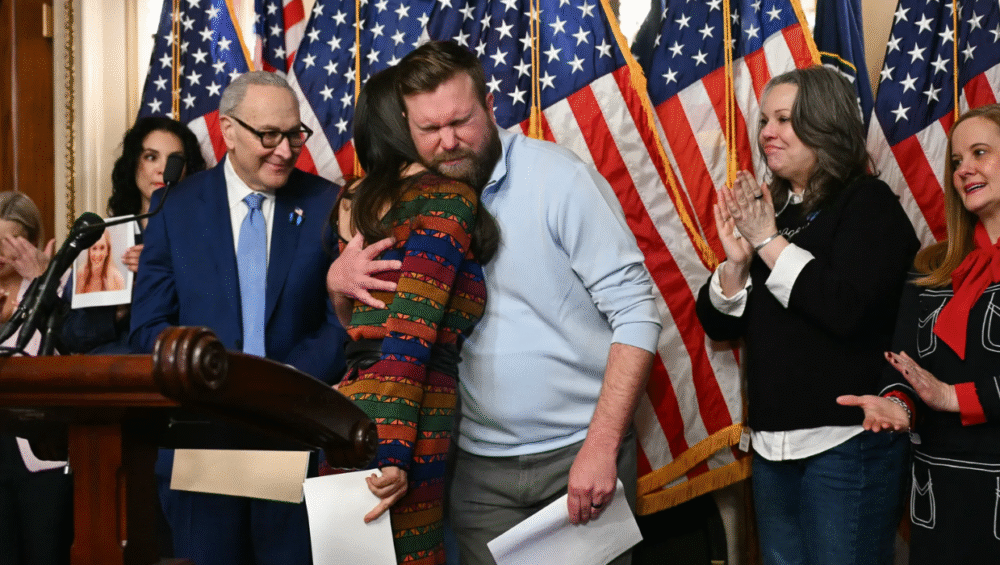
Democratic lawmakers in the US Congress unveiled a new bill that would completely eliminate the statute of limitations for federal civil sex abuse cases. The proposed legislation is called Virginia’s Law, after Virginia Giuffre, who accused the late convicted sex offender Jeffrey Epstein and his associates of sexually abusing and trafficking her during the 1990s when she was a teenager.
The bill is being introduced amid revived scrutiny of Epstein’s network and broader debates about legal barriers that prevent survivors from seeking justice decades after abuse occurred.
What Is Virginia’s Law?
Virginia’s Law was introduced by Senate Democratic Leader Chuck Schumer and Representative Teresa Leger Fernandez, alongside members of Giuffre’s family. The federal legislation would remove all time limits for filing civil lawsuits related to sexual abuse and trafficking.
Civil lawsuits are brought by private parties against one another, whereas criminal cases are filed by the government. Current federal criminal law requires that most offenses be prosecuted within five years, though many trafficking and child sexual abuse-related crimes have no statute of limitations and can be prosecuted decades later.
Under current federal anti-trafficking law, victims have 10 years after a crime occurred to file a civil lawsuit. If the victim was a minor, they have 10 years from their 18th birthday to bring a civil case. Congress removed the statute of limitations for child sex abuse cases in September 2022, going forward, but the reform did not apply retroactively to crimes committed before that date.
Virginia’s Law would eliminate, for all federal civil sexual abuse and trafficking cases, no matter when the abuse had taken place, the 10-year limit.
Lawmakers and Family Call for Unlimited Access to Justice
Introducing the bill, Chuck Schumer told Congress that survivors were often blocked by legal deadlines when they finally felt able to come forward. He said:
“When the truth of Jeffrey Epstein finally started to come out … oftentimes the laws in the books said, ‘Sorry, it’s too late. The deadline to bring your case has passed.’”
Schumer argued that Virginia’s Law would change that reality, saying that justice for abuse survivors “should not have an expiration date.”
Giuffre’s brother, Sky Roberts, said at a Capitol news conference that Virginia wanted to empower survivors and bring abuse into the light. He stated that her dream was to inspire victims to come forward in a world that often ignores or conceals abuse.
Expanded Legal Scope Under the Proposal
The bill would also expand victims’ legal options beyond domestic crimes. It would allow civil lawsuits for relevant sex crimes committed outside the United States if a U.S. court has jurisdiction—for example, if the abuser or victim is American, or if trafficking involved movement to or from the U.S.
However, Virginia’s Law would apply only to federal cases and would not change statutes of limitations at the state level. Constitutional lawyer Bruce Fein explained that the bill applies only to federal sex abuse crimes involving interstate commerce, including the use of mail, the internet, or crossing state lines, as outlined in the Mann Act (18 USC 2421 et seq.).
Fein added that federal law would not override state civil laws, but rather complement them.
Path to Becoming Law
For Virginia’s Law to be enacted, it must pass both chambers of Congress and be signed by the president. The House of Representatives currently has 219 Republicans, 214 Democrats, and two vacant seats, while the Senate has 53 Republicans, 45 Democrats, and two independents who caucus with Democrats.
A simple majority is required in both chambers—51 votes in the Senate and 217 votes in the House. As of now, there is no scheduled vote.
A bipartisan effort last year succeeded in passing the Epstein Files Transparency Act, forcing the Department of Justice to release unclassified files related to Epstein’s investigation, indicating some cross-party momentum on related issues.
Understanding Statutes of Limitations
A statute of limitations sets a deadline for bringing a legal case. In criminal law, it limits how long prosecutors have to file charges, while in civil law, it limits how long victims have to file lawsuits.
Once the time limit expires, defendants generally cannot be prosecuted or sued, even if strong evidence exists. According to the FBI, these limits exist to prevent deterioration of evidence, encourage timely enforcement, and provide legal certainty. Fein noted that memories fade, witnesses die, and documents can be lost over time.
Statutes of limitations also apply to many crimes beyond sexual abuse, and they vary significantly by state and offence type.
State-Level Variations and Reform Trends
In the U.S., statutes of limitations vary widely by state, by whether the crime is classified as a felony or misdemeanor, and by whether the victim was a minor or adult. Felonies typically carry penalties of more than one year in prison, while misdemeanors carry lighter penalties such as fines or short jail terms.
For example, Alabama has no statute of limitations for rape, sexual abuse involving violence or threats, or sexual offences against minors under 16. Arkansas, by contrast, has a six-year limit for rape and three years for certain sexual assault offences.
Many states are moving toward expanding or eliminating time limits for sexual abuse cases. Iowa, Vermont, California, Texas, and others have removed or significantly extended statutes of limitations for many sex crimes. States such as Oklahoma, Kansas, Florida, and Alabama have expanded civil filing windows, sometimes allowing lawsuits decades after abuse occurred or was discovered. Virginia’s Law would not override these state laws, as it applies only to federal cases.
Potential Surge in Lawsuits if the Bill Passes
If enacted, Virginia’s Law could enable many survivors whose claims are currently time-barred to file civil lawsuits. Some legal experts predict a surge of litigation, particularly involving Epstein’s alleged victims.
A comparable example occurred in New York. In May 2022, the state enacted the Adult Survivors Act (ASA), which allowed adult survivors to file lawsuits regardless of when abuse occurred. The law expired in November 2023, but during its active period, more than 3,000 civil lawsuits were filed.
These included writer E. Jean Carroll’s successful sexual abuse and defamation case against former President Donald Trump. Carroll alleged Trump raped her in 1996, claims he denied. After the ASA took effect, she filed sexual abuse and defamation lawsuits, expanding earlier litigation.
Fein suggested that if Virginia’s Law passes, an indeterminate number of women could bring civil actions against individuals named in the Epstein files, including high-profile figures such as Prince Andrew, seeking damages.
Social Barriers and Reluctance to Sue
Fein also noted that the number of lawsuits is difficult to predict because many victims are reluctant to sue due to social stigma. Women are often discouraged from coming forward because of cultural perceptions and fear of reputational harm.
Limits of Previous Compensation Mechanisms
Some Epstein victims have already received compensation through the Epstein Victims’ Compensation Program, established in June 2020 with court approval in the U.S. Virgin Islands. The fund required participants to waive their right to sue Epstein or his estate in exchange for compensation. Approximately 225 claims were submitted before the program closed in August 2021. It remains unclear whether those who accepted compensation would benefit from Virginia’s Law.