
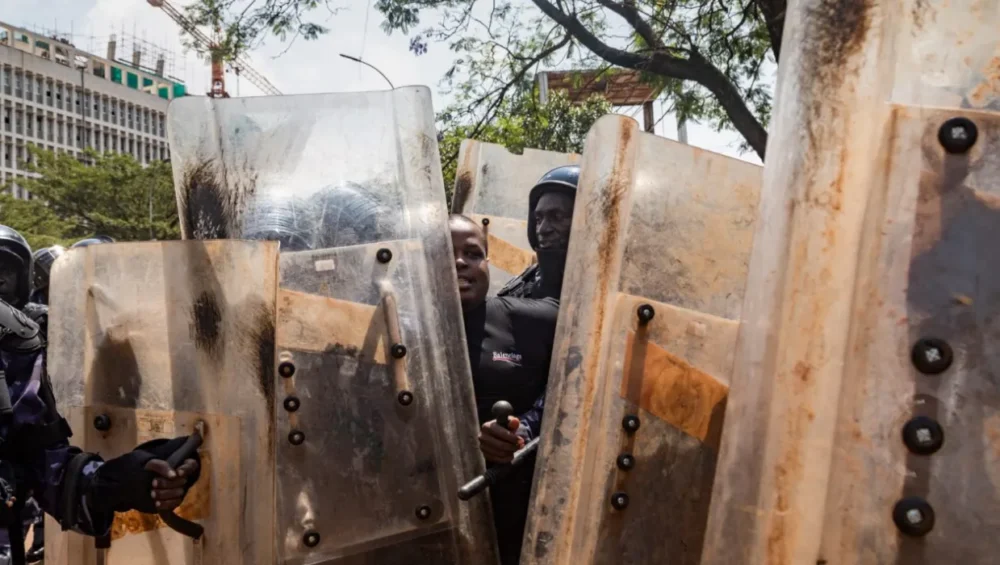
A growing list of human rights abuses is unfolding for the Republic of Uganda as security forces have been implicated in a well-planned assault of violence, threats, as well as arbitrary arrests against supporters of the main opposition political parties prior to the national elections. Violations of international law have serious implications for freedoms at a critical time for the nation’s democracy.
According to Amnesty International, there has been unnecessary and disproportionate force exercised by security forces in Uganda against peaceful opposition rallies, resulting in civilians being subjected to beatings, tear gas, arbitrary arrest, and torture. The forceful crackdown is part of a larger plan by authorities in Uganda to reduce political dissent and weaken the opposition National Unity Platform party, led by presidential candidate Robert Kyagulanyi Ssentamu, commonly known by his stage name Bobi Wine.
Uganda: Authorities subjecting opposition supporters to “brutal campaign of repression” ahead of elections https://t.co/ACEw94VYvf
— AmnestySouthernAfrica (@AmnestySARO) January 5, 2026
Why are Uganda’s elections raising serious human rights concerns?
There is a history of disputes over polls in Uganda, with charges of repression, rigging, as well as violence against leaders of the opposition. President Yoweri Museveni has ruled the country for close to four decades, with security forces increasingly linked to carrying out their duties with impunity, especially during electoral periods.
As the upcoming election draws near, human rights activists claim that history is repeating itself. Instead of making sure that there is a level playing field, it seems that the state is interfering with opposition political campaigns in a way that scares voters who wish to realize their political rights.
How are security forces targeting peaceful opposition rallies?
Amnesty International has also recorded various instances where the police and the military used violence to break up peaceful assemblies in areas such as Kawempe, Iganga, and other districts in the country. This violence included the use of tear gas to disperse the crowds, as well as the use of dogs to intimidate the public.
Witnesses reported that Amnesty that rallies remained peaceful with people carrying only the flag of Uganda and political chants. Nevertheless, security agents allegedly perceived crowds as threats and therefore forcibly dispersed them.
“These actions make it extremely difficult for people to exercise their rights to freedom of association and peaceful assembly,” said Tigere Chagutah, Amnesty International’s Regional Director for East and Southern Africa.
What happened during the Kawempe rally, and why was it dangerous?
In Kawempe, a rally had been staged on 24 November, in which the police are said to have fired tear gas and pepper spray moments after the arrival of Bobi Wine on the scene, resulting in a stampede in which dozens of people tumbled into a roadside ditch.
Security personnel were also charged with beating people up, pushing people into trucks using rifle butts, as well as beating people with batons and wires. Many witnesses reported that the violence was random, with bystanders included in the attack as well as people participating in the rally.
How did the Iganga rally turn deadly?
The repression took a worse turn in Iganga’s Railway ground on 28 November. According to eyewitnesses, the military used a truck to block one of the exits before shooting at the crowd retreating through the only other way out.
Miseach Okello, a 35-year-old who attended a rally, died in a situation which human rights organizations believe could amount to the use of force in violation of the law. Others were injured, though there is no official figure yet.
Why is the handling of the victim’s death raising alarm?
Miseach Okello’s family has informed Amnesty International that armed security guards prohibited the family from accessing the post-mortem examination and that they have never received a death certificate or information regarding the actual cause of death.
According to human rights organizations, the implications of the opacity here are clear: a possible cover-up of the events with the possible sequel being the violation of the right to the truth for the affected family. “No one should die just for peacefully exercising their right of assembly,” Amnesty International posted.
Are movement restrictions being used to sabotage opposition campaigns?
Besides these violent dispersals, the government is also accused of intentionally undermining the campaigns of opposition parties through restrictive movements. Amnesty International confirmed a video documenting the blocking of opposition candidates and supporters from accessing campaign locations by military trucks in Nwoya on 6 November.
The interviewees cited that roads were blocked,processions were redirected without reason, while leaders of opposition were either hindered or not allowed at all to engage in campaigns. It is argued by human rights specialists that there is no legal reason for such processes, nor do they meet standards of necessity and proportionality as set by international law.
How widespread are arbitrary arrests and detention?
According to opposition sources and civil society groups, over 400 people have been arrested either for participating in opposition political gatherings or suspected of supporting the NUP. These have been charged with various crimes including incitement to violence, damages to property, and assaulting law enforcers.
Amnesty International examined case files which appear to indicate that in some instances, people were arrested for membership in political opposition only, and not for any criminal activity.
Are detainees being tortured or ill-treated in custody?
Many former inmates told Amnesty that they experienced torture or cruel, inhuman, and degrading treatment. The treatment methods include beating with batons, shocking with tasers, spraying pepper on the mouth and face, and being detained without access to lawyers and family.
One of the arrested persons, who only identified himself by his first name, Peter, said he broke a tooth and injured his arm due to beatings but has been detained for three days. Medical evidence for his claim has been verified by Amnesty. One of the victims also said police beat him while asking if he still supports Bobi Wine.
How do these actions violate international law?
International human rights law demands that law-enforcement agencies resort to peaceful means first and resort to force only as a measure of last resort and that any resort to force be authorized, necessary, and proportional. Massive resort to firearms to disperse assemblies amounts to unreasonable resort to force.
Arbitrary arrest, torture, and the prohibition of peaceful forms of political expression contravene the country’s international obligations under such agreements as the International Covenant on Civil and Political Rights and the African Charter on Human and Peoples’ Rights.
However, human rights bodies are calling on the Ugandan government to immediately stop the repression, release civilians arrested only because of their peaceful political expression, and make security force members accountable for abuses of power.
“The government of Uganda should vow to respect, protect, and promote human rights before, during, and after the election,” said Tigere Chagutah. “If not, such human rights violations will go on and jeopardize democracy and respect for the rule of law.”
As elections approach, human rights groups point out the treatment of opposition supporters in the country is not just isolated instances of human rights abuses, but rather the systematic undermining of fundamental freedoms, which could descend further into violence if left unattended.