
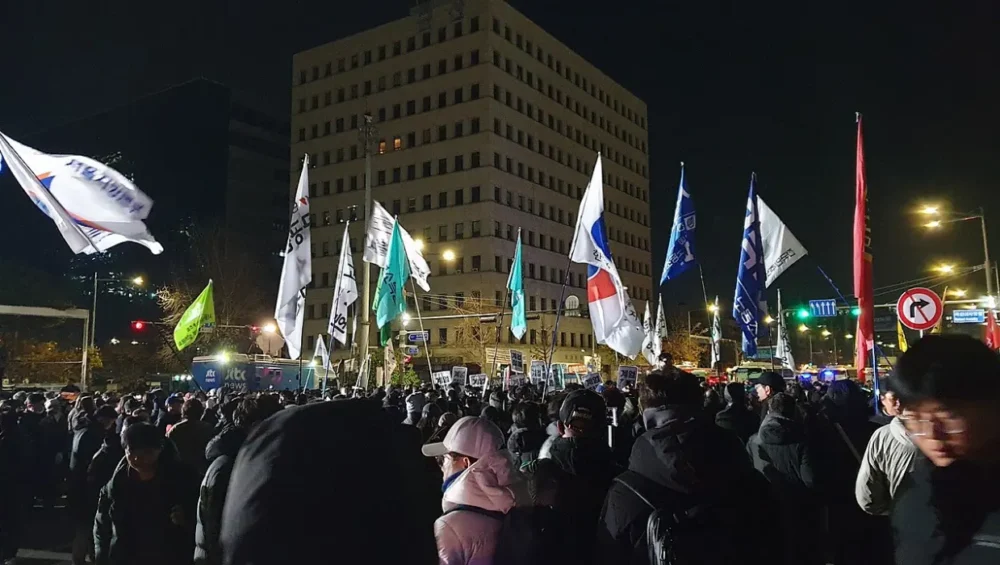
South Korea in 2025 was at a critical juncture between the strength of its democracy and the influence of the state of emergency rule that followed the martial law crisis on December 3, 2024. Although the country’s institutions managed to resist the challenge to their authority, issues such as security laws, discrimination, and intimidation of opposition voices continued to challenge civil liberties in 2025.
From December 2024 Martial Law to a 2025 “Reset”
Then-President Yoon Suk-yeol suddenly declared martial law on 3 December 2024, charging the opposition with being “anti-state forces” and a conspiracy involving North Korea, as he faced strong opposition to his budget and cabinet lineup. The Martial Law Command quickly acted to limit the media, freedom of assembly, and the arrest of political opposition, as soldiers tried to prevent lawmakers from entering the National Assembly building.
Despite the military mobilization, 190 lawmakers still managed to gather in the early morning hours of 4 December to unanimously vote to lift the martial law in a bizarre incident where some lawmakers scaled the walls of the Assembly to evade security barriers. Yoon was forced to withdraw the martial law due to intense political and societal pressure, but this action undermined public confidence in the presidency.
The National Assembly impeached Yoon on 14 December 2024 with the help of members of his own party, and in early 2025, he became the first sitting president of South Korea to be arrested for insurrection-related charges. The Constitutional Court also unanimously confirmed his impeachment in April 2025, paving the way for a new government led by Lee Jae-myung and a year that would be described as a “post-martial law reset.”
Legal Reforms to Contain Martial Law
One of the key elements of 2025 was the strong legislative push to reduce the possibilities of any kind of abuse of emergency powers in the future. On 3 July 2025, the National Assembly adopted amendments to the Martial Law Act, which were aimed at preventing a December 2024-type situation and were later promulgated by President Lee on 22 July.
The revised rules introduced several core safeguards:
- Military and police are barred from entering the National Assembly compound without the Speaker’s approval, even under martial law.
- Any attempt to obstruct lawmakers’ access to the Assembly—such as the cordon used during the 2024 crisis—is explicitly prohibited.
- Parallel bills were introduced clarifying that public officials and military personnel have a right, and in some proposals a duty, to disobey manifestly unlawful orders, including unconstitutional emergency decrees.
In addition to these changes, the Lee government launched a government-wide probe into units and officials who collaborated on Yoon’s martial law plan, together with a shake-up of the top echelons of the military. Within the defense community, the new minister launched an internal inquiry into the deployments made during the crisis, seeking to de-politicize the chain of command.
Constitutional amendments to move from a single term of five years to two terms of four years, with midterm elections, were proposed by the government in September 2025. The rationale for the move was that if the term of office is shorter, the president will be less likely to take drastic actions such as declaring martial law.
Political Repression Before and After Martial Law
Even prior to the emergency in December 2024, there were already signs of tension in the South Korean democratic space, particularly with regard to freedom of expression and security. Human Rights Watch and other groups noted Yoon’s growing resort to criminal defamation and the National Security Law (NSL) in exacting revenge on his critics.
The martial law decree itself escalated this trajectory dramatically. It:
- Ordered security agencies to arrest key opposition leaders and seize control of multiple media outlets.
- Imposed sweeping restrictions on public assembly and association under the banner of combating “anti‑state forces.”
- Echoed NSL rhetoric by framing political opponents as threats aligned with hostile foreign powers, particularly North Korea.
While these policies were only temporary, their chilling effect was felt well into 2025. Civil society groups pointed out that the normalization of “anti-state” dissent had made it easier for future administrations, of any political stripe, to target their opponents.
The NSL itself remained a core instrument of repression. It continued to criminalize possession or dissemination of material deemed “pro‑North Korean,” enabling:
- Police raids on opposition‑aligned groups, including an August raid on the People’s Democracy Party headquarters on NSL grounds.
- Prosecutions of artistic and political expression, exemplified by a 14‑month prison sentence handed to a poet in late 2023 for a poem praising North Korea, a case still cited in 2025 as emblematic of overreach.
On the other hand, some new patterns of repression also appeared during the Lee administration, especially in relation to religion and ideological influence. Conservative analysts criticized the government for staging massive raids on prominent Christian leaders and organizations, claiming that while these raids were labeled as anti-corruption or public order campaigns, they could potentially violate freedom of religion.
Civil Liberties and Social Rights in 2025
Despite the dramatic martial law episode, South Korea in 2025 remained, by global standards, a relatively robust democracy with competitive elections and active civil society, but one grappling with entrenched civil‑liberties deficits.
Freedom of expression and media
The country maintained a diverse media landscape and a high volume of investigative reporting, including critical coverage of both Yoon’s martial law attempt and subsequent policies under Lee. Yet structural weaknesses persisted:
- Criminal defamation provisions continued to expose journalists, activists, and ordinary citizens to criminal liability for critical speech.
- Media outlets recounted the trauma of being named as targets during the martial law decree, when security forces were ordered to occupy newsrooms and censor coverage—an experience that highlighted how quickly formal freedoms can be suspended in a crisis.
Among the most pressing rights issues were digital rights. There was an “explosion” of digital sex crimes in 2025, particularly non-consensual deepfake sexual images of women and girls on platforms such as Telegram, for which the state’s response was deemed inadequate. Advocacy groups for victims claimed that the state’s failure to act on online violence was indicative of broader gender inequality.
Freedom of assembly and protest
The end of 2024 and the beginning of 2025 were characterized by a series of mass protests, first against martial law and then for more general democratic and socio-economic demands. Protests became a visible site of political polarization, with progressive protesters calling for accountability for the coup attempt and conservative protesters objecting to what they saw as witch hunts and left-wing overreach.
The new government largely avoided general prohibitions on protests, although policing was active. The government on occasion used public order or national security as a pretext to limit or monitor protests, continuing a long-standing pattern of contentious regulation of assemblies in South Korea.
In October 2025, President Lee called for a crackdown on rallies that incited violence against foreigners and Chinese tourists, telling authorities to take “special measures” against racial hatred. While rights groups praised the government for attempting to limit racist rallies, they also noted that general prohibitions on “incitement” could be abused to restrict legitimate political speech or monitor migrant communities.
Equality, discrimination, and vulnerable groups
Human rights organizations judged that South Korea’s overall rights record remained “positive” compared with many countries, but with persistent structural discrimination. Key issues included:
- Gender inequality, evident in wage gaps, under‑representation and the surge in tech‑facilitated gender‑based violence.
- Lack of comprehensive protection for LGBT people, who continued to face stigma and legal vulnerabilities in areas like military service and family recognition.
- Age and disability discrimination, where older people and people with disabilities had unequal access to services and full participation in public life.
These patterns intersected with political developments. For instance, critics argued that the state’s failure to protect women from digital abuse undermined its legitimacy when invoking “public safety” to justify restrictions on protests or national‑security policing.
Democratic Resilience and Future Risks
International and domestic observers framed the 2024–2025 period as a stress test of South Korea’s democratic architecture: a sitting president invoked martial law against parliament, but was rapidly constrained by constitutional institutions, popular mobilization, and cross‑party resistance. The swift impeachment and subsequent legal reforms suggested that checks and balances still function in moments of acute crisis.
However, the episode also exposed vulnerabilities. The ease with which emergency decrees temporarily curtailed core civil liberties revealed how much hinges on political norms and the personal restraint of executive leaders. Persistent use of the National Security Law, criminal defamation, and politically tinged policing illustrates that the legal arsenal for repression remains intact, awaiting future opportunistic deployment.