
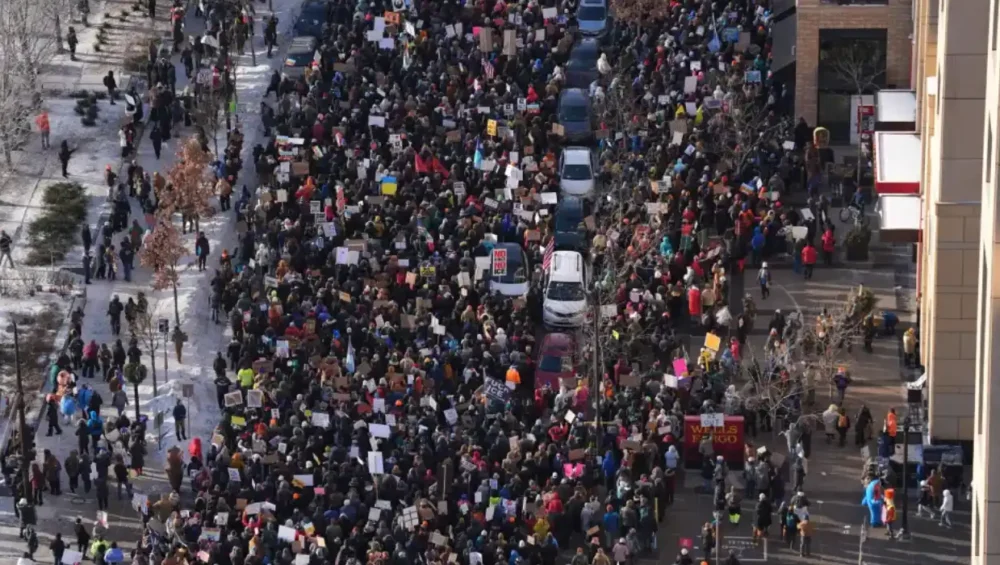
Federal immigration enforcement agents shot and killed a man in Minneapolis, Minnesota, over the weekend, marking the second fatal killing by federal immigration authorities in the city this month. The incident has intensified concerns about the unchecked use of force by federal agencies and the apparent obstruction of state-led investigations into potentially unlawful deaths.
State officials say federal authorities blocked access to the crime scene, despite the presence of a valid search warrant, raising serious questions about transparency, accountability, and whether federal agencies are acting in good faith to ensure an independent investigation.
A City Under Pressure From Aggressive Federal Enforcement
The killing comes after weeks of aggressive and often violent immigration enforcement actions across Minneapolis. Residents and human rights observers warn that the growing federal presence has fueled fear, destabilized communities, and placed civilians at risk.
This latest shooting follows the January 7 killing of another Minneapolis resident by an Immigration and Customs Enforcement (ICE) officer, reinforcing concerns that federal agents are operating with impunity amid a broader surge of immigration enforcement activity in Minnesota and across the United States.
Who Was Alex Pretti?
US Border Patrol agents shot and killed Alex Pretti, a 37-year-old intensive-care nurse and US citizen, at approximately 9 a.m. on January 24. Pretti was reportedly observing and filming federal agents in the street minutes before his death.
Video evidence and witness accounts indicate that agents shoved Pretti, sprayed him in the face with a chemical irritant, beat him with a metal canister, and ultimately shot him multiple times.
Video Evidence and Witness Testimonies Contradict Federal Claims
Human Rights Watch analyzed and verified eight videos taken from different angles showing Pretti before, during, and after the shooting. Researchers also reviewed two sworn witness statements submitted in federal court.
The Department of Homeland Security (DHS) claims agents acted defensively. DHS Secretary Kristi Noem stated that Pretti approached officers with a handgun and “reacted violently” when agents attempted to disarm him. Pretti was reportedly a legal firearm owner with a permit to carry in Minnesota.
However, there is no available evidence that Pretti posed an imminent threat that would justify the intentional use of lethal force under international human rights standards.
What the Footage Shows Before the Shooting
The first video, recorded at 8:58 a.m., shows Pretti filming agents near a senior center on Nicollet Avenue. An agent is seen pushing him back toward the sidewalk.
One witness stated that Pretti was directing traffic and observing the agents when officers ordered observers to back up. Another agent threatened bystanders with pepper spray. According to the witness, Pretti approached with “just his camera out,” and they did not see him reach for or hold a gun.
A pediatrician who witnessed the incident said Pretti was yelling at agents but
“did not see him attack the agents or brandish a weapon of any kind.”
Escalation and Use of Force
Video footage shows an agent shoving one observer, then pushing Pretti. Pretti appears to place his arm around the observer to help them. When another observer is shoved, Pretti positions himself between the agent and the observer.
An agent then sprays a chemical irritant directly into Pretti’s face from arm’s length. Pretti is holding his phone in his right hand and raises his left hand defensively. He staggers and falls backward toward other observers with his back to the agent, who continues spraying him.
Pretti appears to reach toward an observer or their backpack as an agent shouts, “Get back.”
Disarming Pretti and the First Shot
Five additional agents rush in and force Pretti to the ground. As he kneels face forward, two agents restrain him while another reaches for his waist near his right hip.
Video footage shows one agent repeatedly striking Pretti near the head with a small canister. Multiple voices shout that Pretti has a gun.
An agent removes a firearm from Pretti’s right hip and steps away with it. At that moment, another agent unholsters his own handgun and moves behind Pretti, pointing the weapon toward him.
A gunshot is heard. At the time of the shot, the agent who unholstered his weapon appears to be the only one with a drawn firearm, while the agent holding Pretti’s gun is moving away.
Multiple Shots Fired After Pretti Is Disarmed
After the initial shot, Pretti reels upward, planting his right foot while his left knee remains on the ground. As the armed agent stands over him from behind, three more shots are fired in quick succession. Video shows the handgun’s slide cycling, confirming rounds are being discharged.
Other agents step back as another agent unholsters his firearm. It remains unclear whether that agent fired. Based on video analysis, Human Rights Watch concluded that agents fired a total of 10 shots
Delayed Medical Response
Approximately 24 seconds after the final shot, agents approach Pretti’s body. One agent searches him and shouts, “Where’s the gun?” before realizing another agent already has it.
Roughly 90 seconds after the shooting, agents begin removing Pretti’s clothing and call for a medic. Chest seals are requested, indicating treatment for puncture wounds.
According to the pediatrician witness, agents initially prevented them from checking on Pretti but later allowed CPR to be administered until emergency responders arrived. The pediatrician reported that Pretti had no detectable pulse.
Human Rights Standards and Use of Lethal Force
International human rights law permits the intentional use of lethal force only as a last resort, when strictly unavoidable to protect life. It also requires prompt, thorough, independent, impartial, and transparent investigations into potentially unlawful deaths.
DHS policy similarly restricts the use of force, allowing lethal force only when an officer reasonably believes there is an imminent threat of death or serious bodily harm.
Federal Interference in State Investigations
Concerns over accountability have deepened following statements from the Minnesota Bureau of Criminal Apprehension (BCA). The agency’s superintendent stated in a court filing that DHS agents blocked BCA investigators from accessing the scene, despite the presence of a signed search warrant.
This obstruction mirrors problems seen in the earlier killing of Renee Good on January 7. The BCA closed its investigation after the FBI said it would take over and denied the agency access to evidence. Yet days later, Deputy US Attorney General Todd Blanche stated that the Justice Department was not investigating the shooting.
Reports indicate that at least six federal prosecutors and one FBI agent resigned after being ordered to investigate Good and her wife rather than the ICE officer involved.
Growing Calls for Accountability
The killings of Alex Pretti and Renee Good have amplified calls for independent investigations and stricter oversight of federal immigration enforcement operations. Human rights organizations warn that without transparency and accountability, the continued expansion of federal enforcement risks further loss of life and erosion of public trust.