
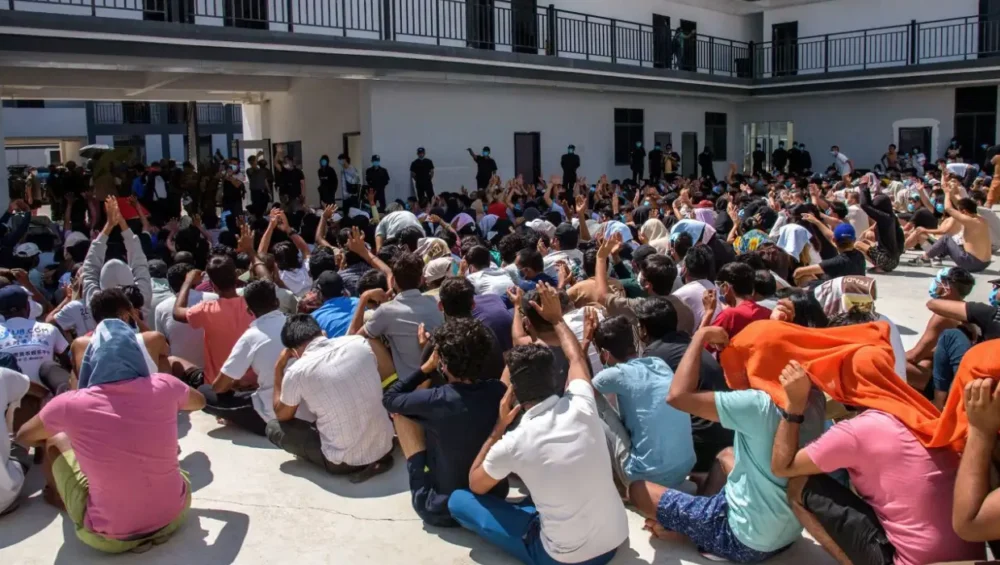
The Scam Centers Trafficking Crisis has grown to become the most complicated form of human trafficking in Southeast Asia to integrate into an organized crime, digital fraud, and forced labor multilateral business. In 2025, United Nations assessments estimated that there were 300,000 trafficked into cyber-fraud compounds within the Mekong region and other countries around it.
These activities have altered the trends of trafficking that used to revolve around forced labor or sexual trafficking. Victims, on the contrary, are threatened and forced to commit a cyber scam on people all over the world. According to investigators, over 60 countries can give birth to victims and these include countries in Asia, Africa, Europe, and Latin America.
According to satellite surveillance and on-site research, a high density of reinforced compounds is at work in remote border areas. Analysts observe that about three-quarters of the known scam sites are found in the Mekong subregion with gaps in governance, porous borders, and economic inequalities that give criminals syndicates good opportunities.
Industrial Scale Fraud Operations
The scam centers have become industrial in contrast to the previous types of trafficking which were linked to small-scale criminal activities. Hundreds or even thousands of trafficked workers are usually involved in online fraud campaigns 24/7 as large complexes.
These centers have multilingual scripts, high-level communications networks, and electronic payment networks that are set to defraud victims worldwide. The common schemes of fraud include investment scam, romance scam and so called pig-butchering schemes that exploit victims by manipulating them into making repeated financial transfers.
According to estimates made by financial analysts, the world suffers tens of billions of dollars every year in a series of losses related to such scams. These areas of income are used to maintain organized crime rings and enable the operators to quickly switch the operations when law enforcement agencies raid.
Expanding Victim Demographics
The victims of the Scam Centers Trafficking Crisis become more and more of various backgrounds and different nationalities. Most of them are drawn via internet job adverts that offer them high paying jobs either in the field of technology or customer care.
After recruitment, they are moved to the foreign countries on false pretexts. Once they reach scam compounds their mobile devices and passports are seized. Survivors often complain that they were severely coerced through beatings, long working hours over 18 hours and threats to their family members.
Although women have always constituted a large proportion of the victims of trafficking, researchers observe that there are increasing numbers of male victims who are compelled to become members of cybercrime. The shift indicates how labor intensive scam activities are, and they demand constant digital communication with the targets.
Regional Hotspots Driving the Crisis
By virtue of geographical and political forces, several south east Asian countries have been at the epicenters of the Scam Centers Trafficking Crisis.
Cambodia’s Expanding Scam Infrastructure
Cambodia has also been cited as one of the most notable places where scam activities are carried out in large-scale. Crackdowns have since 2024 involved several high-profile crackdowns, yet human rights groups claim that enforcement is non-existent.
Areas of industry and gambling casinos have been redesigned into fake compounds in border provinces. These destinations are both physically secure and close to international transit networks, which are appealing to trafficking networks.
In early 2026, the government announced that scam centers throughout the country would be eliminated. Nevertheless, critics take note that such promises have been made in other years and have only led to short-term shutdowns and not permanent structural alterations.
Myanmar’s Border Enclaves and Armed Group Influence
Another hot spot where scam activities have thrived is Myanmar where political instability has been experienced over time. Criminal syndicates have been manifested through armed groups that govern territories along the borders in exchange of money.
Myanmar and Thailand border have gained a reputation (in particular) when it comes to the trafficking of compounds. One of the major raids, which took place in early 2025, along this frontier allowed rescuing around 7,000 victims.
In spite of such interventions, enforcers state that operators often move to neighboring areas when the pressure of enforcement becomes stronger.
Emerging Relocation Zones
As regional crackdowns intensified in 2025, criminal groups began shifting. Criminal groups started moving the business to the less controlled regions as the crackdowns intensified in the regions in 2025. Some of the emerging hubs that have been spotted by analysts include Laos and Philippines.
It is also reported that remote territories such as Oecusse have started to become attractive to scams because of the limited regulation control. The migration pattern points to the flexibility of the trafficking networks that quickly adapt to the enforcement pressure.
Recruitment Methods and Digital Enablers
The massive proliferation of the use of digital means to recruit victims and to organize fraudulent activities has increased the Scam Centers Trafficking Crisis.
Social Media Recruitment Networks
High paying jobs are often promoted on the sites and various messaging applications by recruiters. Salaries several times above local rates suggested by the job offer bring economically disadvantaged populations of job seekers.
After these offers are accepted by the candidates, the recruiters make the necessary travel and visa arrangements. After reaching the scam compounds, the victims usually get to know the real nature of the work.
Studies indicate that over fifty percent of recruitment outreaches are made via social media platforms. There are algorithms that advertise jobs unintentionally enhancing misleading ads.
Cryptocurrency and Financial Obfuscation
The scam centers use digital payment systems and cryptocurrencies in order to hide the financial streams. Through these tools, operators can transfer funds across borders fast without the use of the traditional banking systems.
Virtual private networks and cloud infrastructure also make the work of law enforcement more problematic. The fraud activities often resemble the actual call centers or online marketing companies, confusing criminal activities and the legal business operations.
According to technology specialists, such online tools have made trafficking networks to become intricate cybercrime systems.
Victim-to-Perpetrator Dynamics
One of the concerning issues in the Scam Centers Trafficking Crisis is that some of the victims become enforcement agents in the compounds. Immigrants who once came as victims of trafficking can be forced into the position of managing other people threatening them with violence.
This relationship makes it difficult to determine victims and do rehabilitation. It is always hard to decide if persons who are engaged in scam activities were voluntary participants or victims who were compelled to do it.
Psychologists who have been working with survivors assert that there is rampant trauma with symptoms that are in line with post-traumatic stress disorder.
Policy Responses and International Collaboration
The Scam Centers Trafficking Crisis is one of the issues governments and other international organizations are starting to fight with greater strength by initiating coordinated policy actions.
Regional Campaigns and Awareness Initiatives
In March 2026, the authorities in Vietnam initiated a campaign of public awareness in collaboration with the United Nations office on drugs and crime. The campaign will be used to sensitize travelers and job seekers on the dangers of fraudulent job opportunities.
The officials stressed that the trafficking prevention should start with the increased awareness of the vulnerable groups. Airports and crossings have become the centre of focus of the information campaign aimed at detecting the potential victims prior to departure.
Law Enforcement Cooperation
The international law enforcement agencies have increased their collaboration to break down the trafficking networks. INTERPOL has facilitated the exchange of intelligence among the Southeast Asian nations and governments in which citizens are targeted by the recruiters frequently.
Joint operations in 2025 led to several large-scale rescues, though experts caution that raids alone cannot eliminate the underlying economic incentives driving scam operations.
Challenges in Victim Rehabilitation
One of the most significant policy gaps involves long-term support for rescued victims. Many survivors receive immediate assistance upon repatriation but lack access to psychological counseling or employment opportunities.
Without adequate reintegration programs, some individuals risk returning to trafficking networks due to financial desperation. Human rights advocates argue that survivor-centered recovery programs must become a central pillar of anti-trafficking strategies.
Global Implications of the Scam Centers Trafficking Crisis
The Scam Centers Trafficking Crisis increasingly represents a global security challenge rather than a purely regional issue. Criminal networks have demonstrated an ability to operate across continents while targeting victims in wealthy economies.
Financial fraud linked to these centers has affected individuals from North America to Europe and Australia. Governments in these regions are now recognizing that cybercrime prevention must address the trafficking networks supplying labor to scam operations.
International policy discussions increasingly emphasize the need for stronger collaboration between technology companies, law enforcement agencies, and financial regulators. Limiting the digital infrastructure that enables scam centers may prove as critical as dismantling the compounds themselves.
As the crisis continues evolving, analysts warn that the intersection of human trafficking and cybercrime could redefine the landscape of transnational organized crime. The question facing policymakers is whether current enforcement strategies can keep pace with networks that adapt quickly to legal pressure and technological change, or whether new international frameworks will be required to disrupt the economic engine powering these operations.