
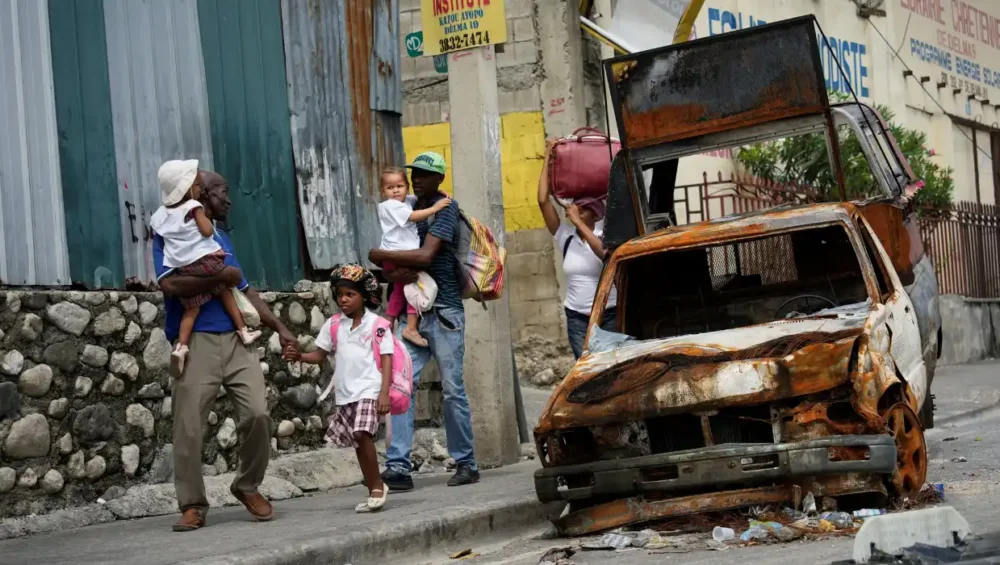
The current situation in Haiti is also going through a crisis in the justice and healthcare sectors because of the increase in gang violence and the inability of the public services to provide for the citizens. The current situation is most immediately affecting migrants and internally displaced persons (IDPs) because they are most vulnerable to being denied access to justice and the right to health.
Because of the increasing control of gangs in Port-au-Prince and the inability of state institutions, the role of the state in providing justice and health care is failing.
Recent statistics from 2025 indicate that the situation is urgent, as more than 1.3 million people are still internally displaced, with most of them living in difficult conditions and without access to justice and health. This is not only a humanitarian crisis but also an important factor that indicates the lack of state legitimacy, especially in the regions where migrants live.
Gang Violence and Its Impact on Justice and Health Services
The control of gangs has been extended to 85-90% of Port-au-Prince, where the gangs have replaced the state. They control the curfews, the extortion rates, and the rationing of access to essential infrastructure like hospitals and courts. This has resulted in a situation where violence has been normalized, and no one is accountable.
During the period from January to August 2025, UN reports recorded 4,006 killings and 1,617 injuries, of which 57% were attributed to security operations and 30% to gang attacks.The number of Sexual and Gender-Based Violence (SGBV) cases rose to 6,450, a 34% rise from the previous year. The largest gang alliance, Viv Ansanm, has been very active in restricting movements, attacking humanitarian convoys, and displacing communities.
The scale of the displacement crisis is staggering, with 1.3 million people displaced from their homes, and 83% of IDPs in host communities that are already stretched to the breaking point. The healthcare infrastructure is buckling under the strain, with 45% of health facilities in Port-au-Prince shut down.
Justice System Dysfunction: Impunity and the Failure of Restorative Approaches
The justice sector in Haiti is seriously dysfunctional. Underfunding, corruption, and the occupation of courthouses by gangs have led to a situation where impunity is the norm. The courts are backed up, and the criminal justice system is inaccessible to vulnerable groups, including migrants and IDPs.
The prisons are overcrowded, with a total of 7,163 inmates, of whom 82% are pre-trial detainees. The conditions are inhuman, with a total of 168 deaths between January and October 2025 from malnutrition and illness. However, the effectiveness of the judicial system in making judgments is also affected, as there are only 241 criminal trials recorded nationwide from October 2023 to October 2024.
In response to international pressure, Haiti formed specialized units for SGBV and mass crimes in 2025. They handled 268 investigations and 36 adjudications, but victims are still suffering from re-traumatization, loss of privacy, and delays. Therefore, restorative justice, as a goal through victim-centered remedies, reparations, and truth-seeking, is still more of a goal than reality.
Healthcare Access Barriers: A Collapsing System Targeted by Violence
The healthcare system is failing because the gangs are deliberately targeting the healthcare workers and facilities. Less than 36-40% of the healthcare facilities are operational, and violence has forced international organizations to pull out their services. Médecins Sans Frontières (MSF) was forced to close its facility in Port-au-Prince in October 2025 because of the regular attacks, leaving thousands of patients without access to healthcare.
Currently, two-thirds of Haitians do not have access to emergency healthcare, and over 40,000 healthcare professionals have fled Haiti due to violence. This has resulted in the resurgence of diseases that can be prevented and chronic malnutrition. Since 2022, Haiti has recorded 87,382 cases of cholera, which shows the deterioration of water and sanitation services. Food insecurity is also a concern, with 5.4 million people suffering from acute food insecurity, including 2.1 million children under five at risk of malnutrition.
IDPs are particularly affected. The camps are overcrowded, with poor sanitation and very limited access to clean water and health care. The number of hospital births has risen in the affected areas: at Boucan Carré, for instance, the number of births per month rose from 13 to 32 in March and April 2025.
Migrant Vulnerabilities: Deportations, Documentation Gaps, and Exclusion
The problem is further exacerbated for migrants and deportees. As of July 2025, 178,345 Haitian migrants have been deported from the Dominican Republic. Approximately 33% of the deportees lack official identification, making it difficult for them to access health care, education, and legal assistance.
The displacement camps have become hotspots for violence and exploitation. 69% of the SGBV survivors are IDPs, but fewer than 25% of them receive care within 72 hours, which is a critical window for medical and legal response. Insecurity and the cost of seeking care are some of the factors that may impede access to care for the survivors. Transactional sex has become prevalent as a way of survival, which exposes women and girls to violence, abuse, and contracting diseases.
The Dominican Republic has a protocol that mandates the reporting of Haitian migrants’ status by hospitals, which has a chilling effect. Migrants are not seeking health care because of the possibility of deportation, which impacts the management of chronic conditions such as HIV and tuberculosis, as well as maternal mortality because of a lack of access to emergency obstetric care.
Violations and Justice Gaps: Restorative Justice Blocked by Impunity
Denial of healthcare and violence against migrants violate the tenets of human rights, including the right to health, the right to non-discrimination, and the right to freedom from inhuman treatment. Healthcare facilities have been targeted by gangs for supplies and evacuations, and deportations have been carried out without due process and humanitarian concerns.
The absence of accountability is a factor that hinders restorative justice. Mass atrocities, such as the La Saline massacre, have yet to be addressed. Extrajudicial killings committed by self-defense groups and armed vigilantes, in excess of 260 in 2024, have continued to undermine society.
Even the intervention of international forces has been a matter of concern. The drone attacks launched on gangs have resulted in 494 deaths (mostly suspected gang members) as of August 2025, but 15 civilians were also killed, which has raised serious concerns regarding the issue of proportionality and accountability. There is no remedy or reparations for the survivors.
The United Nations has repeatedly called for survivor-centered reforms and the rule of law. However, the factors of gang control, poor institutions, and a lack of international support have continued to keep migrants and IDPs in cycles of violence, exclusion, and deprivation.
The Haitian crisis is a multifaceted intersection of violence, state failure, and systemic exclusion. The migrants and IDPs are the most affected by the failure of the system, which is further exacerbated by the lack of access to healthcare and justice. If a holistic approach is not adopted that focuses on protective infrastructure, legal accountability, and accessible healthcare, then Haiti could become a permanent humanitarian crisis.