
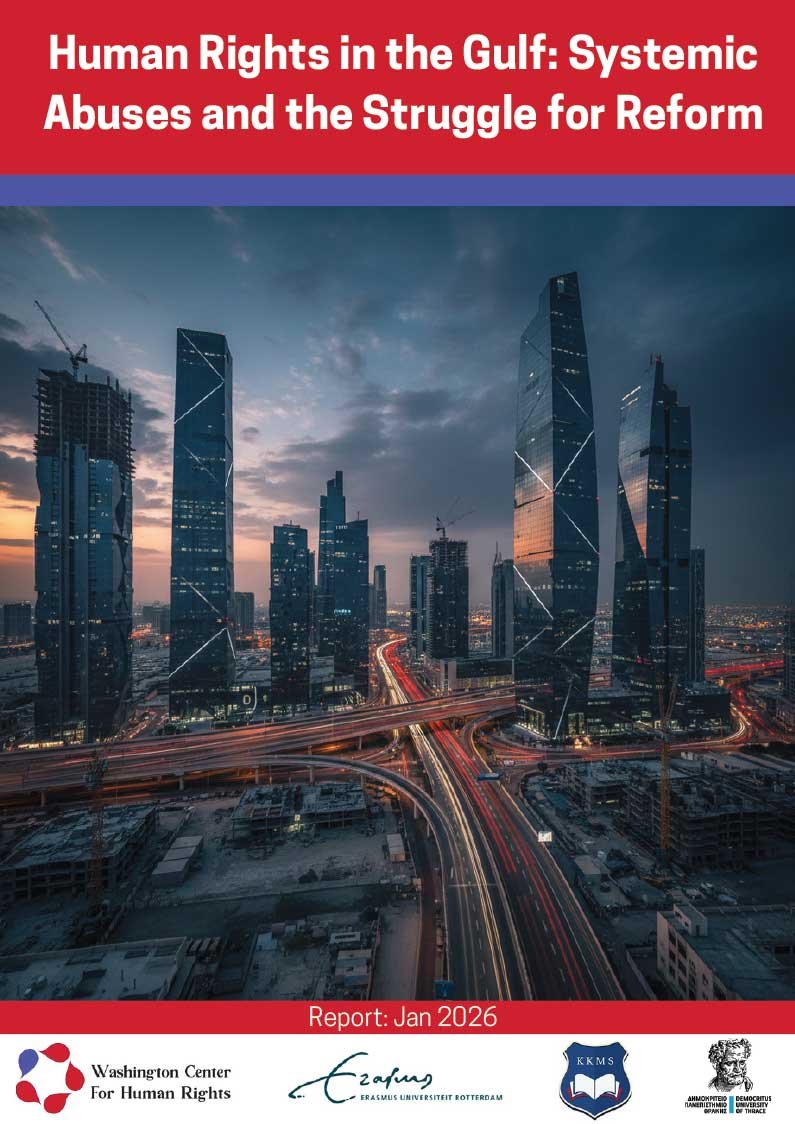
The report Human Rights in the Gulf: Systemic Abuses and the Struggle for Reform (January 2026), produced with contributions from the World Center for Human Rights and authored by Alexandros Sarris, Vassilios Grammatikas, Anesa Agović, and Edwin Austin, presents a comprehensive examination of entrenched human rights violations across the Gulf Cooperation Council states of Saudi Arabia, the United Arab Emirates, Bahrain, Kuwait, and Oman. Drawing on international legal analysis, policy research, and documented cases, the report finds that despite immense economic wealth and political stability, these states continue to exhibit systemic restrictions on civil liberties, labour rights, gender equality, judicial independence, and civic participation, driven by hereditary governance structures, securitized legal frameworks, and weak accountability mechanisms.
It shows that human rights violations in the Gulf are not episodic or transitional, but structural embedded in governance systems characterized by hereditary rule, centralized power, rentier-state economics, and securitized legal frameworks. While governments have introduced selective reforms, particularly in social and economic domains, these measures remain tightly controlled, unevenly enforced, and largely disconnected from genuine accountability or political openness.
Prosperity Without Political Rights
The Gulf region represents a distinct governance paradox: extraordinary wealth coexisting with severe limitations on fundamental freedoms. Since the oil boom of the 1970s, Gulf monarchies have built advanced infrastructure, modern cities, and global economic linkages. Yet political systems remain closed, with power concentrated in ruling families and meaningful political opposition either prohibited or heavily restricted.
Independent media outlets are virtually non-existent, civil society organizations operate under restrictive licensing regimes, and public criticism of state authorities, ruling elites, or official policies carries significant legal risk. The report emphasizes that stability in the Gulf has been maintained not through inclusive governance, but through a combination of economic patronage, surveillance, and legal repression—particularly intensified after the Arab Spring uprisings.
Authoritarian Governance and Legal Control
All five states examined shared governance structures that limit accountability. Executive authority dominates legislative and judicial institutions, undermining separation of powers. Courts often lack independence, particularly in cases involving national security, political dissent, or activism.
Broadly defined counterterrorism, cybercrime, and public order laws enable criminalization of peaceful speech, online expression, and association. Individuals accused of “undermining state security” or “spreading false information” frequently face secretive trials, limited access to legal counsel, and harsh sentences.
The report documents patterns of arbitrary detention, enforced disappearance, and ill-treatment, with allegations of coerced confessions and prolonged solitary confinement. Post-release restrictions, including travel bans and probationary controls, function as extended punishment and deter broader civic engagement.
Labour Exploitation and the Kafala System
Labour rights abuses remain among the most pervasive human rights issues in the Gulf. Migrant workers constitute a majority of the workforce in several states and are essential to construction, domestic work, healthcare, and service industries. Their vulnerability is rooted in the kafala (sponsorship) system, which links residency and employment status to individual employers.
Under this system, workers face restricted mobility, wage theft, unsafe working conditions, and limited access to justice. Employers frequently confiscate passports, while workers who leave abusive situations risk detention or deportation. Domestic workers—predominantly women—are especially exposed due to exclusion from labour laws and inspection mechanisms.
The report stresses that incremental administrative adjustments have not altered the fundamental power imbalance created by private sponsorship. Without structural reform, labour exploitation remains an integral component of the Gulf’s economic model.
Gender Inequality and Women’s Rights
Despite highly publicized reforms related to women’s mobility, employment, and education, gender inequality remains entrenched in law and practice. Personal status laws across the region continue to discriminate against women in marriage, divorce, child custody, and nationality transmission.
The report highlights a stark contradiction: while governments promote narratives of women’s empowerment, women who actively advocate for rights—particularly women human rights defenders—face repression. Activists, journalists, lawyers, and online commentators have been arrested, prosecuted, and subjected to travel bans for peaceful advocacy.
Male-guardianship practices, though partially reformed in some areas, continue to influence women’s autonomy in critical aspects of life. Enforcement gaps, discretionary application of laws, and social control mechanisms further undermine formal legal changes.
Digital Repression and Surveillance
Digital space in the Gulf has become a primary arena of state control. Governments deploy advanced surveillance technologies and expansive cybercrime laws to monitor online activity and suppress dissent. Social media posts, private messages, and digital activism are increasingly treated as criminal offenses.
The report documents technology-facilitated repression, including online harassment, doxxing, intimidation, and prosecution for digital expression. Women human rights defenders are disproportionately affected, facing gendered threats, smear campaigns, and heightened surveillance.
This digital repression has produced a chilling effect on public discourse, reinforcing self-censorship and narrowing already constrained civic space.
Discrimination Against Minorities and Stateless Populations
Religious, ethnic, and stateless communities face systemic exclusion across the Gulf. In Bahrain, political marginalization of the Shia majority remains a central issue, accompanied by discriminatory practices in employment, housing, and political representation. In Saudi Arabia’s Eastern Province, security measures continue to suppress dissent and community organizing.
Stateless populations, including the bidoon in Kuwait and the UAE, remain without citizenship or equal access to education, healthcare, and employment. The report identifies statelessness as a chronic human rights crisis that has been deliberately prolonged through restrictive nationality laws and administrative barriers.
International Legal Commitments and Reservations
The report provides extensive analysis of Gulf states’ participation in international human rights treaties. While most have ratified key instruments, these commitments are often undermined by sweeping reservations invoking Islamic law or national legislation.
Treaties addressing civil and political rights, women’s rights, labour protections, and freedom of expression are frequently accepted in principle but limited in practice. Reservations targeting core provisions—such as gender equality, freedom of religion, and political participation—significantly weaken enforcement.
Regional human rights frameworks lack binding mechanisms and effective oversight, leaving rights protection largely subject to state discretion.
International Responses and Strategic Silence
International engagement with the Gulf on human rights remains selective and inconsistent. Western governments prioritize strategic interests—including energy security, arms sales, and counterterrorism cooperation—over sustained rights advocacy.
Statements of concern are rarely accompanied by concrete measures such as conditionality, sanctions, or enforcement benchmarks. This permissive environment allows Gulf governments to pursue economic modernization and global branding while maintaining restrictive domestic practices.
Reform Trajectories and Structural Barriers
Reform in the Gulf follows a tightly controlled, top-down model aimed at economic diversification and social modernization without political liberalization. Initiatives such as Saudi Arabia’s Vision 2030 and the UAE’s Centennial 2071 emphasize development, innovation, and global competitiveness, but avoid addressing political participation or judicial independence.
The report identifies key barriers to reform: authoritarian governance, rentier-state dynamics, weak oversight institutions, securitized legal frameworks, and geopolitical protection from external pressure. Nevertheless, generational change, digital connectivity, and growing international scrutiny are slowly increasing pressure for accountability.
The report concludes that human rights reform in the Gulf will remain limited unless structural changes are undertaken. Symbolic reforms and legal amendments are insufficient without independent courts, empowered institutions, and protected civic space.
Prosperity without rights may deliver short-term stability, but it carries long-term risks of social fragmentation and political fragility. Sustainable governance in the Gulf depends on recognizing that human rights are not external impositions, but essential foundations of legitimacy, justice, and resilience.
Meaningful reform may be incremental, but it is neither optional nor unattainable. The future of the region will be defined not by economic growth alone, but by whether rights protections become real, enforceable, and accessible to all.