
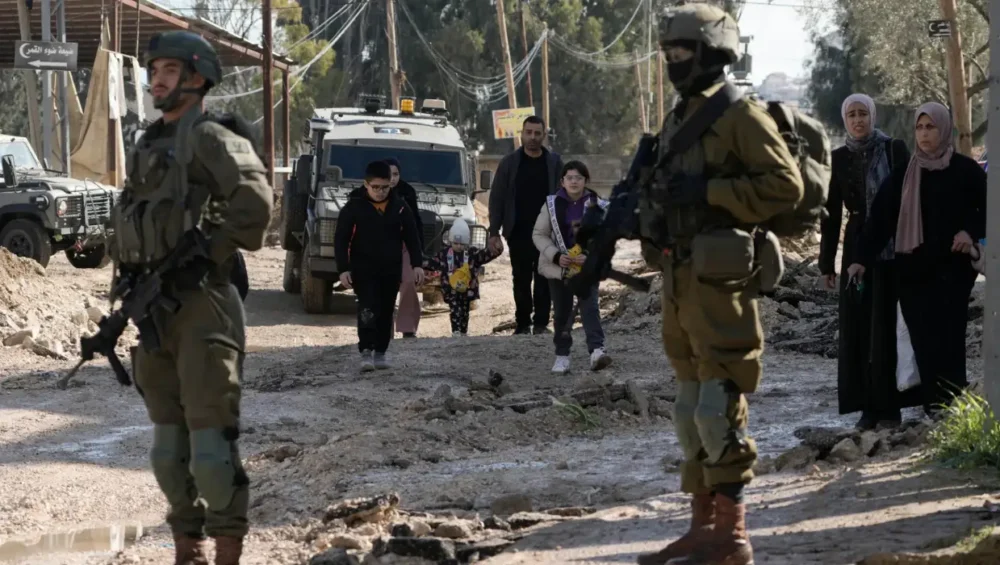
The PFLP war crime allegation came into the limelight on February 27, 2026 when the Popular Front for the Liberation of Palestine announced that Israeli attacks on Palestinian police stations in the West Bank were a complete-fledged war crime. This was trailed by the drone attacks on the facilities in Jenin and Nablus where at least three stations were damaged structurally as counter-terror activities continued to expand.
The Israeli security forces insisted that the targeted compounds were being occupied to store the weapons and organize the militant activity. An arms cache was found in about 60 percent of raids of facilities of Palestinian Authority affiliation according to briefings of 2025. The conflict over the merits of these stations being considered as a protected civilian object or a dual-use military target is the central issue of the legal conflict currently taking place.
The situation of violence in the West Bank intensified drastically after October 2024. According to the data obtained by the United Nations Office for the Coordination of Humanitarian Affairs, approximately 700 Palestinians died in the course of 2025 actions and approximately 120 of them were members of Palestinian security services. Jenin refugee camp alone was the home of approximately 5,000 residents, and since the resurgence of raids started at the beginning of 2025, it has transformed the security environment and the demographic of civilians.
Drone strike precision and tactical shifts
The strikes taking place were carried out mostly through the use of unmanned aerial systems and this was an indication of a wider Israeli shift of tactical response to precision attacks. The officials of the military claim that the use of drones will limit the exposure of ground forces and casualties among the Israeli forces. In 2025, Israeli security deaths in the West Bank were reported to be down by 40 per cent over the preceding year due in part to increased aerial surveillance and targeted killings.
Critics, such as the PFLP, respond that the change in the use of drones does not change the legality of the targets. They state that precision attacks should be able to meet the proportionality and military necessity criteria as per the international humanitarian law. The controversy has been fueled by the fact that the extent of destruction has not been very significant in the case of individual attacks but rather cumulative over months of actions.
Palestinian Authority infrastructure under strain
In addition to direct deaths, the frequent attack on police stations has degraded the governance capability of Palestinian Authority. Ramallah and Nablus facilities have been affected which has caused a halt of local policing and administrative services. Palestinian authorities recorded about 200 grievances in 2025 on connected to infrastructure damage filed in international legal organisations.
Strain is increased by budgetary constraints. The security budget of the Palestinian Authority was reported to have reduced by almost 30 percent following fiscal deficits to restrict efforts of reconstruction. Analysts observe that the eroded institutional control can unintentionally generate vacuum, which is used by militant groups, which adds to a vicious cycle where the weakening of security warrants further attacks.
Legal thresholds and dual-use controversies
The main point in the PFLP war crime allegation is the interpretation of the Article 52 of additional Protocol 1 of the Geneva Conventions that safeguards civilian objects except where they are utilized in military activities. Article 8 of the Rome Statute also does the same thing with intentional attacks on civilian infrastructure. The categorization of the police stations in the active conflict zones, however, is not always that straight forward.
The officials in Israel argue that when a police facility has weapons or a coordination of armed attacks, it has no civilian immunity anymore. In 2025, military briefings referred to the finding of explosives and small weapons in more than 120 locations in the north of the West Bank, even inside security compounds. In this view, the strikes can be categorized in an article 51 of the United Nations Charter self-defense framework.
Proportionality assessments in contested environments
The test of proportionality is a conclusive legal test. Even dual-use targets should not result in the excessive killing of civilians as compared to the anticipated military benefit as has been highlighted by expert panels reviewing 2025 incidents. It is reported that the recent drone attacks were not associated with mass killings, which is why they differ in their scope of a broader ground attack previously in the overall escalation of the drone strikes.
Still, the displacement of civilians and destruction of infrastructures are also the factors increasing humanitarian impact over time. The international legal observers warn that proportionality analysis goes beyond instant fatalities to predict eventual secondary impacts, such as service failure and population displacement.
ICC examination and admissibility questions
ICC scrutiny of the Palestinian situation had been underway since 2021 and the submission of West Bank operations increased in 2025. In the year, Palestinian authorities have allegedly submitted more than 300 war crimes dossiers to the courts with some of the evidence coming from Jenin and other flashpoints.
Israel challenges the jurisdiction of the court and claims that it is not signatory to the Rome Statute. The principles of complementarity also make the proceedings difficult because admissibility will depend on whether there are credible domestic inquiries in progress. By parallel, Palestinian judicial institutions are limited by political fragmentation and lack of resources to scrutinize their ability to prosecute militant actors internalized in official institutions.
Palestinian Authority political calculations
In early 2026, the president of the Palestinian Authority Mahmoud Abbas denounced the strikes as an intensification of attacks against the state institutions. His office called on the intervention of the United Nations Security council and the targeting of police infrastructure was interpreted as an attempt to sabotage the Palestinian self-rule.
The security coordination mechanisms, which are based on the Oslo framework, have become spoiled. In 2025, joint patrols were reported to stop following tens of friction moments, which narrowed the avenues of deconfliction. Analysts claim that the unilateral speed of operation in Israel is the indication of a lack of confidence in the ability of Palestinian authority to suppress the armed groups on its own.
Meanwhile, internal Palestinian divisions make it hard to act in one direction. The move to have a unity government collapsed in 2025 due to wrangles on ownership of security apparatuses. This disintegration enables militant groups such as the PFLP and Palestinian Islamic Jihad to present the Israeli action against national institutions instead of anti-terror actions.
Israeli operational rationale and escalation metrics
The Israel Defense Forces insist that the activities in Jenin and Nablus are targeted against certain militant units that organize planned or executed attacks. Based on 2025 operation summaries, some 450 militants had been neutralized in West Bank raids, almost 30 percent of which were undertaken in Jenin. According to the security officials, at least 20 attacks were intercepted and averted in the course of the year.
The situation in Gaza after the ceasefire has changed the Israeli strategic focus to the West bank. With the number of cross-border hostilities decreasing at the end of 2025, funds rebalanced to sabotage networks in the north of West Bank, especially those purportedly tied to the Iranian supply networks. Major interference with smuggling activities associated with militant procurement was mentioned in intelligence tests as disrupting flows of their activities to the tune of 10 million dollars.
Regional overlays and proxy dimensions
The local works combine with regional processes. Israeli intelligence groups have accused Iran of funding and supplying West Bank groups with financial and logistical resources, and have compared this to the Hezbollah model that exists in Lebanon. In 2026, sanctions against organizations affiliated to such networks were imposed, which indirectly involved affiliated factions by seizing their assets to the tune of about 200 million dollars.
Diplomatic efforts by Egypt and Qatar to mediate security reforms have stalled amid disagreements over Palestinian Authority restructuring. Meanwhile, United Nations Security Council initiatives addressing West Bank escalations have encountered veto threats, reinforcing perceptions of diplomatic stasis.
Urban conflict precedents and evolving doctrine
The transformation of police stations into contested spaces reflects broader patterns observed in protracted urban conflicts. Facilities originally designed for civil order may acquire dual-use characteristics when governance collapses or militant infiltration occurs. International jurisprudence offers limited direct precedent, leaving proportionality assessments highly context-dependent.
Technological integration further alters the equation. Israeli forces report that biometric databases and artificial intelligence-supported targeting contributed to 65 percent of high-value arrests in 2025. These tools enhance discrimination in target selection but also intensify scrutiny over data reliability and oversight mechanisms.
As accusations and counter-claims multiply, the PFLP war crime claim underscores the blurred boundaries between civilian governance and militant infrastructure in the contemporary West Bank theater. The durability of legal arguments will likely hinge not only on statutory interpretation but on granular evidence linking specific facilities to operational threats. With Jenin’s police compounds now emblematic of this contest, the evolving interplay between tactical necessity, institutional fragility, and international law may redefine how urban security spaces are classified in asymmetric conflicts that show little sign of de-escalation.