
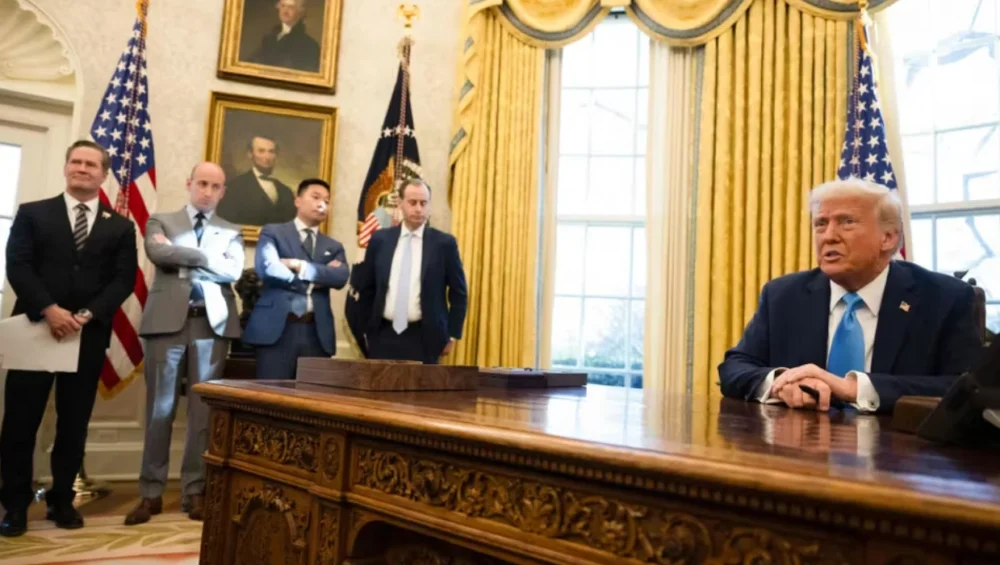
One year since the return of Donald Trump to the presidency, the United States is experiencing a perilous onset of the degradation of democratic principles and human rights safeguards. A new report from Amnesty International,
“Ringing the Alarm Bells: Rising Authoritarian Practices and Erosion of Human Rights in the United States,”
details the alarming trend of purposefully reducing civic space, the rule of law, and institutional checks and balances.
The United States, within the last year, is moving further down into authoritarianism under Trump, who is abusing power through state violence and other methods of political intimidation. This is not only giving way to shrinking civic spaces but is also resulting in a more and more fearful society, which is moving full throttle into a state that Amnesty International has always described as typical across various authoritarian states around the globe.
The U.S. Is Sliding Into a Human Rights Emergency
“We are all aware that there is a dangerous trend under President Trump that has already created a human rights emergency,”
stated Paul O’Brien, Executive Director of Amnesty International USA.
According to the report, the U.S. is facing not only failures in policies but a structural tearing apart of democratic institutions. Through the consolidation of power and the destruction of accountability, the administration is actually working to make it difficult for citizens to live their basic rights.
Twelve Pillars of Democracy Under Attack
Amnesty International identifies twelve interconnected areas where the Trump administration has attacked core democratic safeguards:
- Freedom of the press and access to information
- Freedom of expression and peaceful assembly
- Civil society organizations and universities
- Political opponents and critics
- Judges, lawyers, and the legal system
- Due process
- Refugee and migrant rights
- Scapegoating of minority communities
- Use of the military for domestic purposes
- Dismantling corporate accountability and anti-corruption
- Expansion of surveillance without oversight
- Undermining international human rights systems
Each of these areas is not just a policy failure but a coordinated effort to weaken the ability of the public to hold power accountable.
Data Shows Repression Is Increasing, Not Decreasing
A Surge in Political Repression
The report shows how repression is escalating in multiple areas simultaneously:
- Arrests of protesters and students have increased, particularly during anti-government and anti-police demonstrations.
- Civil society organizations have been targeted through intimidation and legal restrictions, including increased IRS scrutiny and threats against NGOs.
- Dissent is being criminalized, especially in universities and campus protests.
This mirrors global authoritarian patterns, where governments use “law and order” narratives to justify repression.
Migrant Rights: A Human Rights Crisis in Plain Sight
Trump’s immigration policies have systematically dismantled protections for refugees and migrants. Key data points show how the administration has turned humanitarian obligations into a political weapon:
- Asylum denials have soared, with approval rates dropping dramatically across major border sectors.
- Family separations and detention policies have intensified, even after international condemnation.
- “Expedited removals” and forced returns have expanded, undermining due process.
The message is clear: migrants are being treated as a security threat rather than as people with rights.
The Militarization of Domestic Security
One of the most alarming trends is the normalization of military force in civilian contexts:
- The deployment of federal troops to suppress protests has become routine.
- Cities are increasingly treated as battlegrounds rather than communities.
- Police and federal agents operate with little oversight, using unmarked vehicles and aggressive tactics.
This represents a dangerous erosion of the principle that the military should never be used to police citizens.
Press Freedom Under Attack
The Trump administration has intensified hostility toward journalists, labeling them “enemies of the people,” and using intimidation to prevent reporting on state abuses.
Data and trends show a clear decline in press freedom:
- Journalists have been detained, physically assaulted, and arrested while covering protests.
- Government agencies have increased secrecy and restricted access to information.
- The White House has used misinformation and political attacks to discredit reporting.
Without a free press, abuses become harder to expose and easier to normalize.
Surveillance Expansion Without Oversight
Amnesty International highlights an alarming increase in surveillance programs, often justified by national security claims:
- Surveillance powers have expanded while oversight mechanisms have weakened.
- Tech companies have been pushed into cooperating with government surveillance through executive pressure.
- There is little transparency or accountability for data collection on citizens.
This expansion of surveillance creates a chilling effect on dissent, speech, and activism.
The Courts, Lawyers, and Rule of Law Are Under Assault
The report documents attacks on the legal system designed to weaken accountability:
- Judges and lawyers are targeted with threats, public attacks, and politicized investigations.
- Legal protections like due process and fair trial rights are being eroded.
- The independence of the judiciary is under strain, as political interference grows.
This is not a minor concern; it is a direct attack on the last remaining institutional check on executive power.
The U.S. Is Following a Global Authoritarian Pattern
Amnesty International notes that the U.S. is exhibiting the same behaviors it has long documented in authoritarian states:
- Concentrating power in the executive branch
- Controlling information and discrediting critics
- Narrowing civic space
- Weakening accountability institutions
“The attack on civic space and the rule of law and the erosion of human rights in the United States mirrors the global pattern Amnesty has seen and warned about for decades,”
said O’Brien.
The question facing the United States is not whether it will remain a democracy, but whether its democratic institutions can survive a president who treats human rights as a political inconvenience rather than a foundational principle.
If the current trajectory continues, the U.S. risks becoming a country where dissent is punished, information is controlled, and human rights are eroded—not by accident, but by design.