
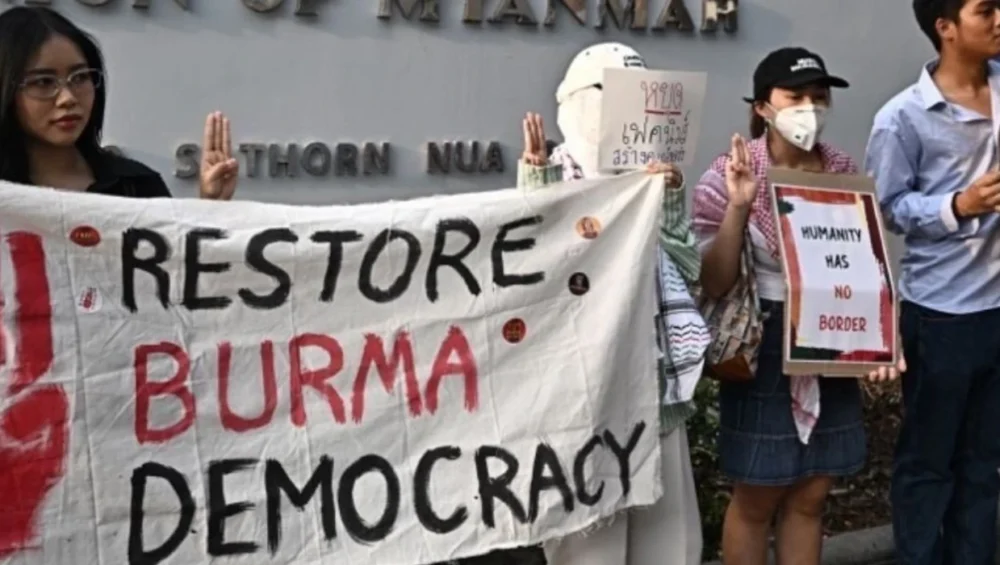
The military-organized elections that took place in Myanmar on December 29, 2025, have been widely condemned as being illegitimate. The nation continues to rebuild after enduring multiple years of organized oppression, together with a brutal military coup.
Human rights organizations maintain that the election fails to meet basic international voting standards because it took place during armed conflict, and when fundamental rights faced severe limitations, and widespread arrests occurred.
Myanmar 🇲🇲
— Fortify Rights (@FortifyRights) December 28, 2025
While attacking its own people, the military junta is staging sham elections, says @john_hq3 of @FortifyRights
🎧 Listen to Sveriges Radiohttps://t.co/ngqOgqsZZD pic.twitter.com/5qH1qsnPL1
The polls received strong condemnation from Women’s Peace Network (WPN), Info Birmanie, and Alternative ASEAN Network on Burma (ALTSEAN-Burma), and International Federation for Human Rights (FIDH).
The organizations have requested states and intergovernmental organizations, and international development and cooperation partners to publicly reject the election results and refuse to recognize any authorities that emerge from the process while increasing their demands for the military to stop attacking civilians and release political prisoners and give up control and speed up the creation of a civilian government through democratic elections.
We have joined over 200 organisations to urge international governments to take action against the Burmese military, which plans to hold sham elections and is committing war crimes, including the bombing of Mrauk-U public hospital on Human Rights Day https://t.co/MfvwzX2cwG
— Burma Campaign UK (@burmacampaignuk) December 19, 2025
The 2021 military coup that dismantled democracy
Myanmar’s political collapse began on February 1, 2021, when the military toppled Aung San Suu Kyi’s National League for Democracy (NLD) elected government.
The military rejected the NLD’s overwhelming victory in the November 2020 general elections, which had only been held for a few months, without offering hard evidence of fraud. The coup abruptly ended a ten-year, precarious democratic transition, leaving the country in a state of prolonged instability.
The Civil Disobedience Movement (CDM) attracted millions of people who demonstrated peacefully through street protests following the coup. The military conducted violent attacks against protesters through both open gunfire and nighttime operations, which led to the capture of political opposition members.
The military government secured power through emergency decrees, which destroyed independent institutions and banned opposition parties. It enforced strict control over all media outlets.
Polls held amid war and widespread abuses
The country conducted elections on December 29, 2025, during the ongoing civil war, and planned to conduct the second voting phase on January 11, 2026. The military continues to fight resistance groups, and ethnic armed forces across the entire country, while substantial areas of Myanmar remain beyond the reach of junta control.
I am appalled & condemn in strongest possible terms the strikes on Rakhine hospital which left dozens of civilians dead and wounded. I reiterate my concerns about new waves of acute violence & fear in #Myanmar ahead of military-imposed ‘election’ – @Volker_turk
— UN Human Rights (@UNHumanRights) December 11, 2025
Such attacks may… pic.twitter.com/9287sXWR0Q
The complete ban on voting in multiple locations created serious problems about including all citizens in the process, and ensuring their voices were heard.
Human rights organizations emphasize that in a setting where freedom of expression, assembly, and association have been routinely suppressed, a credible election is impossible. The government forces opposition groups to operate secretly while forcing their members to flee abroad, suppress independent journalists, and establish legal penalties against political discussions.
ASEAN: Reject Myanmar Junta’s Sham Elections https://t.co/c0V9XQxWCw
— Human Rights Watch (@hrw) October 23, 2025
The polls are essentially faulty due to the lack of significant political competition and the exclusion of important stakeholders.
Escalating violence against civilians
The military launched a major escalation of its attacks against civilians during the last few months before the upcoming elections. The Armed Conflict Location & Event Data Project (ACLED) recorded 3,493 armed conflicts and civilian attacks from August 18, 2025, when the junta revealed its election plans, until December 12, 2025. The incidents resulted in the death of 1,057 people who were not involved in any military activities.
Myanmar votes in sham election under atmosphere of fear and coercion: ‘What will change? Nothing’ – The Independent https://t.co/wLBSyOjvR0
— AHRC-USA NGO in Consultative Status with ECOSOC-UN (@AHRCUSA) December 28, 2025
The military government has adopted airstrikes as its main method of operation. The military carried out 862 airstrikes across 121 townships in seven states and six regions, which resulted in the deaths of at least 650 civilians during this period. The bombing of entire villages, along with the continuous targeting of civilian infrastructure including schools, places of worship, and displaced person camps, has raised major violations of international humanitarian law.
Mass arrests and legalised repression
The military government has used both large-scale arrests and military operations to suppress all forms of resistance. The Assistance Association for Political Prisoners (AAPP) reports that at least 1,932 individuals were arbitrarily arrested or detained between August 18 and December 12, 2025. The number of political prisoners who remained in custody reached 22,668 as of December 22, 2025.
The following groups face imprisonment: peaceful protesters, CDM members, journalists, human rights defenders, activists, elected representatives, and NLD supporters. The military has conducted secret trials through special courts. These resulted in numerous detainees receiving sentences after facing torture and denial of their legal rights.
The government has implemented laws which now enforce stronger control over people. The Law on the Protection of Multiparty Democratic Elections from Obstruction, Disruption, and Destruction was passed by the junta on July 29, 2025.
The law forbids any form of electoral process criticism, and applies the harshest punishment of death when obstruction leads to death of others. At least 122 people had been detained under this law by the middle of December, and some of them had been sentenced to up to 49 years in prison for peaceful expression.
Martial law and the absence of basic freedoms
The military retains its power for 63 townships throughout nine states and regions by maintaining martial law, which grants military leaders control, and allows them to conduct civilian trials through military tribunals. Basic rights like freedom of movement, assembly, and association are essentially suspended under these circumstances. Human rights organizations contend that any assertion that the elections represent the will of the people is refuted by these facts alone.
A call for rejection, not recognition
As the first phase of the polls has now concluded, human rights groups insist that the international response is more critical than ever. They urge states to reject the results, refrain from recognising any authorities formed through the process, and avoid providing technical or financial support to the junta or its election bodies.
For critics, the elections held on 29 December do not mark a return to democracy but represent another step in the military’s effort to entrench its rule through coercion. Without an end to violence, accountability for grave abuses, and the restoration of civilian governance, Myanmar’s political crisis—and the suffering of its people—shows no sign of abating.