
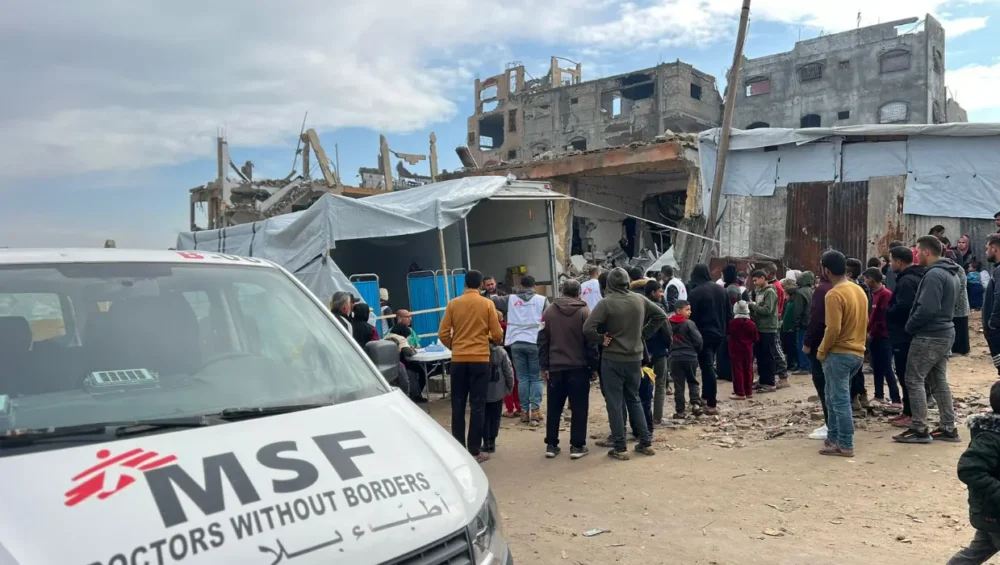
The medical charity Doctors Without Borders (Médecins Sans Frontières, MSF) has confirmed it will provide Israeli authorities with the personal details of some of its Palestinian and international staff operating in Gaza and across the occupied Palestinian territory. The decision has triggered widespread anger among medical professionals, activists, and humanitarian observers, who warn that Israel could exploit the information to further target aid workers during an ongoing genocide in Gaza.
Israel’s military has already killed more than 1,700 health workers, including at least 15 MSF employees, during the war. Critics fear that handing over sensitive personal data in this context exposes humanitarian staff to surveillance, detention, or lethal targeting in Gaza, the occupied West Bank, and East Jerusalem.
MSF said it faced what it described as an “impossible choice”: comply with Israel’s demands or be forced to suspend life-saving medical operations altogether.
How Did Israel Pressure Aid Organisations?
On January 1, Israeli authorities revoked the licences of 37 humanitarian organisations, including MSF, the Norwegian Refugee Council, International Rescue Committee, and Oxfam. Israel accused them of failing to comply with newly imposed “security and transparency standards.”
Under rules issued by Israel’s Ministry for Diaspora Affairs, aid groups are required to submit extensive information on their staff, funding, and activities. The demanded data reportedly includes passport copies, CVs, and names of family members — including children.
Israel has said it would bar organisations it suspects of “inciting racism,” denying Israel’s existence or the Holocaust, or supporting what it labels “armed struggle” or “terrorist organisations.” The measures have been widely condemned as vague, politically weaponised, and designed to intimidate humanitarian groups.
Israel has also accused MSF — without evidence — of employing individuals involved in Palestinian armed groups. MSF has firmly rejected the claim, stating it would “never knowingly” employ anyone engaged in military activity.
Why Did MSF Ultimately Agree?
MSF operates critical medical services in Gaza and the occupied West Bank, providing emergency trauma care, surgery, and lifesaving treatment. The organisation helped run field hospitals in Gaza throughout more than two years of Israeli military assault.
In a statement released on Saturday, MSF said that following Israel’s
“unreasonable demands to hand over personal information about our staff,”
it had informed Israeli authorities that, as an exceptional measure, it was prepared to share a limited list of Palestinian and international staff names, subject to conditions prioritising staff safety.
MSF said its Palestinian staff had agreed to the decision after extensive internal discussions. However, critics question whether genuine consent is possible under conditions of siege, starvation, and mass killing.
MSF also disclosed that since January 1, 2026, all international staff arrivals into Gaza have been denied entry and all MSF medical supplies have been blocked by Israel — a move that severely constrained its operations and intensified pressure to comply.
Are Palestinians Being Forced to “Consent” Under Genocide?
Observers argue that MSF’s framing of staff consent obscures the coercive reality Palestinians face. Ghassan Abu Sittah, a British surgeon who has volunteered repeatedly in Gaza, said the decision reflects a deeper moral failure.
“The moral bankruptcy lies in the implication that during a genocide, Palestinians are capable of making free consent,”
he said.
“Their employees have as much choice as Palestinians who knowingly went to their death at the feeding stations to feed their families.”
Abu Sittah added that the decision likely violates European Union data protection laws, raising serious legal concerns for MSF as a European-based organisation.
How Have Doctors, Activists, and Experts Responded?
MSF’s decision has been condemned by former staff, doctors, and humanitarian advocates, many of whom warn it could endanger lives.
A former MSF employee, speaking anonymously, told Al Jazeera the move was “extremely concerning” from a duty of care, data protection, and humanitarian ethics perspective.
“Staff are extremely concerned for their wellbeing and futures,”
the former employee said.
“Other NGOs have been in uproar, since it further exposes their decision not to concede to Israel’s demands.”
They added that MSF faced a brutal dilemma: comply with what they called “the demands of a genocidal regime,” or refuse and face total expulsion and the collapse of medical care. But they questioned whether compliance under genocide can still be called humanitarianism.
“There must be alternatives — alternatives that demand a much bolder and more disruptive approach to humanitarianism amid such brutal political decline,”
they said.
Is MSF Undermining Its Own Humanitarian Principles?
Hanna Kienzler, a professor of global health at King’s College London, questioned MSF’s decision on social media, noting the organisation’s history of withdrawing from conflict zones when staff safety or mission integrity was compromised.
“MSF, you have withdrawn your teams from war-affected settings before when you felt a mission’s integrity and/or safety were compromised,”
she wrote.
“What makes you think Palestinian staff can be treated like cannon fodder so you can continue your mission in Gaza?”
Her comments reflect a broader concern that Palestinian staff are being exposed to disproportionate risk to preserve the appearance of humanitarian access.
Have Other NGOs Accepted Israel’s Conditions?
Israel claims 23 organisations have agreed to the new registration requirements. The remaining groups are believed to have refused or are still deliberating. Oxfam has been contacted for comment, but has not yet responded. The silence of many NGOs underscores the fear of retaliation, deregistration, or expulsion.
Is Aid Actually Reaching Gaza?
Despite claims that Gaza has been pulled back from the brink of famine, humanitarian needs remain overwhelming. Food shortages persist, healthcare systems are shattered, and Israeli attacks continue.
Since a fragile ceasefire took effect in October, more than 400 people have been killed, amid ongoing displacement and a deepening medical crisis.
Israel pledged to allow 600 aid trucks per day into Gaza. However, residents and aid groups say only around 200 trucks are entering daily — far short of what is needed to sustain the population.
What Does This Mean for Humanitarian Work Under Genocide?
The MSF decision highlights a broader and deeply troubling reality: humanitarian organisations are being forced to operate under conditions where neutrality, consent, and protection no longer exist.
As Israel tightens control over aid, data, and access, critics warn that humanitarianism itself is being reshaped — not to protect civilians, but to function within the constraints of a system accused of committing genocide.
For many observers, the question is no longer whether MSF made the “right” choice — but whether meaningful humanitarian action is even possible when aid, access, and survival are conditioned on submission to an occupying power.